





 Portuguese
  English
  Spanish
  6 min of reading
  28 comments


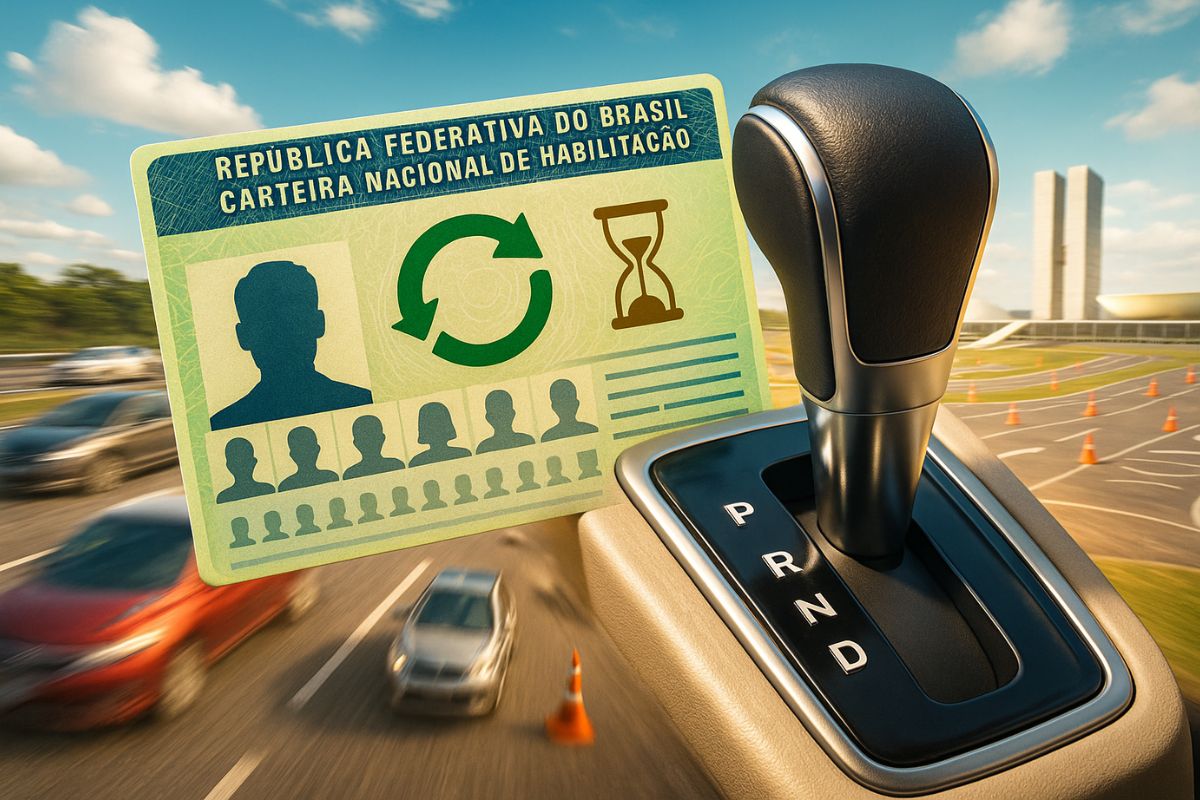


Changes Under Discussion for the Driver’s License Include Mandatory Renewal Every 5 Years and a Special License for Those Who Drive Only Automatic Cars, Which May Change Tests, Categories, and Renewal for Millions of Drivers Across the Country.
Brazil is discussing one of the largest recent overhauls of the licensing model, with changes that directly impact the Driver’s License of drivers of all categories. Under debate are the creation of mandatory refresher courses every five years for license renewal and the possibility of a specific Driver’s License for those who drive automatic vehicles, keeping pace with the changes in the Brazilian fleet and the advancement of car technology. In practice, this could alter how new licenses are issued, how current ones are renewed, and even the routine of those who rely on the Driver’s License for work.
The proposals are part of a revision of the Brazilian Traffic Code and align with a scenario where embedded technology in vehicles is rapidly increasing, while many drivers continue to drive based on rules and habits from years ago. The idea is for the Driver’s License to cease being merely a document that is renewed from time to time and to function as a continuous commitment to updates in road safety, legislation, and the correct use of different types of vehicles.
Why the Government Wants to Change the Rules of the Driver’s License
The central point of the discussions is to modernize the current Driver’s License model, bringing the document closer to the realities of the streets, vehicles, and mobility in the country.
-
Mercado Livre “opens the vault” and announces a record investment of R$ 57 billion in Brazil in 2026, a value 50% higher than the previous year, with an expansion plan that includes 14 new logistics centers, totaling 42 units in the country and hiring an additional 10,000 employees.

-
How investment in technology can revolutionize the national economy and enhance industrial gains, according to a study that highlights the direct impact on productivity, innovation, and wealth retention within Brazil.

-
The largest food company on the planet, JBS, has just opened a 4,000 square meter laboratory in Florianópolis to develop customized proteins that modulate muscle mass gain, immune response, and metabolic performance.

-
After nearly 30 bids and competition among industry giants, a Spanish company purchases one of the largest airports in Brazil for almost R$ 3 billion and takes over the management of Galeão in a concession that will last until 2039.


The government operates under the logic that laws change, technologies advance, and traffic becomes more complex, but many drivers continue to drive as they learned in their first driving school.
In this context, the proposal for mandatory refresher courses every 5 years for Driver’s License renewal aims to eliminate the “automatic pilot” of the legislation, forcing periodic contact with updated rules, new infractions, penalties, signage, and good defensive driving practices.
The measure also addresses the rise of automatic cars and the need for specialization for this type of transmission.
How the New Special Driver’s License for Automatic Cars Might Work
One of the most sensitive points of the discussion is the creation of specific subcategories of Driver’s License for drivers of automatic vehicles.
The idea is to separate, in training and testing, those who learn and are assessed in manual cars from those who choose to drive only automatics.
In practice, this would mean that the future driver could obtain the Driver’s License already focused on automatic cars, with lessons and tests concentrated on this type of vehicle.
The proposal recognizes that the experience of driving an automatic car is different from that of a vehicle with a manual transmission, especially regarding the use of pedals, control on slopes, maneuvers, and interaction with electronic systems.
It is also being discussed how the registry on the Driver’s License itself would reflect this. The license could feature specific markings indicating whether the driver is authorized to operate only automatic vehicles or is qualified to drive both types, which would directly impact car choice and even job opportunities that require proficiency in a manual transmission.
Why Specialize the Driver’s License for Automatic Vehicles
The rise of automatic vehicles on Brazilian streets is one of the factors justifying the discussion of a more detailed Driver’s License.
Cars with automatic transmission are no longer a rarity in large centers and are beginning to spread to smaller cities, driven by heavy traffic, mobility apps, and daily comfort.
Thus, the specialization of the Driver’s License for automatic vehicles is seen as a way to ensure that drivers are trained to handle specific technologies, such as driving modes, electronic assistants, systems to aid in ascents and descents, and different vehicle responses in risk situations.
The logic is simple: the more suitable the training is to the reality of the car, the greater the chance of reducing human errors and accidents.
Mandatory Refresher Courses Every 5 Years for the Driver’s License
Another pillar of the proposal is the creation of mandatory refresher courses for Driver’s License renewal every 5 years.
Instead of merely bringing documents and completing traditional tests, the driver would have to undergo a structured update process focused on legislation, safety, and good driving practices.
The idea is for these refresher courses to be offered in an accessible format, both in-person and online, by the State Traffic Departments and accredited institutions.
The focus is to transform the renewal of the Driver’s License into a moment for reviewing concepts, rather than just a bureaucratic formality. This includes a reinforced emphasis on topics such as using a cell phone while driving, speed limits, respect for pedestrians and cyclists, recent changes in the Traffic Code, and new infractions.
What Benefits Are Expected for Traffic Safety
If implemented, the changes to the Driver’s License could directly influence road safety indices. The expectation is that drivers more informed about current legislation and the real risks of everyday life will commit fewer infractions and be involved in fewer serious accidents.
Additionally, periodic refresher courses reinforce the sense of responsibility, reminding the driver that driving is not an automatic right, but an authorization conditioned to rules, ongoing updates, and respect for life.
The combination of a specialized Driver’s License for automatic vehicles and mandatory refresher courses also helps align Brazil with global trends in the continuous training of drivers.
What Is the Status of the Draft Law Affecting the Driver’s License
For all these changes to come into effect, the path must go through the National Congress. The proposals related to the Driver’s License are included in Bill 7746/17, currently under discussion in the Committee on Constitution, Justice, and Citizenship.
Only after analysis, approval, and sanction can the new rules become reality and officially integrate the Brazilian Traffic Code.
Until then, the Driver’s License continues to operate under the current model, but the debate already indicates that the future of licensing in Brazil tends to be stricter, more technological, and more aligned with continuous training.
What May Change in the Routine of Those Who Depend on the Driver’s License
For millions of regular and professional drivers, the proposals represent both challenges and opportunities. On one hand, there will be a greater demand for updates to keep the Driver’s License current, with periodic refresher courses and, possibly, more segmented training for certain types of vehicles.
On the other hand, the trend is that traffic will become safer and more organized, especially if the courses are well-structured and accessible.
In the case of drivers who use automatic vehicles for work or daily commuting, the creation of a Driver’s License special may require increased attention at the time of choosing the category, taking tests, and planning their professional future.
Those who already have a license may also be called to understand the new rules and, if necessary, adjust their Driver’s License to the new classifications.
In light of all this, the question arises that hits directly at your reality: If these changes to the Driver’s License are approved, do you think it is fair to require mandatory refresher courses and specialization for automatic cars, or will this only complicate the lives of those who need to drive every day?










Esses governos principalmente o pt sempre pensando em rancar dinheiro do povo trabalhador tinha que ter faculdade específica para se políticos isso ninguém fala o país vai de mal a pior quem sabe o país melhorava
É somente para arrecadar mais dinheiro para a Esbanja gastar no exterior
Complica mais o cidadão bras