





 Português
  Inglês
  Espanhol
  6 min de leitura
  10 comentários


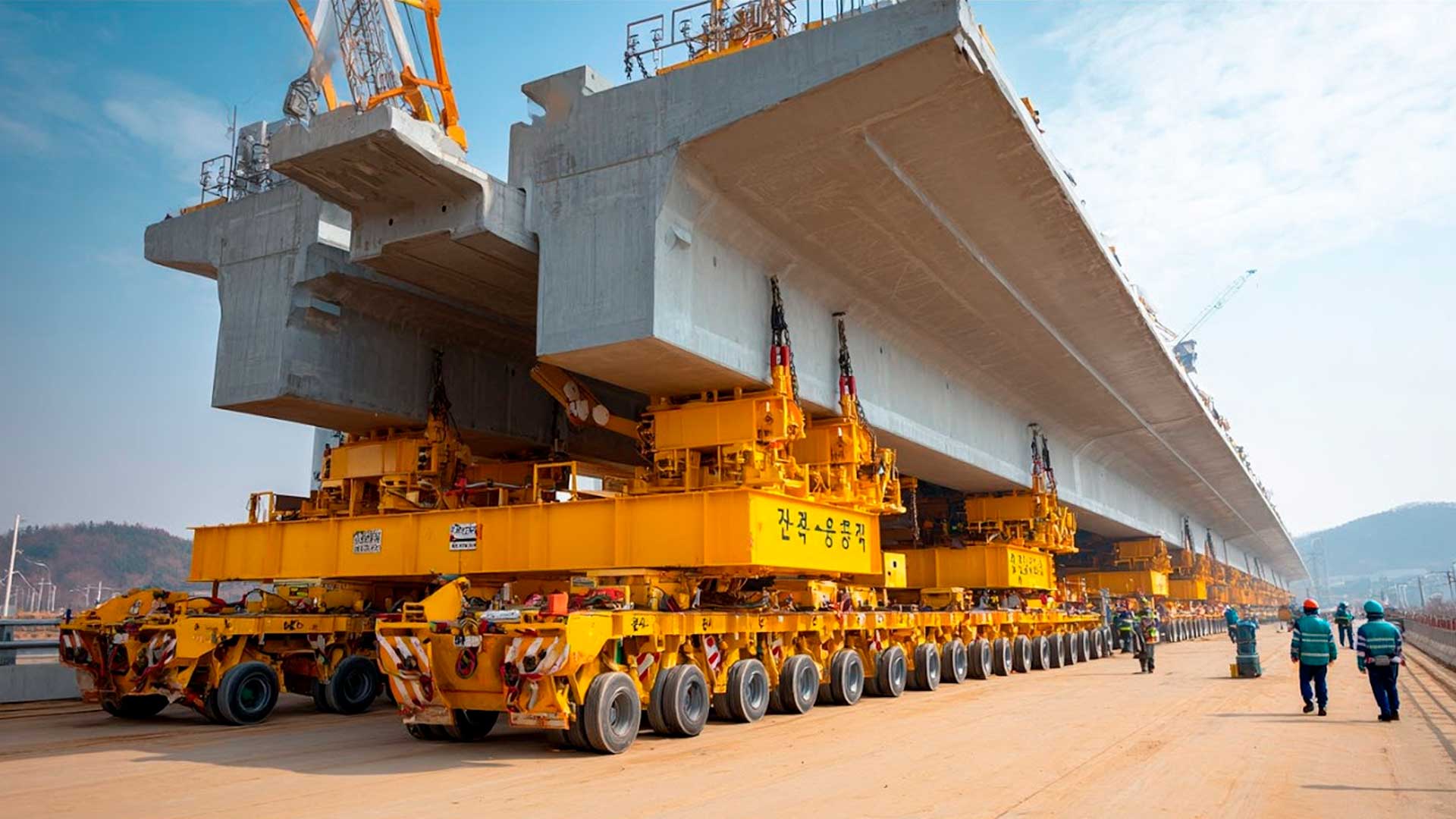


The Segmental Precast Technology Allows South Korea to Build High-Speed Railway Infrastructure in Record Time While Other Countries Still Rely on Slow and Costly Traditional Methods
The South Korea has gained international recognition not only for its technology but also for the impressive speed at which it builds bridges and viaducts for high-speed railways. The secret lies in a revolutionary method known as PSM (Precast Segmental Method), which has transformed the construction industry in the Asian country.
The method has been widely applied in the Honam high-speed railway, one of South Korea’s largest infrastructure projects.
According to technical project information, construction included the Mangyong River Bridge, where 25-meter-long concrete segments were produced in a factory and installed on-site with millimeter precision.
-
The world’s first octopus farm wants to open in the Canary Islands and is already provoking an international reaction: the plan aims to produce 3,000 tons per year.

-
Drought may be creating stronger superbugs in the soil and helping antibiotic resistance reach hospitals, warns a study highlighting a problem that could grow alongside extreme weather.

-
The biggest scam in history: Napoleon’s France deceived the United States by selling them a territory that was Spanish.

-
Why is the Danakil Desert so dangerous? It has unstable terrain and how extreme temperatures and toxic gases turn the region into one of the most hostile environments on Earth.


According to data from Railway Technology, the 231-kilometer Honam line’s first phase began in December 2009 and started operation in April 2015. The project, estimated at approximately US$ 10.6 billion, reduced travel time between Seoul and Gwangju from over 12 hours to just 90 minutes.
Industrial Manufacturing Elevates Bridge Construction Quality


The differentiator of the PSM method begins in the precast factories. Unlike traditional construction, where concrete is molded and cured at the construction site exposed to climatic variations, each segment is produced in a controlled environment with temperature, vibration, and mixture proportions rigorously monitored.
This industrial approach ensures superior structural strength and dimensional precision that would be impossible to achieve in field conditions. According to civil engineering experts, prefabrication eliminates common problems such as irregular concrete curing and execution errors, resulting in more durable and reliable structures.
The 25-meter segments weigh approximately 800 tons and are manufactured as hollow rectangular prestressed concrete beams. After rigorous quality inspection, the pieces are stored until the installation moment at the construction site.
Mass production allows multiple segments to be manufactured simultaneously while foundations and pillars are being constructed on-site, drastically reducing the overall project timeline.
Specialized Equipment Accelerates Assembly at the Construction Site
The transport of the segments to the installation site is carried out by special multi-axle trailers designed to support extremely heavy loads without causing deformation. Once on site, large cranes or launching gantries position each segment over the pillars with millimeter precision.
According to information from ASBI (American Segmental Bridge Institute), the span-by-span method allows impressive installation rates of 2 to 4 spans per shift in well-planned projects. This represents a construction speed several times higher than conventional methods.
The crucial equipment in this process is the launching girder, a steel truss structure that moves along the alignment of the bridge. This system eliminates the need for scaffolding or bracing underneath the structure, making the method ideal for bridges over rivers, highways, or difficult-to-access terrain.
According to technical data, each segment is hoisted by the launching gantry’s winch system and positioned on temporary supports on the pillars. The installation sequence is carefully planned with alignment sensors and hydraulic jacks that adjust the position with millimeter precision.
Prestressing Integrates Segments into Continuous Structure
After positioning, adjacent segments are connected through high-strength epoxy adhesive applied to the contact surfaces. This connection ensures waterproof joints and uniform load transfer between the elements.
The next step is crucial: prestressing cables are inserted through ducts that run the entire span length. Using hydraulic jacks, these cables are tensioned, compressing all the segments and transforming them into a continuous beam able to support its own weight and the dynamic loads from the trains.
According to Freyssinet, a world leader in prestressing systems, this process eliminates tensile stresses in the concrete and significantly increases the load-bearing capacity of the structure. The technique also minimizes crack formation during the operation of the high-speed railway.
After completing one span, the launching gantry advances to the next section through a process called self-launching. This operation involves sliding or rolling the massive truss structure along temporary rails placed over the newly completed deck, allowing for fast and systematic progress.
Environmental and Safety Advantages Consolidate Method
The PSM method offers significant benefits beyond construction speed. According to studies published in the scientific journal Advances in Bridge Engineering, prefabricated construction drastically reduces project time, improves quality control, and minimizes environmental impacts compared to traditional methods.
As most operations occur in the factory, noise, dust, and waste generation at the construction site are drastically reduced. The method also protects nearby ecosystems, as it eliminates the need for extensive concreting in sensitive areas such as riverbanks.
Worker safety is another critical aspect. With less manual labor and assembly of forms in elevated structures, the risk of accidents is significantly lower. The mechanization of the installation process, using synchronized cranes and lifting systems, ensures precision without the need for extensive scaffolding.
From an economic perspective, although the initial investment in precast facilities is high, the total savings are substantial. According to industry analyses, the reduced timeline translates into lower labor costs, fewer weather delays, and less material waste.
The Honam line consists of 48.35% viaducts (111.7 km) and 21.26% tunnels (49.12 km), according to Wikipedia data. This project demonstrates the technical feasibility of applying the PSM method on a large scale for high-speed transport infrastructure.
Precision and Quality Control Define Korean Standard
Precision engineering is the foundation of South Korea’s success in bridge construction. Before the installation of segments, the pillars are built and aligned with millimeter precision. Temporary supports are installed on top of the pillars to receive the precast beams.
The use of automatic concrete mixers, curing chambers, and precision molds in factories ensures consistent dimensions and uniform surface finish for each segment. The controlled prestressing process increases the durability of the structure, reducing long-term maintenance needs.
According to technical sector information, the mechanized installation system using gantries and synchronized lifting systems ensures precise placement without the need for extensive bracing. This makes the method ideal for long-span viaducts that cross rivers and dense urban areas.
Continuous monitoring throughout the operation is conducted by engineers who verify alignment, tension levels, and joint conditions. The use of advanced sensors and computerized control systems in modern launching gantries increases both precision and safety.
International Experience Expands Application of the Method
The PSM technology is not exclusive to Korea, but South Korea has stood out for systematic and large-scale implementation. According to Railway News, the Honam project demonstrates a remarkable balance between innovative technologies and international collaboration.
The method originated in Western Europe, particularly in France and Germany, during the 1950s. The first precast segmented concrete bridge was built in 1962 over the Seine River in France. Since then, the technique has evolved and expanded globally.
For the Honam project, RAIL.ONE provided approximately 530,000 bi-block concrete sleepers, produced in plants in Icheon and Cheonan operated in partnership with Taemyung Industrial Co. Ltd. This example illustrates the international collaboration necessary for large-scale projects.
Taiwan has also adopted a similar complete-span launch method for its high-speed railway bridges, where 800-ton precast segments were manufactured in molding yards and transported by specialized modular self-propelled vehicles.
According to experts, the combination of engineering precision, advanced materials, and automated processes makes PSM the preferred solution for large-span concrete bridges worldwide. The method represents the future of transport infrastructure construction.
What do you think about adopting the PSM method? Is our construction industry ready to implement these large-scale prefabrication technologies? Are there projects in our country that could benefit from this innovative approach? Share your thoughts in the comments.









Lo.mas.critico de la ingeniería son los obstáculos de la corrupción
Eso no me parece nada de el otro mundo aquí en Bogotá el IDU y la alcaldía desaparecería el dinero de ésas obras en menos de un mes😅😅😅😅
Importante conocer de nuevas tecnologías para acelerar ejecución de proyectos