





 Portuguese
  English
  Spanish
  6 min of reading
  0 comments


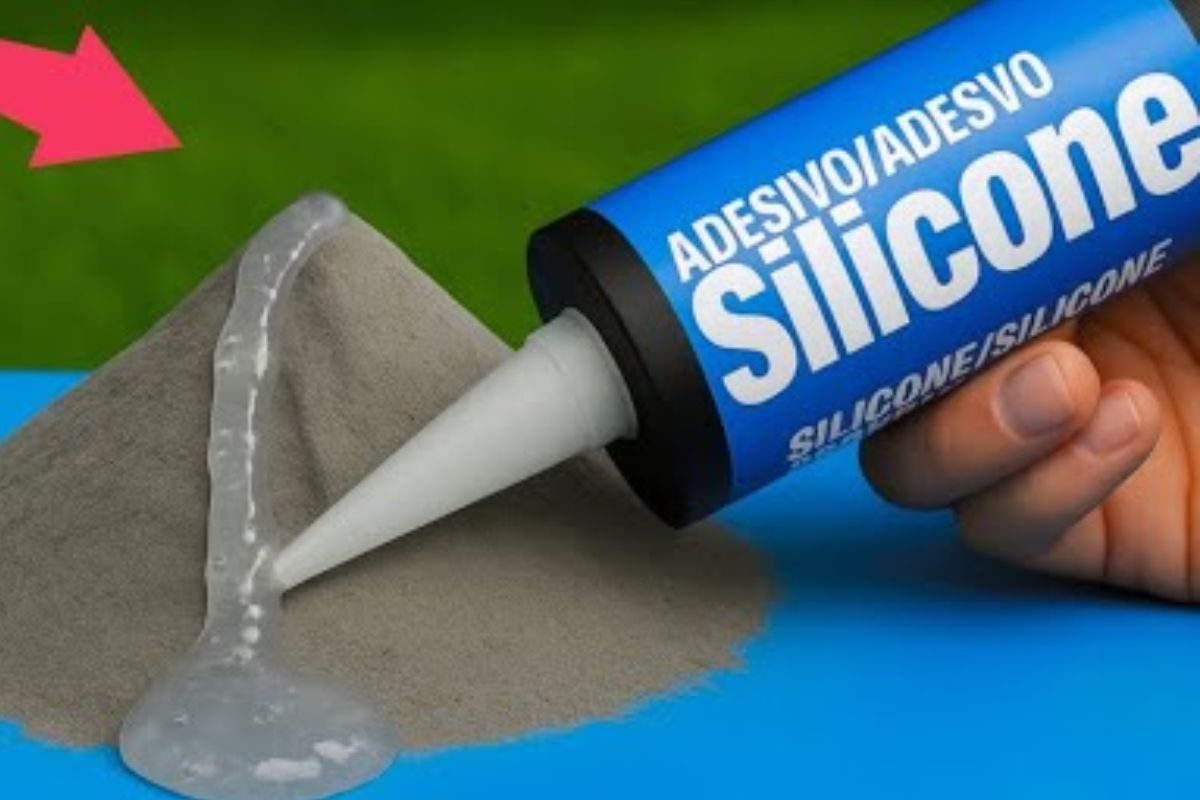
With Neutral Silicone, Solvent, and Some Spoons of Cement, Experiment Transforms Common Materials into a Super-Adhesive Paste That Waterproofs Floors and Walls, Resists Water, and Creates a Flexible Coating for Different Surfaces
Using simple ingredients like neutral silicone, solvent, and cement, a homemade experiment demonstrates how it is possible to create a super-adhesive paste capable of sealing cracks, reinforcing surfaces, and forming a water-resistant barrier. The result deviates from the conventional use of these products and reveals a little-explored combination in home repair routines.
More than just a bench curiosity, this super-adhesive paste presents itself as a practical solution for those needing to fix cracks, protect floors and walls, and improvise quick waterproofing without immediately resorting to complex industrial systems. The mixture, when well prepared, adheres to concrete, wood, tiles, and even tire rubber, forming a flexible and durable coating.
How the Super-Adhesive Paste is Created
The base of the super-adhesive paste is silicone, taken directly from the tube and placed in a sturdy container, preferably metallic, to withstand the solvent action.
-
Drought may be creating stronger superbugs in the soil and helping antibiotic resistance reach hospitals, warns a study highlighting a problem that could grow alongside extreme weather.

-
The biggest scam in history: Napoleon’s France deceived the United States by selling them a territory that was Spanish.

-
Why is the Danakil Desert so dangerous? It has unstable terrain and how extreme temperatures and toxic gases turn the region into one of the most hostile environments on Earth.

-
With a height of 221 meters and a capacity for trillions of liters, Hoover Dam still holds a trick that makes water defy logic.


Instead of being applied pure, as in traditional uses, the neutral silicone is diluted with a compatible solvent, forming a homogeneous gel.
To speed up this process, the experiment utilizes an improvised mixer with a rod and nylon clamps attached to a drill.
The rotation transforms the neutral silicone into a uniform paste, free of lumps, ready to receive the cement.
This is the point where the mixture starts to gain characteristics of a super-adhesive paste, with appropriate viscosity to spread, fill, and adhere to uneven surfaces.
Role of Neutral Silicone and Solvent in the Mixture
The neutral silicone is responsible for the flexibility and waterproofing of the formula.
When diluted with solvent, it ceases to be just a paste sealant and starts to behave like a liquid matrix, capable of incorporating cement without losing its adhesion capacity.
The solvent serves a dual purpose: it reduces the viscosity of the neutral silicone, facilitating the mixture, and helps the super-adhesive paste penetrate better into small cavities before drying.
When the solvent evaporates, what remains is a structure in which the neutral silicone and cement combine into a composite, sturdier than pure silicone, but still with good surface elasticity.
By the end of the preparation, the super-adhesive paste presents a creamy, thick, and slightly sticky texture, an ideal condition for application with a spatula in specific repairs.
This step is decisive to ensure that the final performance meets the goal of sealing, protecting, and waterproofing.
Cement Adds Bulk and Strength
Once the mixture of neutral silicone and solvent is stabilized, common cement spoons are added.
The cement is the component that gives bulk, rigidity, and mechanical strength to the super-adhesive paste.
Gradually added, the cement distributes throughout the silicone base, modifying the internal structure of the mixture.
The result is a firmer super-adhesive paste, capable of withstanding friction, moderate impacts, and temperature variations without easily breaking apart.
This combination transforms what would be just a flexible sealant into a hybrid coating: part elastic, part mineral.
The cement helps the paste fill cracks in floors and walls without breaking apart, maintaining adhesion to concrete and other compatible surfaces.
Application on Cracks, Floors, and Walls
In the practical test, the super-adhesive paste is applied over a crack in a previously cleaned concrete floor, with dust and loose particles removed. In some cases, slight humidification of the area helps with adhesion.
The paste is then pressed with a spatula, filling the entire extent of the flaw.
Once leveled, the surface is ready to dry.
The goal is to create a continuous barrier in cracks, floors, and walls, reducing the risk of infiltrations and the progression of superficial fissures.
In similar applications, the same super-adhesive paste can be used in tile joints, critical points of slabs, and small areas exposed to rain.
With the proper curing time, the super-adhesive paste hardens while maintaining adhesion and water resistance, which is essential in floors and walls subject to humidity.
After complete drying, it is possible to lightly sand the area and even paint, provided that the finish is done with compatible products.
Flexible Coating for Tires, Wood, and Paper
The logic of the mixture also appears in another variation, in which silicone is combined with gasoline in a defined proportion (20 g of silicone for 40 ml of gasoline), again with the help of a mixer.
In this configuration, the solution transforms into a thin waterproof film with strong surface adhesion.
The experiment shows the application of this coating on tire, wood, and even paper.
On the tire, the layer acts as additional protection against drying and moisture.
On the wood, it creates a film that prevents water penetration, causing droplets to run off without absorption.
On paper, the contrast is even more visible: the treated part resists water, while the area without coating becomes soaked and breaks easily.
Although this version does not receive cement in the same proportion as the super-adhesive paste used in cracks, floors, and walls, the principle is the same: the diluted silicone forms a flexible and waterproof coating, useful for enhancing the protection of surfaces that suffer from constant contact with water or moisture.
Water Resistance and Performance in Domestic Use
The strong point of this family of mixtures is the ability to form barriers against water.
Whether in the super-adhesive paste with cement, applied in cracks, floors, and walls, or in the diluted silicone solution used as a coating, waterproofing is the common thread.
In the case of the super-adhesive paste with cement, the idea is to combine structural filling and basic insulation, reducing moisture passage through cracks.
For the flexible coating, the focus is to prevent direct absorption, as demonstrated on wood and paper.
In both contexts, silicone is the central element of waterproofing, while cement mainly serves as mechanical reinforcement when thicker and sturdier material is desired.
Safety Precautions and Practical Limitations
Although they are accessible solutions, these mixtures require care.
The use of solvents and gasoline demands a well-ventilated environment, distance from flames or sparks, and protection for hands and eyes.
Additionally, very thin plastic containers may be damaged by the solvent, which is why the use of metallic containers is recommended.
Another important point is to understand that this super-adhesive paste does not replace professional engineering systems in critical structures.
In a domestic context, it can be useful for small repairs in cracks, floors, and walls, spot sealing, and additional protection of surfaces such as tires or exposed wood.
However, in cases of extensive structural infiltrations, deep cracks, or flaws in slabs, technical evaluation remains essential.
Finally, the actual durability of the super-adhesive paste depends on factors such as correct preparation, cleanliness of the base, curing time, and exposure to sun, water, and traffic.
The greater the care in each step, the greater the chance of the repair consistently meeting its objective.
And you, in what situation in your house or workshop would you first use a super-adhesive paste made with silicone, solvent, and cement?








-

Uma pessoa reagiu a isso.