





 Portuguese
  English
  Spanish
  5 min of reading
  4 comments


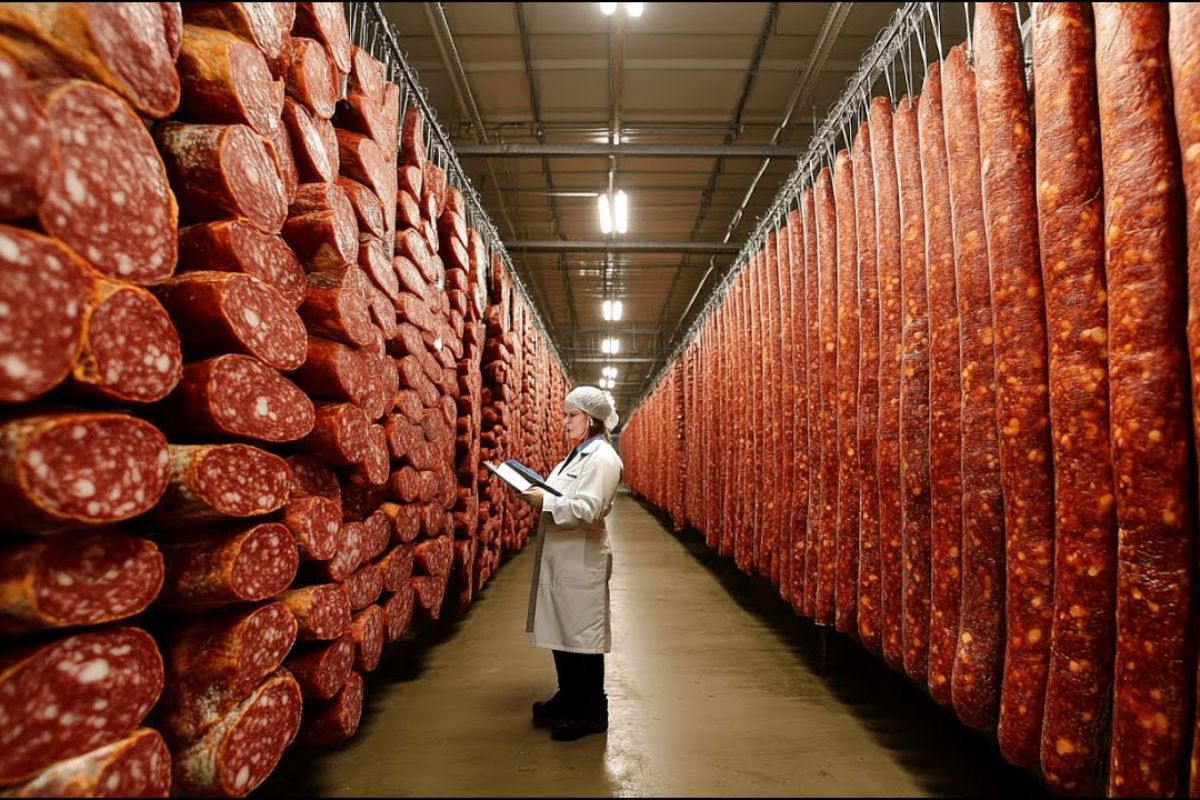


With Technical Precision and an Almost Scientific Approach, Italian Producers Combine Large-Scale Farming, Rigorous Selection of Meat and Fat, Slow Fermentation, and Humidity Control to Transform Salami Into Cultural Food, High-Value Industrial Product, and a Symbol of Gastronomic Identity Recognized Worldwide in Restaurants, Markets, and Modern Homes.
Since the dawn of civilization, the idea of preserving meat with salt, time, and circulating air has accompanied human history, but it was the Italian producers who transformed salami into an icon. Among mountains, small villages, and now large industrial complexes, this cured meat has evolved from a travel provision to a centerpiece of platters, sandwiches, and sophisticated menus.
In factories that combine tradition and automation, each stage is designed to replicate with precision something that began as a handcrafted endeavor: choosing the right animal, balancing fat and lean meat, caring for fermentation, and controlling the curing process. The result is a product that appears simple but relies on a complex chain in which Italian producers fine-tune details invisible to the end consumer.
From Ancient Origins to the Legacy of Italian Producers

The logic behind salami is ancient: salting meat, using fat as a source of energy, and leveraging time as an ally.
-
Plastered walls become a trend and end up being the perfect choice for finishing; the secret of the 2 coats that prevent waste in painting.
-
With 333 meters and equivalent to a 20-story building: China launches a supertanker that transports 2 million barrels, has 540,000 m² of area, and saves $5 million per year.

-
Brazil becomes a beacon of hope for ending plastic waste by leading a global plan that could prevent millions of tons from entering the oceans.
-
The low-cost solution called PatchPal, invented in South Africa to fix potholes in minutes, does not crack and prevents water from entering, becoming more compact with each car that drives over it, revolutionizing road repairs that governments have forgotten.

People from Mesopotamia and the Mediterranean had been experimenting with combinations of meat and salt for thousands of years, but it was on the Italian peninsula that this knowledge gained its own identity.
The Etruscans began preserving wild boar and pig meat in compact forms, ideal for travel and hunting.
Later, the Romans brought these techniques to other regions, turning necessity into food tradition.
Over time, rural families began making salami at home, gifting pieces and passing down recipes.
Today, Italian producers in the industry have inherited this historical base and translate it into standardized processes, maintaining the concept of “a piece of history in every slice.”
From Industrial Farm to the Balance Between Meat and Fat

Behind a well-made salami is a highly organized system of pig farming.
Modern farms are structured into specific areas for breeding, maternity, and fattening, with strict control over feeding, health, and well-being.
This organization ensures that Italian producers receive carcasses with predictable characteristics, a starting point for consistent salami.
In the butchering lines, machines and operators separate lean cuts from creamy white fat.
The goal is to achieve a precise balance: if there is too much fat, the product becomes heavy and greasy; if there isn’t enough fat, it loses texture and mouthfeel.
The final mixture must respect proportions tested over decades, and Italian producers treat this balance as true sensory science applied to meat.
Mixing, Seasoning, and the Role of Slow Fermentation

After being separated, lean meat and fat go through industrial grinders capable of processing large volumes while maintaining controlled temperatures.
Keeping the mixture cold is essential to preserve texture and microbiological quality.
At this point, spices and starter cultures come into play, the technical basis that differentiates modern salami from fully empirical production.
Salt, pepper, garlic, and a touch of white wine are added in calibrated amounts to enhance the flavor of the meat, not to mask it.
Together with these ingredients, selected beneficial bacteria enter, responsible for slow fermentation that reduces the pH, increases the safety of the product, and builds part of the aromatic profile.
For Italian producers, this phase is one of the hearts of the process because it determines whether the salami will be merely correct or truly memorable.
Filling, Suspended Rails, and Fine Control of Curing
With the mixture ready, the filling begins in natural casings or technical wrappings, depending on the type of salami and the goal of standardization.
The diameter, length, and internal compactness directly influence the speed of fermentation and drying.
Therefore, Italian producers treat the filling as a process engineering step, not just a mechanical routine.
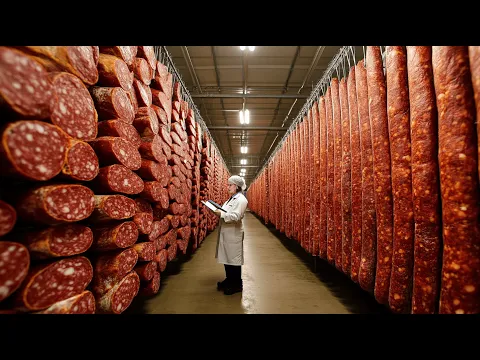
In the warehouses, suspended rails transport the salamis between chambers with controlled temperature and humidity.
For several days, fermentation occurs in a stable environment, allowing beneficial microorganisms to transform sugars into lactic acid and consolidate the structure of the piece.
In some styles, a specific white mold develops on the surface, protected and stimulated by manufacturers to create a natural layer that helps retain moisture and contributes its own aroma.
Precise Curing: Weeks of Waiting for a Few Minutes of Consumption
Once fermentation is complete, the drying and maturation phase begins, which can take about 3 weeks to over 2 months, depending on the thickness and style.
During this period, the salami loses water, gains density, concentrates flavor, and stabilizes its color.
Small variations in humidity, temperature, and air circulation can alter the result, which is why Italian producers monitor parameters with almost laboratory-like attention.
It is during the curing process that the clearest differences appear between a generic product and a high-quality salami.
Residual moisture, cut texture, fat distribution, and final aroma are evaluated batch by batch.
Some manufacturers use physical and chemical tests, while others combine technology with the experience of masters who recognize the ideal point by touch and smell.
In both cases, precise curing is treated as an irreversible step: if something goes wrong, there’s no way to “undo” weeks of maturation.
Packaging, Food Safety, and Global Reputation
When maturation reaches the desired point, the finishing stage begins.
The pieces may remain whole, with or without a rind, or be sliced in automated lines that organize thin slices into trays.
The challenge is to protect the integrity of the product without interfering with flavor.
Techniques such as vacuum or modified atmosphere help extend shelf life while maintaining color and texture within expected standards.
Before leaving the factory, each batch undergoes quality controls that check physical and microbiological aspects.
Italian producers know that a failure affects not only one customer but the image of a tradition that took centuries to establish as a global reference for salami.
Global Tradition in the Hands of Italian Producers
From salt to controlled mold, from choosing the animal to the design of the packaging, the salami that reaches the table is the result of a long, technical chain full of critical decisions.
Italian producers act as guardians of knowledge that was born in the field, crossed empires, survived industrialization, and today adapts to expectations of safety, traceability, and global standardization.
In every slice, past and present coexist: techniques passed down through generations, automated equipment, climate-controlled chambers, and daily decisions that determine whether the product continues to be worthy of being called traditional Italian salami.
Understanding this background shows why a simple cured meat can be treated as gastronomic heritage and a strategic piece of a modern food industry.
And you, after learning about this background, do you think that Italian producers can balance tradition and technology well in the salami that reaches your table?







Nós temos que esperar muitos anos parar aprendermos o que o europeu, sabem muito.Eles são de civilização secular !
O problema é saber se é original ou falsificado
Eu teria um enorme orgulho de ter esse conhecimento e ser também um produtor.
Um povo milenar é outra história!!!
Viva o povo italiano e seus conhecimentos e tradições!!!!