





 Portuguese
  English
  Spanish
  5 min of reading
  0 comments


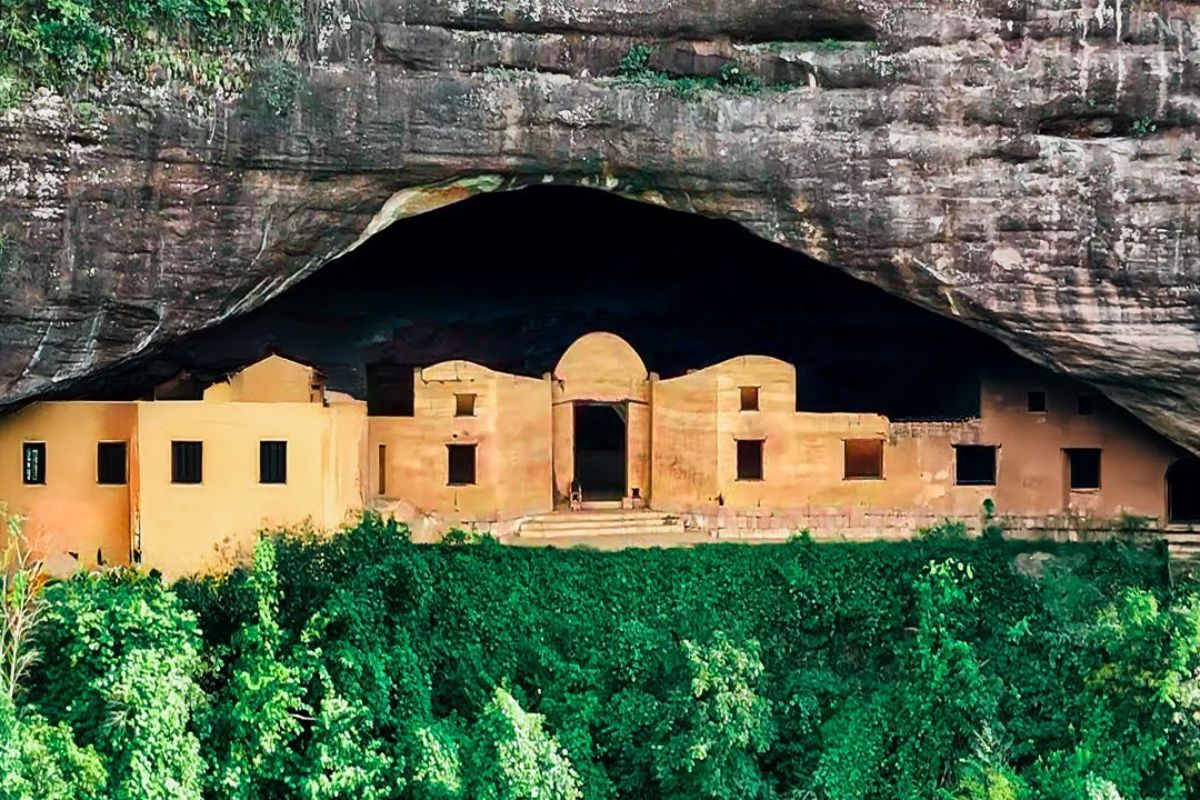
Hidden On A Four Hundred Meter Cliff, The Five Thousand Square Meter Cave Houses The Hideout Of The Legendary King Of Thieves In China, An Isolated Stone House Accessible Only By A Treacherous Trail, Venomous Snakes And A Natural Labyrinth Of Tunnels And Vertiginous Voids That Scares Even Local Residents
A few kilometers from Chenzhou, in Hunan province, an apparently inaccessible rock wall guards a monumental cave, about five thousand square meters, where the hideout of the legendary King of Thieves in China is concealed. The site, over four hundred meters high, was only identified in detail with drone support, given the difficulty of locating it by eye.
There, amidst the mountains, an ancient stone house built inside the natural cavity reinforces the place’s reputation as a refuge for bandits who were said to have lived there for years, away from the authorities’ action. The combination of colossal cave, steep cliff, and extremely restricted access helps explain why the hideout remained practically invisible, even to residents who have known the region for decades.
A Monumental Cave Carved Into The Cliff

Access to the hideout of the legendary King of Thieves in China begins with a mountain trail described as steep, slippery, and full of natural hazards.
-
Italian researchers have detected what appears to be a second Sphinx buried under the sands of Egypt, and satellite scans reveal a gigantic underground megastructure hidden beneath the Giza Plateau for over 3,000 years.

-
There are 4,223 drums and 1,343 metal boxes concreted with 50-centimeter walls that store the radioactive waste from Cesium-137 in the worst radiological accident in Brazil, just 23 kilometers from Goiânia, with environmental monitoring every three months.

-
Giant Roman treasure found at the bottom of Lake Neuchâtel in Switzerland reveals an advanced trade system, circulation of goods, and armed escort in the Roman Empire about two thousand years ago.

-
He buried 1,200 old tires in the walls to build his own self-sufficient house in the mountains with glass bottles, rainwater, and an integrated greenhouse.
The sandy and rocky ground requires the visitor to constantly rely on the vegetation of the slopes, under the constant threat of slips and falls in narrow sections.
Residents report that the presence of venomous snakes is frequent, making any attempt to climb even more dangerous, especially on rainy days.
The journey takes about thirty minutes, but time is just one of the obstacles: the feeling is like walking in a setting designed to deter curious onlookers and protect anyone who might be hiding up there.
Topography Tailored For Escape And Confusion

Upon reaching the middle part of the mountain, visitors encounter a singular rock formation described as a kind of giant stone bridge, which dominates the landscape.
There is only one main trail to ascend, which is extremely steep, making it easy to imagine how simple it could be for a group on the run to set traps and slow down any pursuit in that natural corridor.
The path also features strategic forks that can mislead those unfamiliar with the terrain. Choosing the correct route itself requires heightened attention.
Even with some recent improvements to the trail, the combination of inclines, sharp turns, and exposed sections demonstrates why this setting became ideal as a long-term refuge for the King of Thieves and his men.
The Interior Of The Refuge And The Ruined Stone House
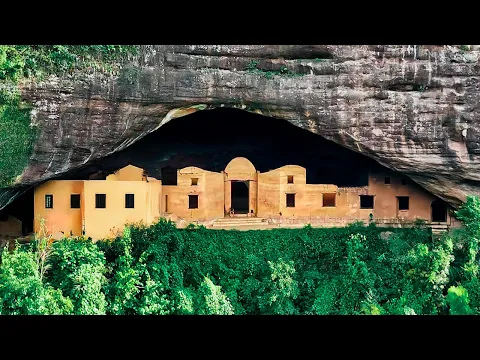

Up close, the cavity in the cliff is impressive.
The cave, about five thousand square meters, forms a natural hall capable of housing a large number of people, provisions, and weapons, reinforcing the logic of a structured communal hideout.
Inside, there remains an ancient stone house, now cracked and in ruins, with small rooms built almost entirely of rustic masonry.
The remains point to an intense use in the past: there are burn marks on the walls and signs of internal compartments, suggesting areas for sleeping, cooking, and storing essential items.
There is no furniture or preserved objects, just the stone architecture surviving the test of time.
The impression is that the group left in a hurry or simply abandoned the site after it lost its strategic function.
Labyrinth Of Caves, Tunnels And Possible Escape Routes
One of the most intriguing aspects of the hideout of the legendary King of Thieves in China is how the main cave connects to other cavities and large lateral openings.
Some of them seem to have been used for storing food and equipment, taking advantage of the more stable temperature and protection against rain and wind.
There is also suspicion of an ancient escape cave below the main one, now possibly buried.
Local residents, in a semi-serious, semi-humorous tone, speak of supposed underground tunnels beneath the complex, which adds to the aura of mystery surrounding the refuge.
Even without evidence, the very geology of the place, with multiple voids and passages, favors the idea of discreet escape routes for those who knew every meter of the mountain.
Giant Rock Arch And Almost Impossible Route
Connecting part of the slope to the void, a massive natural stone arch dominates the horizon and reinforces the feeling of being in front of a fortress sculpted by nature.
There are indications that some route led to the top of this rocky bridge, possibly used as an observation point or as part of a defense and surveillance strategy.
With dense vegetation covering most of the terrain, the exact path to the top remains uncertain.
Even residents who claim to have seen someone up there cannot point out exactly how to get there.
In practice, the set of cliffs, voids, and thick underbrush turns the area into a vertical labyrinth, reinforcing the image of the place as one of the most difficult refuges to access in the region.
Nature, Risk And The Logic Of A Perfect Hideout
Today, the hideout of the legendary King of Thieves in China is completely abandoned, but it continues to be an extreme example of how relief, geology, and isolation can be used as a strategic advantage.
The monumental cave, the four hundred meter cliff, and the dangerous trails create a setting where the greatest ally is nature itself.
The recommendation from those who know the region is clear: long clothing, charged cell phone, constant attention to venomous snakes, and never go alone.
Even so, the risk remains high. A century ago, finding and occupying a place like this, without a map, without modern technology, and without safety equipment, required a level of courage, adaptation, and terrain reading that helps explain why the figure of the King of Thieves became legendary.
Ultimately, the aerial view of the cliff, the giant cave, and the tiny stone house carved into the rock shows a striking contrast: the colossal scale of nature versus human ingenuity in seeking a hideout where almost no one would think to climb.
And you, would you dare the trail to the hideout of the legendary King of Thieves in China if given the opportunity, or just imagining this cliff makes you want to stay on solid ground?










-

2 pessoas reagiram a isso.