





 Portuguese
  English
  Spanish
  5 min of reading
  0 comments


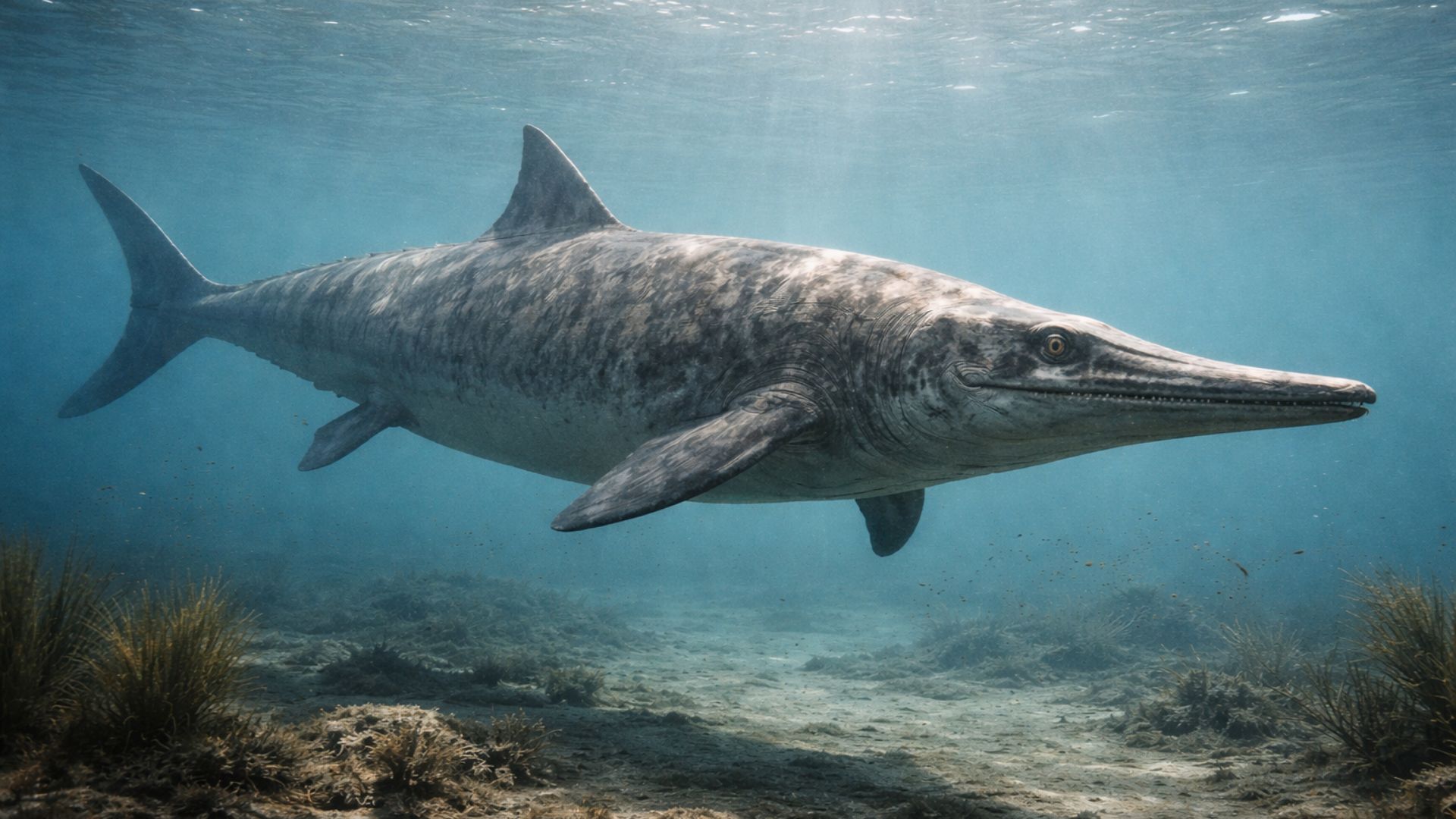
Discovery of a Gigantic Bone on an English Beach Led Scientists to Identify a New Species of Ichthyosaur of Large Proportions, Associated with the End of the Triassic, Expanding the Scientific Debate About the Maximum Size Reached by Extinct Marine Reptiles.
A bone from the lower jaw measuring over two meters in length, found on a beach in southwestern England, led researchers to describe a new species of large ichthyosaur and to re-examine the size limits reached by marine reptiles throughout geological history.
The animal was named Ichthyotitan severnensis, and its body length was estimated to be between 22 and 26 meters, based on the comparison of the preserved bone with equivalent structures from closely related species already described in the scientific literature.
Scientific Publication and Criteria for Species Validation
The formal description of the species was published in the scientific journal PLOS ONE. The study is based on two fossils attributed to the same taxon. One was collected in 2016 on the coast of Somerset.
-
Friends have been building a small “town” for 30 years to grow old together, with compact houses, a common area, nature surrounding it, and a collective life project designed for friendship, coexistence, and simplicity.

-
This small town in Germany created its own currency 24 years ago, today it circulates millions per year, is accepted in over 300 stores, and the German government allowed all of this to happen under one condition.

-
Curitiba is shrinking and is expected to lose 97,000 residents by 2050, while inland cities in Paraná such as Sarandi, Araucária, and Toledo are experiencing accelerated growth that is changing the entire state’s map.

-
Tourists were poisoned on Everest in a million-dollar fraud scheme involving helicopters that diverted over $19 million and shocked international authorities.


The other, considered more complete, was located in 2020 at Blue Anchor beach, in the same region.
According to the authors, the morphological similarity between the two bones, along with geographic proximity and the same geological timeframe, supports the proposal of a new genus and species.

Ichthyotitan severnensis gen. et sp. nov. To facilitate comparison, A and C were flipped.
Fortuitous Discovery and the Role of Researchers
The finding in 2020 drew attention for occurring during an amateur fossil hunting expedition.
According to information from the Natural History Museum in London, 11-year-old Ruby Reynolds and her father, Justin Reynolds, found fragments of the bone on the beach and recognized it as unusual material.
After the discovery, they contacted paleontologist Dean Lomax, a research associate at the University of Manchester, who had already been studying a similar fragment found on the same coast years prior.
A report published by Reuters states that, following the initial identification, other parts of the bone were located in the area, including a larger segment partially exposed in a mudslide.
Preserved Jawbone and Body Length Estimates
The analyzed bone corresponds to the surangular.
This element is part of the lower jaw of various non-mammalian vertebrates.
In the study, the surangular was used as a reference to estimate the size of the animal.
According to the scientific paper, the more complete specimen exceeds two meters in length.
Based on this measurement, researchers estimated that the animal could reach about 25 meters in body length, a value consistent with the range of 22 to 26 meters mentioned in scientific and journalistic communications regarding the work.
Origin of the Name and Scale Comparisons

The name Ichthyotitan severnensis was chosen to reflect the large size of the animal and its geographic association.
According to the Natural History Museum in London, the name references the River Severn and the regional context of the findings.
The estimated length is comparable to that of a modern blue whale, often cited as the largest known animal.
Experts emphasize, however, that the comparison is strictly dimensional. This is because whales belong to the group of mammals, while ichthyosaurs were extinct marine reptiles, with a distinct evolutionary history.
Giant Ichthyosaurs at the End of the Triassic
Ichthyosaurs formed a diverse group of reptiles adapted to marine life throughout the Mesozoic.
In the article published in PLOS ONE, the authors highlight that the end of the Triassic was a period when some of the largest representatives of the group emerged.
The fossils from Somerset are attributed to the Rhaetian stage.
This interval corresponds to the final phase of the Triassic, dated at about 202 million years.

This timeline positions Ichthyotitan severnensis among the large marine vertebrates that lived near the transition between the Triassic and the Jurassic.
Limitations of Available Fossil Material
Despite the estimated dimensions, the study clearly delineates the scope of possible conclusions.
The article notes that the surangular found at Blue Anchor is better preserved than the previously described specimen.
This allowed for more detailed analyses of the anatomy and bone tissue, including thin sectioning.
The Natural History Museum in London reports that these analyses indicate that the individual was still in a growth phase.
At the same time, the researchers emphasize an important limitation.
The species is known only from parts of the jaw.
There is, as yet, no complete skull or articulated skeleton associated with the taxon.
Scientific Interpretation and Caution in Classifications
According to the study’s authors, the fossils exhibit features compatible with ichthyosaurs from the shastasaurid group.
This group includes some of the largest known representatives from the Triassic.
The researchers clarify, however, that the available material is insufficient for a definitive attribution at the family level.
In the article, Ichthyotitan severnensis is described as possibly the largest marine reptile formally described to date, with the caveat that this assessment is based on isolated bones and morphological comparisons with related species.
Coastal Findings and the Dynamics of Paleontological Research

The case draws attention for involving fossils found on current beaches, environments subject to constant erosion.
In these areas, fragments can be quickly exposed or removed by the action of the sea.
The process described by the researchers also highlights the interaction between field collecting and academic research.
In addition to scientists, the discoverers themselves participated in sending the material for analysis, integrating the flow from casual finding to peer-reviewed scientific publication.
Destination of the Fossils and Scientific Dissemination
As a follow-up to the study, the Natural History Museum in London reported that the fossils attributed to Ichthyotitan severnensis are set to be displayed at the Bristol Museum and Art Gallery.
The public exhibition is expected to increase access to the material and the dissemination of the finding.
Images of the bone accompanied by human scales are often used to contextualize the estimated size of the animal in scientific communication efforts.
Gaps Still Present in the Fossil Record
Despite the impact of the announcement, limitations recognized by the authors remain.
Without other bones associated with the same individual, it is not possible to reliably describe body characteristics beyond the jaw.
Current knowledge depends on comparisons with already known ichthyosaurs.
Thus, Ichthyotitan severnensis remains represented by only two jaw pieces recorded on the coast of Somerset, which keeps the discussion open regarding the actual size and diversity of the largest marine reptiles of the past.









-

-

-

4 pessoas reagiram a isso.