





 Portuguese
  English
  Spanish
  9 min of reading
  0 comments


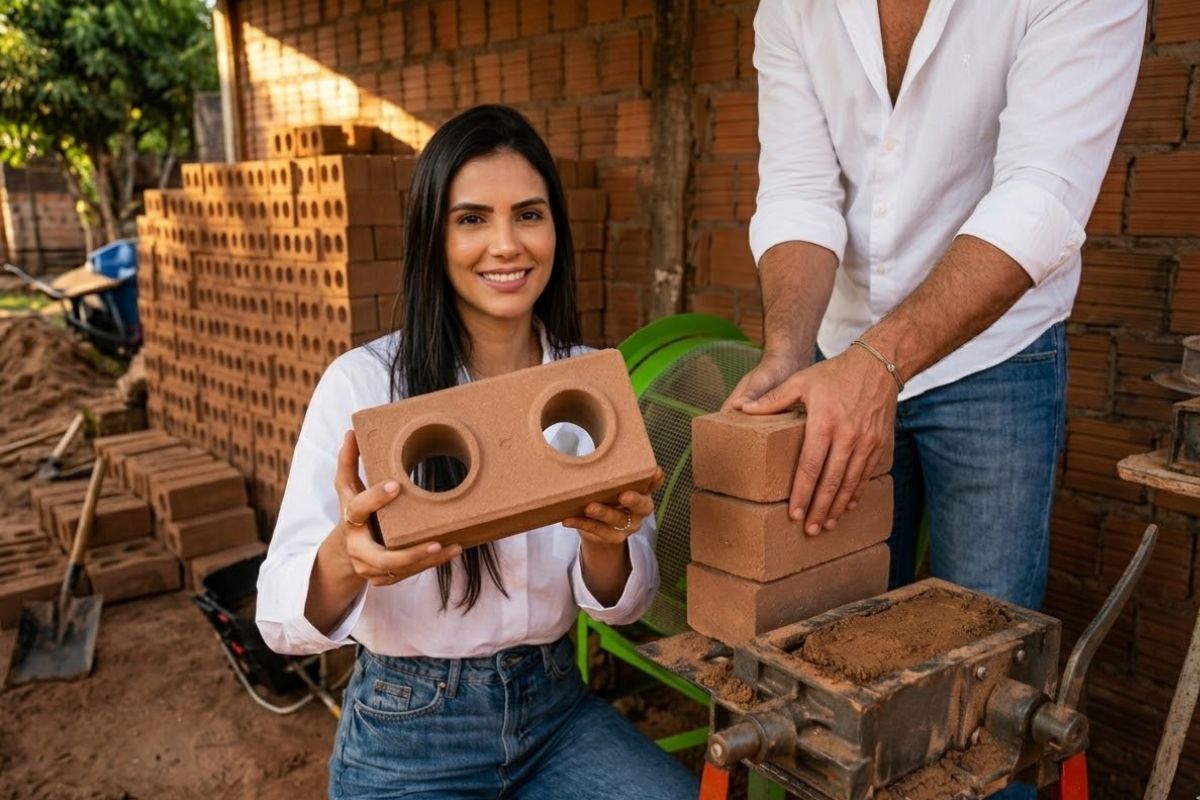
When Producing Ecological Brick With Manual Press, Rented Concrete Mixer, and Soil Already Near Ideal Composition, the Couple Reports Reducing the Thousand to Less Than R$ 600, Cutting Steps, Reusing Structure, and Transforming a Self-Construction of 225 m² Into a Project With Accumulated Savings of Great Measurable Financial Impact.
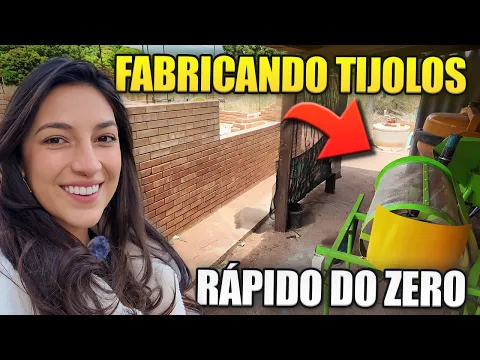
The Channel Amanda and Fernando shows how ecological brick became the center of the strategy adopted by a couple who decided to self-construct after starting the project without a defined plan. When searching for alternatives to lower the budget, they concluded that manufacturing their own pieces could be more advantageous than buying the thousand ready-made in the region, where the price, they report, varies between R$ 1,300 and R$ 1,500.
From there, the logic of the project changed. With a manual press, a rented concrete mixer, repeated mixing and curing tests, along with the search for suitable soil, the process went from being just a stage of the construction to being treated as a decisive part of the household economy. In the calculations presented by the couple, the thousand drops to less than R$ 600 and the accumulated difference can represent tens of thousands of reais at the end of the project.
How the Ecological Brick Became Sensible Within Self-Construction
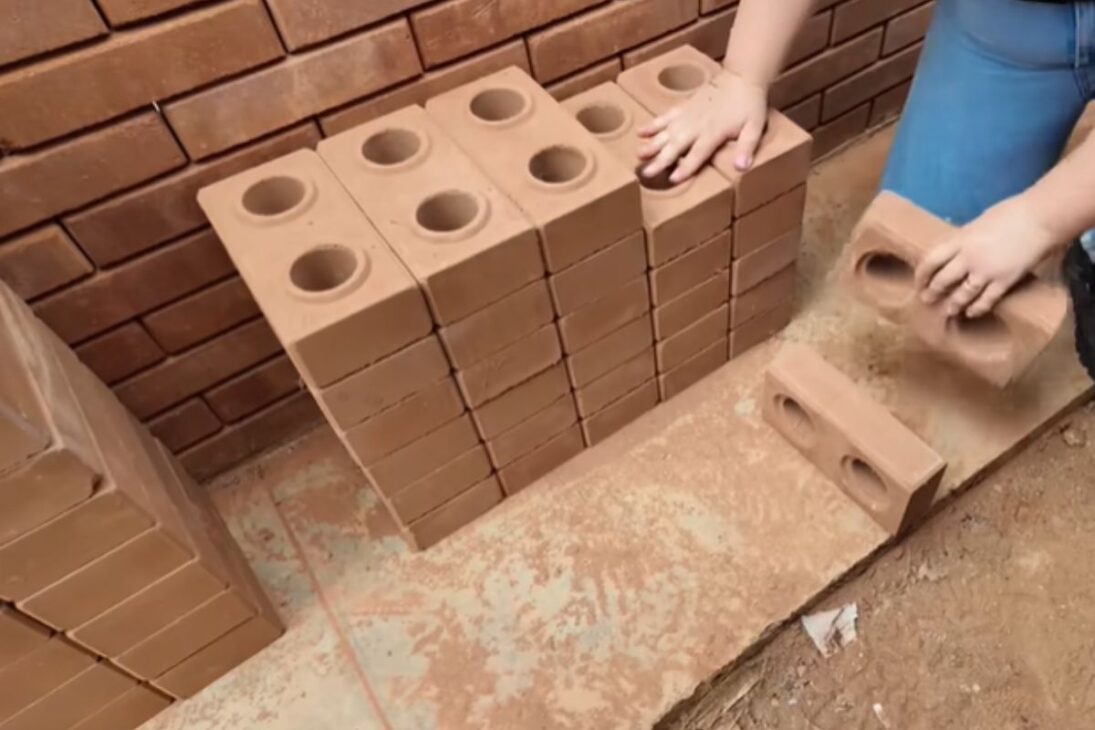
The turning point occurred when the project was already underway and self-construction emerged as a real way to reduce expenses. Instead of concentrating the budget solely on the purchase of ready-made materials, the couple began to observe where the greatest margin for savings was. The ecological brick appeared as one of these opportunities because it combines local production, direct quality control, and decreased unit cost compared to the regional market.
-
Abandoned house for 15 years disappears in the woods, shocks owner with unrecognizable scenery and is reborn in an intense transformation after almost 90 hours of work in just 10 days.
-
In just three hours, a natural stone floor transforms the entrance of the house with an organic effect, immediate drainage, and a sophisticated non-slip finish that doesn’t puddle water, dries quickly, and impresses with the final result.
-
‘Interlocking brick’ made of earth arrives in the construction industry with cost reductions of up to 40% on the project.
-
Espírito Santo will receive the largest engineering project in its history with the duplication of BR 262, which will have 50 viaducts, 28 bridges, and 2-kilometer tunnels cutting through the most challenging mountainous region of the entire state.

The central argument is not just about the price of the thousand, but about the scale. When a house requires tens of thousands of pieces, a difference of a few hundred reais per thousand stops being a detail and becomes a structural factor in the budget. That’s why self-production, in this case, is not presented as a hobby or parallel experience, but as part of the financial model of the project.
The narrative becomes even more significant when considering the total dimension of the construction. The mentioned house has 225 m² and, according to the presented estimate, could cost between R$ 1 million and R$ 1.3 million in the region. In the group’s calculations, however, the project has been conducted for about R$ 150 thousand to R$ 175 thousand, depending on the inclusion of furniture.
Even considering that several factors influence this result, the ecological brick appears as one of the pillars of overall reduction.
The Process Begins Simple: Manual Press, Concrete Mixer, and Production Routine
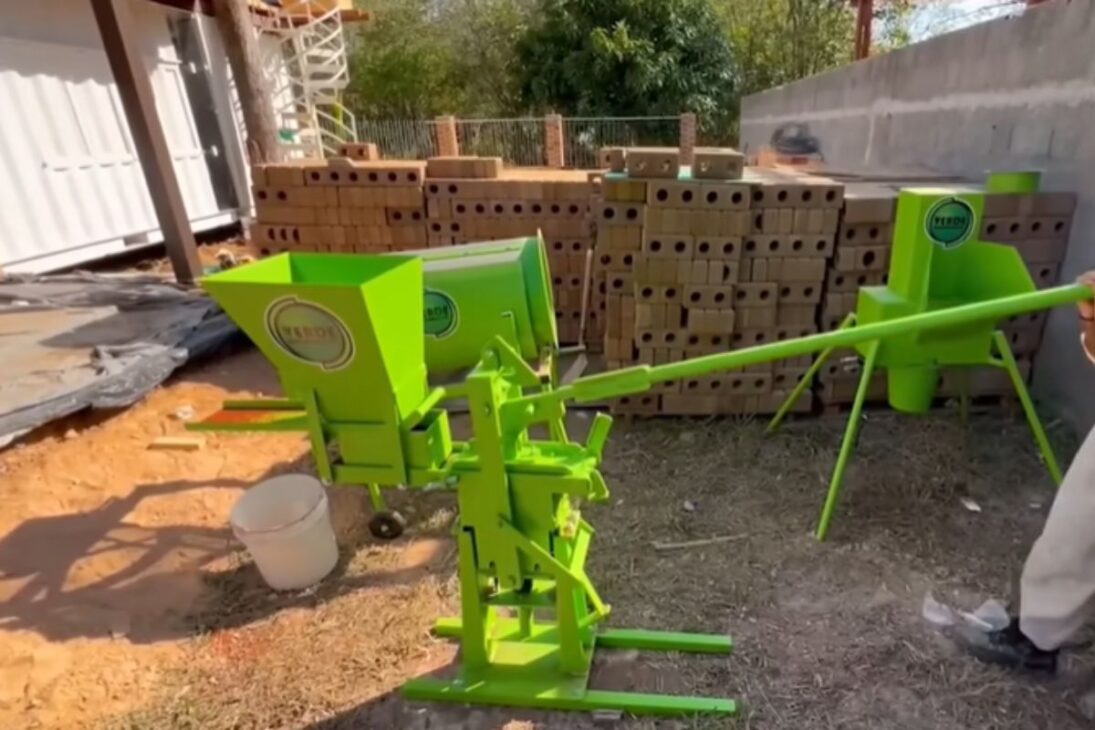
One of the most relevant points of the case is that the couple does not describe a complex industrial structure as an initial condition. The basis of production was set up with a manual press and a rented concrete mixer for R$ 350 per month. This choice completely changes the entry point of the process because it reduces the initial investment and allows production to keep pace with the project’s rhythm, without requiring a complete factory from day one.
This also helps explain why the project fit into their routine. The work was done in short windows, often at night, with few hours available each day. In this scenario, simple equipment, constant maintenance, and repetition of well-defined steps become more valuable than maximum speed. Efficiency here does not arise from haste, but from regularity.
Over time, auxiliary equipment was added to speed up production, such as an electric sieve and a crusher. Still, the couple makes it clear that these items were incorporated later, when the need became higher productivity and not just project viability. For those who want to manufacture ecological bricks for their own home, the central message of the case is straightforward: the manual press and the concrete mixer would already be sufficient to start.
Another important detail is the maintenance of the equipment. The press was disassembled for cleaning, and this care appears as part of the process, not as a secondary detail. In artisanal or semi-artisanal production, the durability of the machine directly affects the final cost of the ecological brick. Poorly maintained equipment raises the cost of what seems cheap, whether due to loss of yield or premature wear.
The Choice of Soil Defines the Cost Much Before the Press Comes Into Action
Among all the points mentioned, the raw material may be the most decisive. The couple insists that no one should buy a press before resolving the supply of soil. This observation is central because the cost of ecological brick does not depend only on cement and machinery but on the composition of the available soil. If the soil is already close to the ideal ratio, the process becomes cheaper, simpler, and more predictable.
In the reported case, the ideal soil had about 70% sand and 30% other components. This reduces the need to correct the mix with separately purchased sand. When this adjustment is necessary, costs rise and work increases. In other words, the savings do not start at the press, they begin at the right dump truck full of soil.
The price difference between materials reinforces this reasoning. A truckload of soil is described as much cheaper than a truckload of fine sand or washed sand. Thus, finding a suitable supplier represents not just logistical convenience, but a concrete cost advantage. The couple even cites that a truck with about 6 m³ to almost 7 m³ of soil could cost R$ 150, while loads of sand were much more expensive.
There’s also a relevant technical point: the chosen soil was not seen merely as input for the ecological brick. It also conversed with other solutions in the project, such as natural plaster, earth paint, grout, and mortars made on-site. This integration amplifies the effect of the initial choice. When the soil serves more than one function, the project reduces external purchases, simplifies the material chain, and reinforces a logic of low-cost construction.
Curing, Finishing, and Resistance: Where the Ecological Brick Stops Being Impromptu
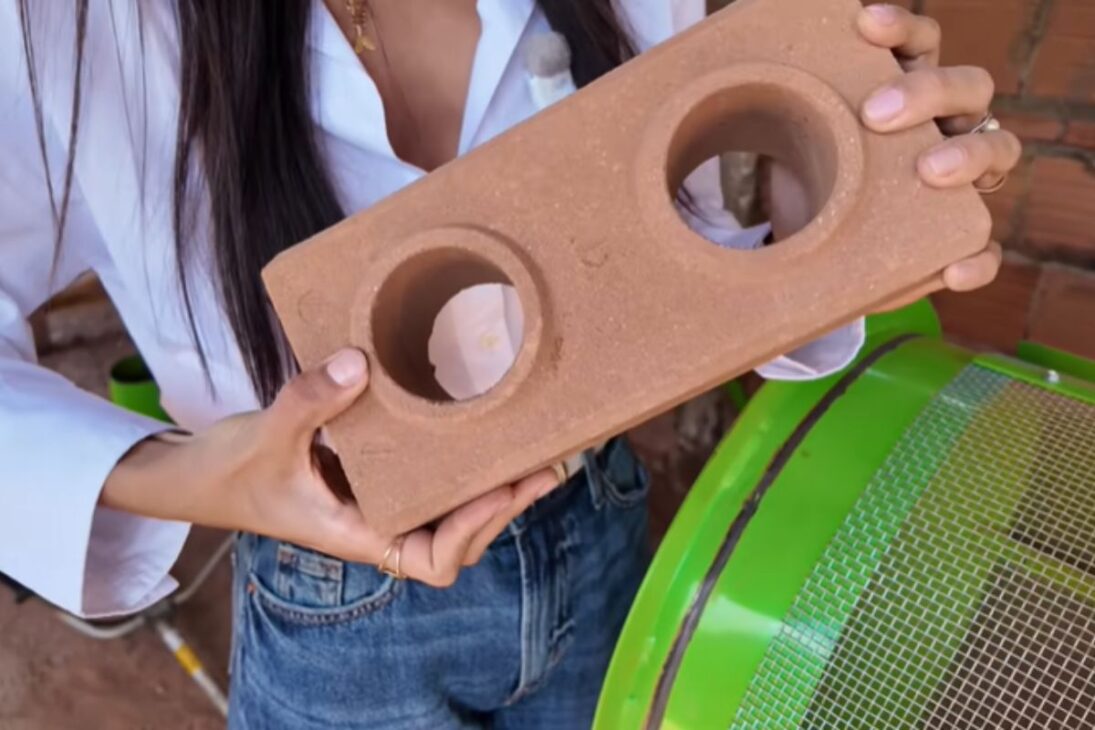
The couple attributes a significant part of the quality of the ecological brick to the tests carried out over time. The goal was not just to manufacture cheaper pieces but to achieve a fine finish, with better fitting, satisfactory resistance, and uniform appearance. It is at this point that the narrative of savings tries to distance itself from the idea of improvisation: producing at lower cost, but without accepting a loss of performance.
One of the clearest examples of this is in curing. According to their account, many manufacturers leave spaces between the bricks during this phase, which would favor stains and quicker moisture loss. After tests and reports, the couple began to stack the pieces very close to each other, maintaining humidity and improving the curing process. For them, this detail directly affects both the visual and final resistance.
The presence of stains, marks, and imperfections is also treated as a technical problem, not merely aesthetic. The couple claims to have identified the source of these marks and adjusted the procedure. This care aligns with another point mentioned in production: the choice of a press whose mold produces pieces with certain constructive details, such as chamfer and a slight lower curvature designed to help reduce the risk of cracking due to expansion at the meeting point between bricks.
The group also mentions reports and claims to have reached 2.9 MPa, a value they assert is about 30% above the applicable standard. Additionally, they state they use high initial strength cement, which would allow them to deliver the bricks in about ten days. Even though this information is presented by the couple themselves, it helps to understand the reasoning behind the process: the ecological brick only sustains the promise of savings when curing and quality control stop being improvised.
Where the Economy Really Appears When the Bill is Made on the Whole Project
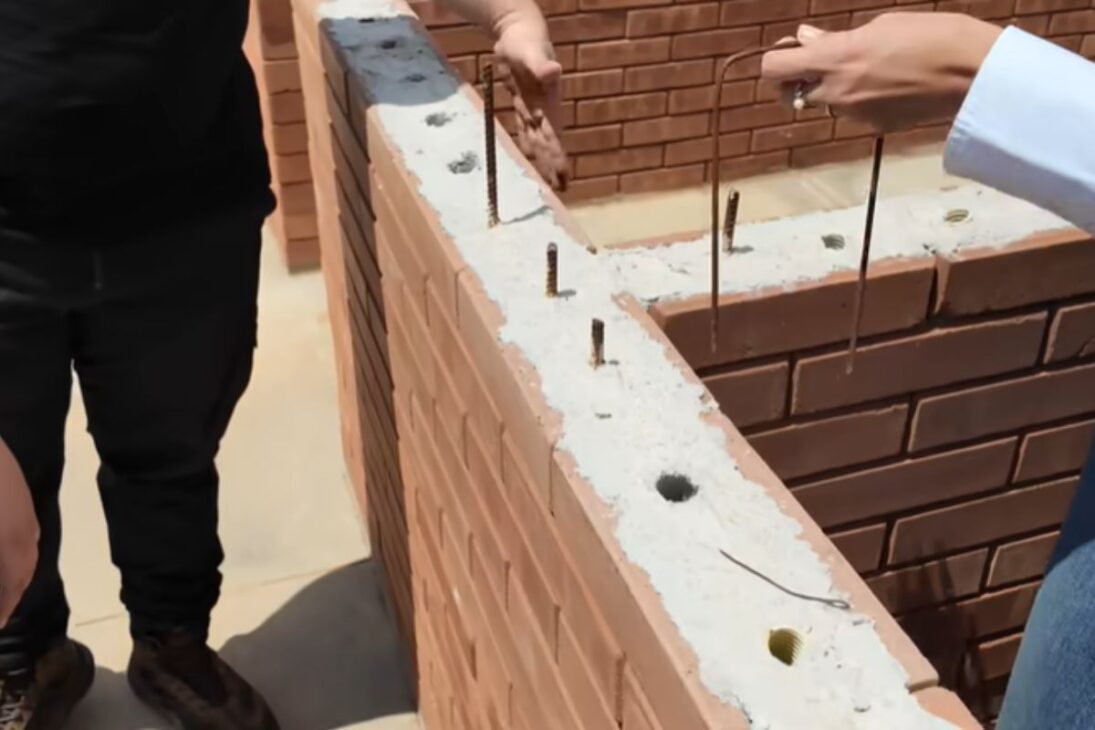
The most striking gain arises when production is projected over the total volume of pieces. The couple states that each house would consume around 22,000 bricks. Since the equipment was purchased in a shared manner to serve two projects, the total scale reached approximately 44,000 bricks. In this scenario, the difference between buying ready-made and producing independently stops being marginal and becomes a real weight in the budget.
The presented calculation is straightforward: if the thousand bought would be nearly R$ 1,600 with freight and the self-production is below R$ 600, the savings hover around R$ 1,000 per thousand. In 44 thousands, this would mean around R$ 44,000 saved just in that stage. It’s this type of multiplication that transforms a technical decision into a financial decision.
Another important aspect is that the savings are not limited to the ecological brick itself. The structure set up for production was designed to utilize available materials, such as existing wood on the land and a cover that would later be reused in another part of the project. This reuse mentality appears in various parts and helps to explain why the final result cannot be attributed to a single isolated item.
In practice, the ecological brick would also be used in other nearby constructions, including in a house financed by Minha Casa, Minha Vida. In this application, the group mentions a savings of 73%. This broadens the reach of the case because it shows that the logic presented was not restricted to the couple’s main residence. Still, the central point remains the same: cost reduction only occurs due to a combination of the right material, production method, scale, and discipline on the construction site.
Why This Model Attracts Attention Even Without Promising a Magic Formula

The interest awakened by this type of experience lies in the fact that it addresses a very concrete pain: the cost of construction. In regions where the price of ready-made materials presses the budget from the start, any alternative capable of reducing the price per thousand attracts attention. The differential here is that ecological brick does not appear only as an alternative item, but as part of a complete self-construction strategy.
At the same time, the case also shows that there is no automatic shortcut. There was research, brand comparisons, conversations with those who already produced, finishing tests, observation of curing, seeking soil suppliers, and adapting the process to the project’s reality. The savings did not come from a magic solution, but from a sequence of well-adjusted choices.
This is an important point to understand why the narrative resonates so much. The ecological brick enters the discussion not just because of the promise of spending less, but because it offers the builder greater control over a stage that is typically delivered ready to the site. When this control works, it can reduce costs, better organize production, and still integrate other bio-construction and reuse solutions.
The case also helps reposition the debate on cheap construction. Instead of associating savings with a loss of quality, the experience tries to demonstrate that lower spending can come from study, method, and mastery of the process. This does not eliminate challenges nor guarantee that the same result will be replicated in any context, but it explains why the initiative draws so much attention among those seeking to build at lower costs without sacrificing performance.
In the end, what stands out most in this story is not just the value below R$ 600 per thousand, but the way in which the ecological brick was incorporated into a larger logic of construction, reuse, and planning. When the bill closes in detail and also in volume, the difference stops being punctual and begins to alter the total cost of the house.
And you, do you think that producing the ecological brick yourself is a viable solution only for family works and well-monitored projects, or can this model gain space in larger constructions?









Seja o primeiro a reagir!