






 Portuguese


Comet 220P/McNaught Experiences Outburst Near the Sun, Becomes Over 8,000 Times Brighter and is Photographed Over Namibia
The comet 220P/McNaught featured an unusual series of activity in 2026, suffering a strong outburst during its closest approach to the Sun in June, when its brightness reportedly increased by about 8,000 times the normal level. The activity didn’t stop there: in August, the object intensified its brightness again and was captured by astrophotographers over Namibia, displaying an intense green coma as it traversed the inner regions of the Solar System.
The information was published by Daily Galaxy on August 13, 2026, referencing data also released by Space.com, along with photographs taken by astrophotographers Gerald Rhemann and Michael Jäger. The image was captured on August 8, 2026, during a new phase of heightened brightness when the comet was approximately 600 times more luminous than in its normal state.
Comet 220P/McNaught Completes an Orbit Every 5.5 Years
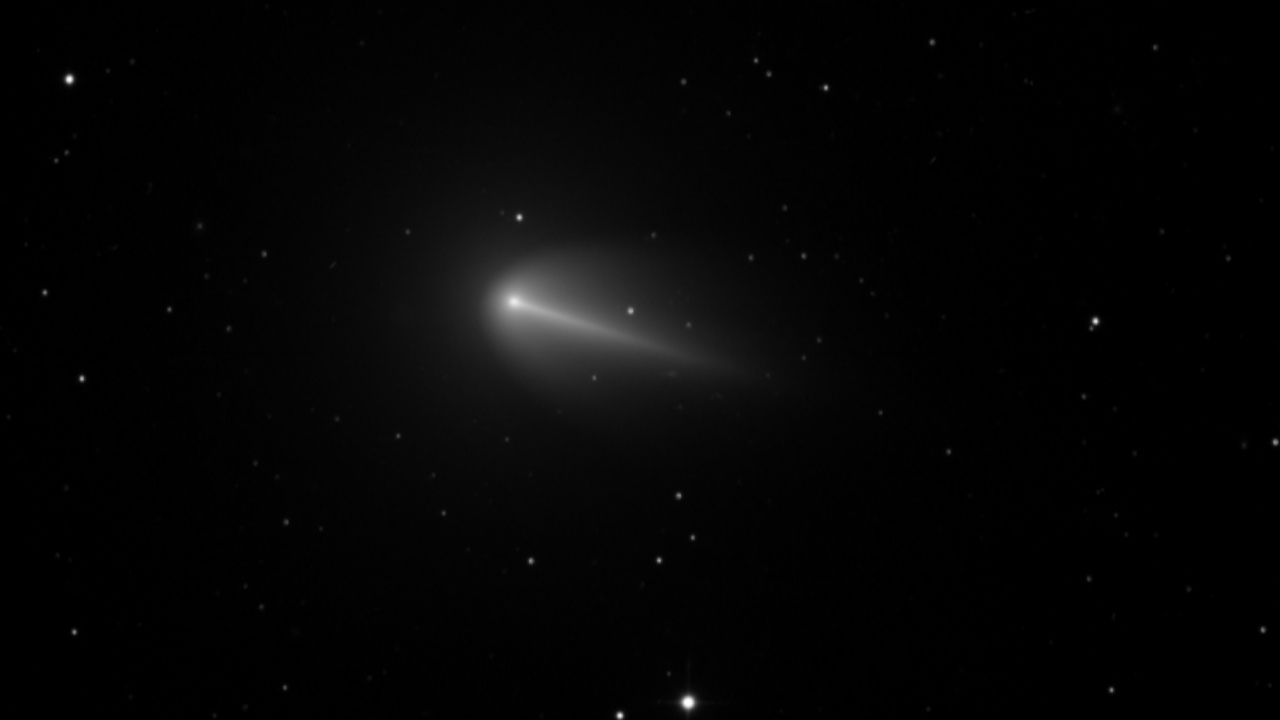
Comet 220P/McNaught is a periodic object discovered by Australian astronomer Robert H. McNaught. Its orbit around the Sun lasts approximately 5.5 years, causing it to repeatedly return to the hotter inner regions of the Solar System before heading back to more distant areas.
-
Elon Musk Plans to Build the World’s Largest Building in Texas: Tesla and SpaceX to Develop a 9.3 Million Square Meter Chip Mega Factory with an Initial Investment of R$86 Billion to Supply Robots, Autonomous Vehicles, and Space Projects

-
Saipem 7000 Navigates Bosporus with Reduced Height for Bridge Passage

-
Ra World Ship: An Interstellar Vessel Measuring 115 km in Length to Transport 1 Million People with a Capacity of 10 Million

-
NASA’s WB-57 Aircraft Takes to the Skies from Iceland During the August 12 Solar Eclipse, Capturing the Sun’s Corona with the SAMI System


This periodicity makes its orbit relatively predictable, but it doesn’t mean that its physical behavior is equally easy to anticipate. Outbursts can occur abruptly, dramatically altering the brightness and the amount of gas and dust released from the nucleus during a solar approach.
Approach to Perihelion Preceded Major Outburst
The 2026 approach gained prominence near perihelion, the point in the orbit where an object is closest to the Sun. It was during this period, in June, that 220P/McNaught exhibited the major outburst reported by observers.
The effect was extremely significant visually. The apparent brightness reportedly increased by about 8,000 times, temporarily transforming a comet that is usually difficult to detect into a much more apparent target for astronomical instruments.
Solar Heating Can Activate Volatile Materials
Comets are composed of a combination of rocky materials, dust, and frozen volatile substances. As they approach the Sun, the increase in temperature can trigger significant changes on the surface and in areas beneath it.
Heating can cause gases to escape from the nucleus and carry dust particles into the surrounding space. This release rapidly increases the amount of material illuminated by the Sun, making the comet appear much brighter even though its solid nucleus remains relatively small.
Outbursts Can Occur Suddenly
A comet outburst represents a rapid increase in the object’s activity. Among the possibilities mentioned by the source are the exposure of materials rich in volatiles, the buildup of pressure beneath the surface, or thermal changes capable of destabilizing parts of the nucleus.
In the case of comet 220P/McNaught, the mere increase in brightness does not allow for determining which of these mechanisms occurred. To achieve a more precise physical explanation, it would be necessary to track composition, dust production, and evolution of the object before, during, and after the event.
Brightness Increased Approximately 8,000 Times in June
The most impressive number associated with the 2026 passage was precisely the increase of approximately 8,000 times in brightness reported during the June outburst. The variation illustrates how dramatically the environment around a comet can change in a short period.
This occurs because a large part of the observed brightness does not come directly from the nucleus. The sunlight reflected by the dust and emissions produced by the gases surrounding the object can dominate its appearance, rapidly multiplying the apparent brightness after an intense release of material.
Activity Did Not End After the First Outburst
After the significant intensification in June, the comet reduced its brightness, but did not immediately return to a subdued behavior. In August, a new phase of activity was recorded.
According to the source, the object returned to approximately 600 times its normal brightness. Although well below the previously estimated peak, this level still represented extraordinarily high activity and helped create conditions for the photography obtained in Namibia.
New Intensification Occurred in August
The resumption of brightness shows how a comet’s behavior can continue to change even after the main episode of activity. The orbital trajectory can be calculated with great precision, but the physical processes of the nucleus present much greater levels of unpredictability.
For observers, this transforms each passage by the Sun into a different opportunity. Comet 220P/McNaught demonstrated at least two remarkable episodes of increased brightness within just a few months, making its 2026 appearance particularly significant.
Photography Taken Over Namibia on August 8
Gerald Rhemann and Michael Jäger captured the object over Namibia on August 8, 2026, precisely during the second period of heightened activity. The image shows the comet against a dense field of stars.
The choice of location also favored the capture. Remote regions of Namibia can provide very dark skies and low interference from artificial lighting, conditions that facilitate the capturing of weak astronomical structures and details difficult to perceive with the naked eye.
Specialized Equipment Revealed Details of the Coma
The photograph was obtained with a 12-inch astrophotography telescope combined with a ZWO ASI 6200 MM Pro astronomical camera. This combination allowed capturing structures and emissions much more subtle than would have been observed without specialized equipment.
The result primarily highlighted the region surrounding the nucleus. The coma appears as a broad, greenish luminous cloud, showcasing the material released by the comet during its intense activity phase.
Coma is a temporary atmosphere around the nucleus
The coma is formed when gases and dust escape from the nucleus of a comet as it approaches the Sun. It serves as a sort of temporary atmosphere, which can reach sizes much larger than the solid body itself.
This material is responsible for much of the spectacle observed in photographs of comets. Although the nucleus is small and dark, the illuminated coma can make the object much brighter and visually expansive.
Green color is not just a photographic effect
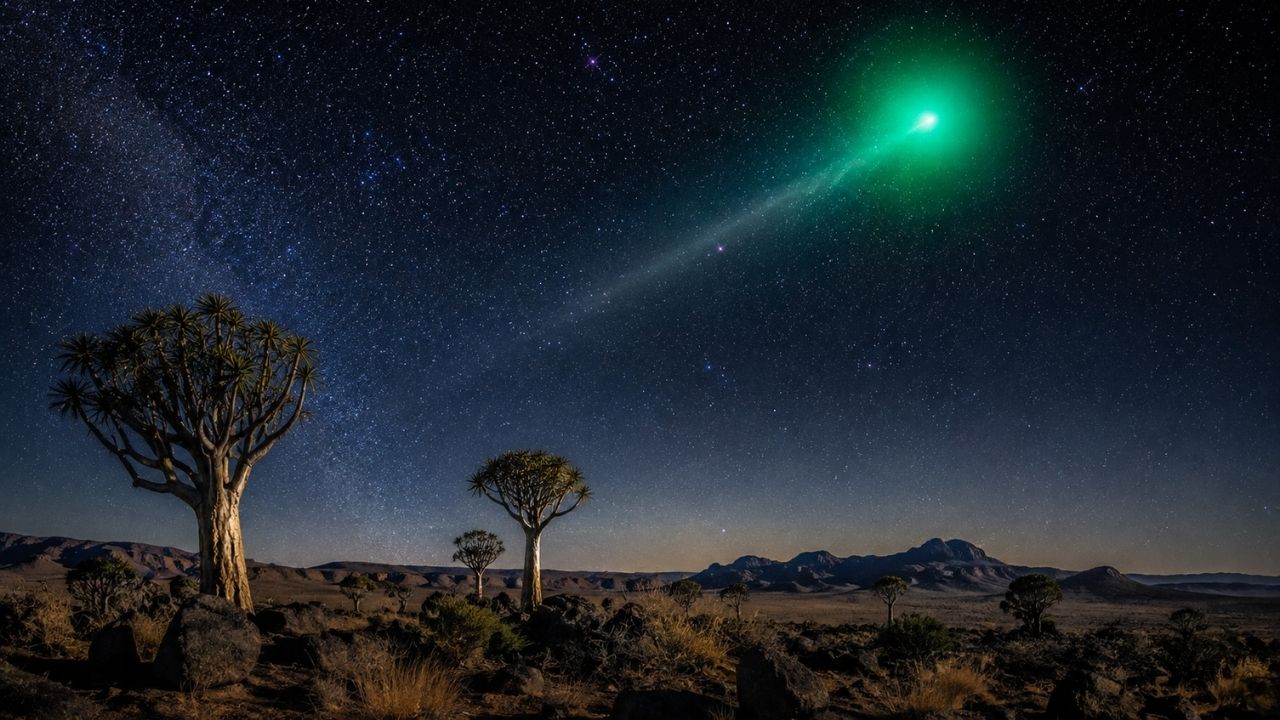
The intense green coloration recorded in Namibia is not viewed by the source as a mere artistic outcome or image processing. Green comas are known in certain active comets and are related to physical and chemical processes involving the released gases.
One of the components that can contribute to this phenomenon is dicarbon, known as C2. When specific molecules present in the coma interact with solar radiation, they can emit light at specific wavelengths associated with the green hue.
Dicarbon may contribute to the greenish brightness
Dicarbon can fluoresce upon receiving energy from sunlight. This process causes the region near the nucleus to exhibit a characteristic green color under certain conditions.
The emission tends to concentrate in the coma because the molecules can be destroyed by ultraviolet radiation as they move away from the nucleus. Thus, the green color does not necessarily accompany the entire length of a potential comet tail.
Photography records interaction between the Sun and cometary material
The image of the comet 220P/McNaught has significance beyond its visual impact. It directly captures the result of the interaction of solar radiation with materials released by a body formed in very ancient periods of the Solar System’s history.
Each approach to the Sun can modify the comet. New regions of the surface may be exposed, frozen materials may sublimate, and already active areas may change, making each orbital return slightly different from the previous ones.
Inner Solar System increases the heating of the comet
As it re-enters the inner regions of the Solar System, 220P/McNaught is subjected to higher temperatures than those found in the more distant sections of its orbit.
This increase in solar energy is precisely one of the factors driving cometary activity. The greater the warming, the more certain gases and particles can be released, although the exact intensity depends on the physical characteristics of each object.
Small nucleus can produce a much larger structure
An important characteristic of comets is the difference between the dimensions of the nucleus and the size of the luminous structure seen around it. The solid body represents only a fraction of what appears in images.
When activity increases, gases and dust spread rapidly. This cloud can greatly expand the area capable of reflecting sunlight or producing emissions, explaining how the apparent brightness can change so dramatically.
Brightness does not solely reveal the mechanism of the outburst
Although an increase of about 8,000 times is extraordinary, this figure does not exactly explain what occurred inside the nucleus. Different physical processes can produce similar effects on the observed brightness.
To understand the origin of an outburst, researchers need to gather additional information about composition, speed of material release, dust production, and temporal evolution. Brightness serves as a visible signal of activity but not as a complete diagnosis of its cause.
Comet continues predicted trajectory despite activity
Even with violent episodes of material release, the orbital motion of the comet 220P/McNaught follows a calculable trajectory. The large uncertainty is much more related to surface activity than to the general direction of its movement.
This difference helps explain why astronomers can predict when a comet will return close to the Sun, but not necessarily when it will undergo an outburst. Orbit and physical behavior are distinct problems within cometary observation.
The 2026 passage has become particularly unusual
The sequence formed by the June perihelion, the outburst of about 8,000 times, and the renewed intensification in August turned the 2026 passage into a particularly active period for the object.
A photograph from Namibia visually captured this later phase. Even after leaving the extreme level recorded in June, the comet still showed brightness about 600 times higher than normal when it was photographed.
Comet 220P/McNaught shows how these objects can change rapidly
The comet 220P/McNaught transitioned from a normally inconspicuous target to an object thousands of times brighter around its solar approach, resumed high activity weeks later, and appeared in images with a vibrant green coma over Namibia. This sequence highlights the dynamic nature of icy bodies that periodically traverse the inner Solar System.
The 2026 episode also illustrates the difference between predicting an orbit and anticipating what will happen on a comet’s surface during its approach to the Sun. What stands out to you in this case: the increase of about 8,000 times in brightness or the intense green coma captured in Namibia? Share your thoughts in the comments.


