





 Portuguese
  English
  Spanish
  4 min of reading
  0 comments


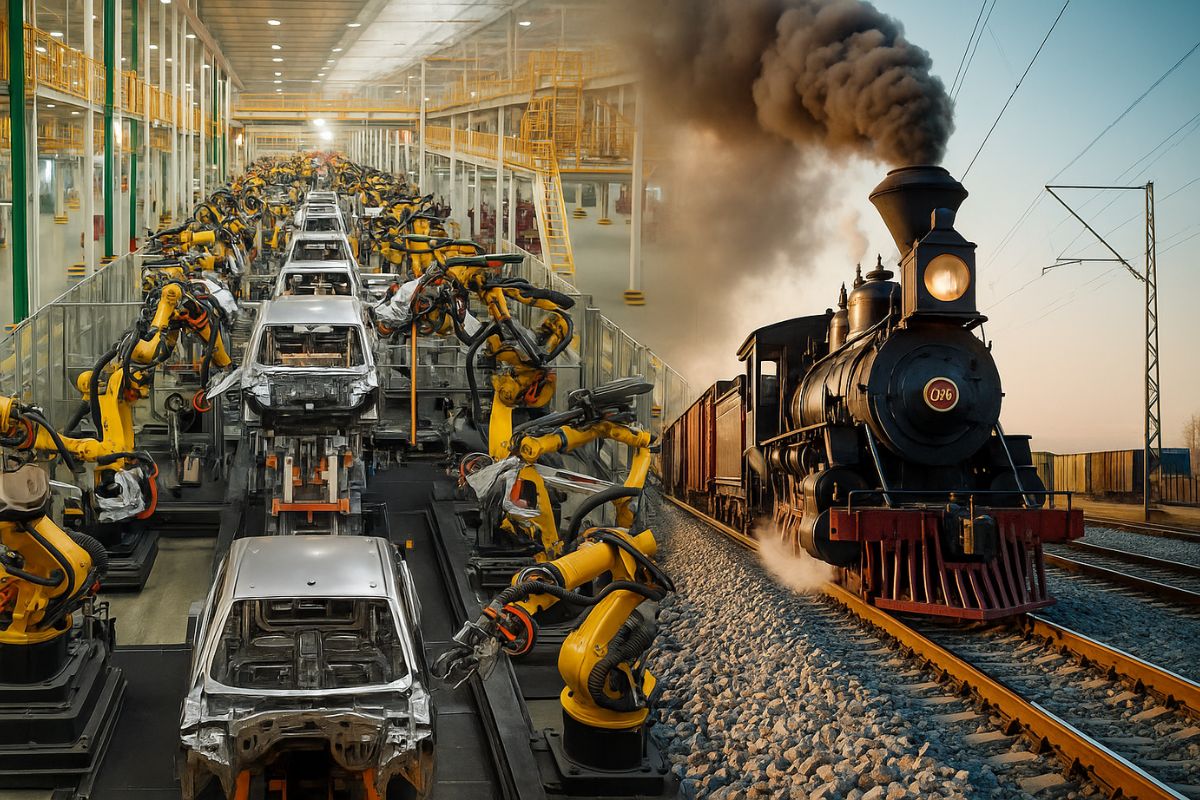
From Steam Engines to Artificial Intelligence: Understand What the Industrial Revolution Was, Its Phases, Its Impacts, and How Its Legacy Continues to Transform Us.
The Industrial Revolution was a long period of profound technological, economic, and social transformations. Beginning in Great Britain in the late 18th century, it marked the transition from agrarian and craft economies to industrialized production systems, radically reconfiguring human societies.
This article explores the different phases and impacts of the Industrial Revolution. We will analyze everything from the first industrial machines that changed the world to the debates about automation and artificial intelligence that define our time, showing how this transformation continues to evolve.
What Was the Industrial Revolution?
The Industrial Revolution refers to the transition from manual production to mechanized production. This process led to the creation of the factory system, accelerated urbanization, and a new social class structure. Its historical importance is comparable to that of the Neolithic Revolution, which introduced agriculture.
-
With 74% of companies facing difficulties in hiring, technicians and engineers in renewable energy are becoming scarce in Brazil and are essential to support the expansion of solar, wind, and green hydrogen projects.

-
Historic bankruptcy of Centauro shocks the market, and the century-old company puts more than 500,000 products, machines, and complete infrastructure up for online auction.

-
New shoe factory in Ceará is expected to create 400 jobs and strengthen the local economy.
-
No one imagined it, but a mixture of sawdust with a mineral that fights fires surprises scientists with a result that changes the course of fire-resistant construction.

Historians divide the Industrial Revolution into phases:
- First Industrial Revolution (c. 1760-1850): Centered in Great Britain, marked by the steam engine, coal, and the mechanization of the textile industry.
- Second Industrial Revolution (c. 1870-1914): Characterized by steel, electricity, oil, and the internal combustion engine. Industrialization expanded to the USA, Germany, and Japan.
- Third and Fourth Industrial Revolutions (mid-20th century – present): The era of electronics, computers, automation, and more recently, artificial intelligence and the Internet of Things (IoT).
The First Industrial Revolution (c. 1760-1850): The British Pioneering
Great Britain was the cradle of the Industrial Revolution due to a combination of factors. The Agricultural Revolution of the 18th century increased food production and released labor from the fields to the cities. At the same time, capital accumulation from colonial trade and other sources provided the resources to invest in new technologies.
Technological innovations were crucial. The invention of the steam engine by James Watt revolutionized energy generation, freeing factories from dependence on rivers. In the textile industry, machines like the “Spinning Jenny” drastically increased yarn production. In metallurgy, the use of coke (derived from coal) allowed for large-scale iron production. These changes led to intense urbanization, with the emergence of industrial cities and a new working class, the proletariat.
The Second Industrial Revolution (c. 1870-1914): The Era of Steel, Electricity, and Oil
From the second half of the 19th century, the Industrial Revolution entered a new phase. Steel, mass-produced through the Bessemer process, replaced iron, allowing for the construction of stronger railways, larger ships, and the first skyscrapers.
Electricity and oil emerged as new energy sources. Electricity transformed factories, transportation (trams), and urban lighting. Oil, with the development of the internal combustion engine, ushered in the automobile era. During this period, industrialization spread, and Germany and the United States surpassed Great Britain as major industrial powers, while Japan began its rapid modernization.
The Consolidation of Capitalism and the New Industrial Elite
The Second Industrial Revolution not only introduced new technologies but also consolidated capitalism as the dominant economic system. This period saw the emergence of large corporations and the strengthening of a new industrial and financial elite, which came to control vast sectors of production. The need for large investments in new industries, such as steel and electricity, favored the concentration of capital and the formation of trusts and cartels.
This new market dynamic, driven by mass production, created the need to constantly expand consumer markets. The search for new trade routes, sources of raw materials, and the export of industrialized products became a priority, intensifying globalization. Companies specializing in cutting-edge technologies, such as Elite, are direct heirs of this legacy of innovation and industrial specialization that began in this era.
The Social Responses and Ideologies of the Industrial Era
Analysis from specialists and social historians shows that the Industrial Revolution generated profound tensions. The harsh working conditions in factories, with 12 to 16 hour shifts, low wages, and unsanitary environments, led to the emergence of labor movements. Ludism, with the breaking of machines, was one of the first forms of protest.
Over time, more structured organizations emerged, such as the Trade Unions in England, which fought for better wages and working conditions. Chartism, in turn, focused on the struggle for political rights for workers. Exploitation and inequality also inspired the emergence of new ideologies that criticized the capitalist system. Socialism and Anarchism gained strength, proposing alternatives to private ownership of the means of production. Figures like Mikhail Bakunin, one of the main theorists of anarchism, advocated for the abolition of the state and a society based on the free association of individuals.
The Lasting Legacy of the Industrial Revolution and Current Debates
The impact of the Industrial Revolution shaped the world as we know it. It solidified capitalism as the dominant economic system and fueled globalization, with advances in transportation and communications that “shrunk” the planet.
However, it also left a heavy environmental burden. The burning of fossil fuels initiated the process of global warming. Water and air pollution, along with deforestation, became serious problems. Today, we live in the Fourth Industrial Revolution (Industry 4.0), marked by artificial intelligence, robotics, and the Internet of Things. Current debates about the future of work, automation, and sustainability are direct echoes of transformations that began over 250 years ago, showing that the revolution is a continuous process.








Seja o primeiro a reagir!