





 Portuguese
  English
  Spanish
  6 min of reading
  0 comments


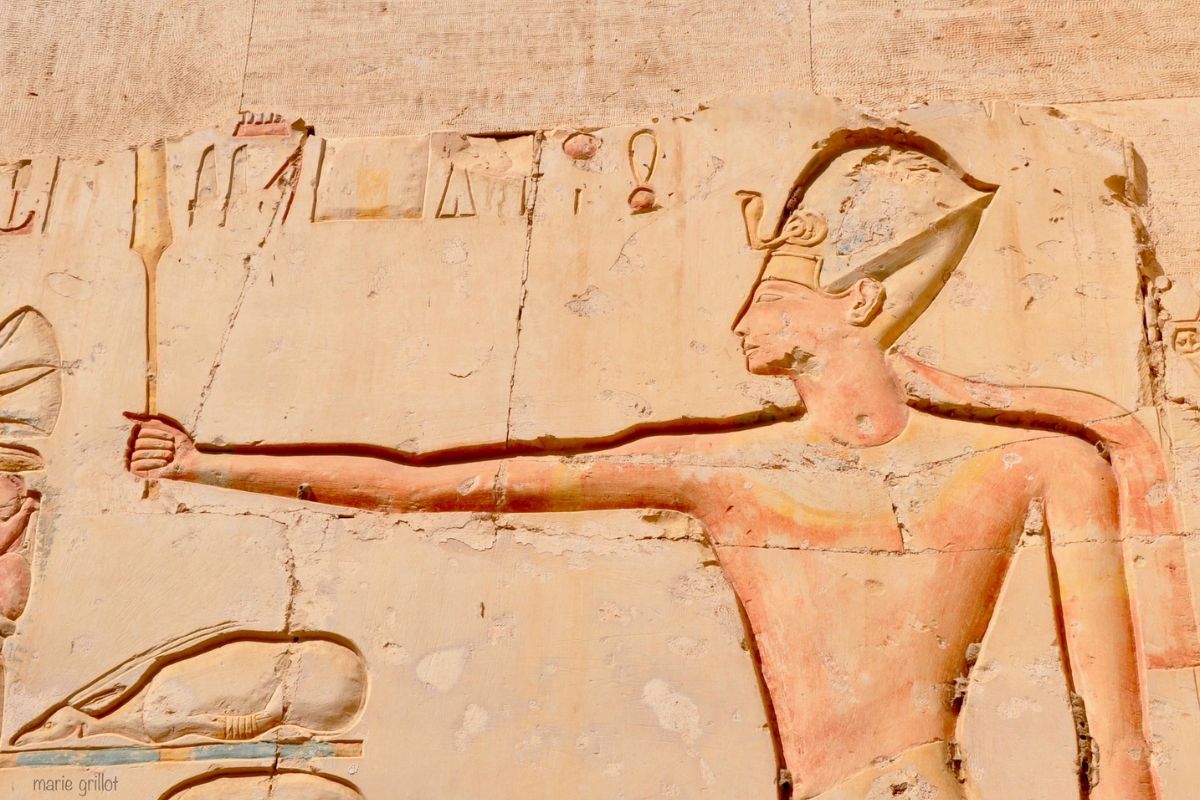
Between Tuning Forks, Resonance, and Ultrasonic Drilling, a Theory Attributes Circular Holes and Deep Grooves in Granite to Controlled Vibrations, Not Modern Drills. The Proposal References Egyptian Symbols, Wave Sticks, and Leak Tests, but Faces Skepticism Due to Lack of Direct Archaeological Record on Ancient Egyptian Monuments
Amidst tuning forks and skepticism, the discussion about stone cutting by sound has resurfaced because it attempts to explain, without electricity, how regular holes and millimeter fittings appear in hard rocks. The hypothesis associates tuning forks with resonance applied to granite in Egypt and also to marks observed in Machu Picchu, where geometry seems to demand more than simple tools.
The central point is the idea of ultrasonic drilling: vibrations at a specific frequency would be transmitted to a rod or a metal tube, creating rapid impacts that fragment granite with less mechanical effort. Advocates cite standing waves, fine-tuning resonance, and indirect evidence in Egypt, while critics point to the absence of direct records and the ease of confusing technique with narrative.
What the Tuning Fork Hypothesis Really Proposes

The cited formulation attributes a broad proposal to Professor Ivan Watkins: ancient peoples would have exploited natural forces, including sound, to work stone on a monumental scale.
-
The lost continent beneath Europe: separated from North Africa about 240 million years ago, comparable in size to Greenland, Greater Adria was crushed over 40 million years and left geological marks from the Alps to the Balkans.

-
A cold front advances through the South this Saturday and reaches the Southeast on Easter Sunday with heavy rain and a drop in temperature, while the North and Northeast face the risk of storms and flooding throughout the holiday.

-
Brazil is about to inaugurate the largest maritime surveillance system in its history, with radars, infrared cameras, and autonomous sensors installed on Ilha Grande to monitor the entire Brazilian coast in real time.

-
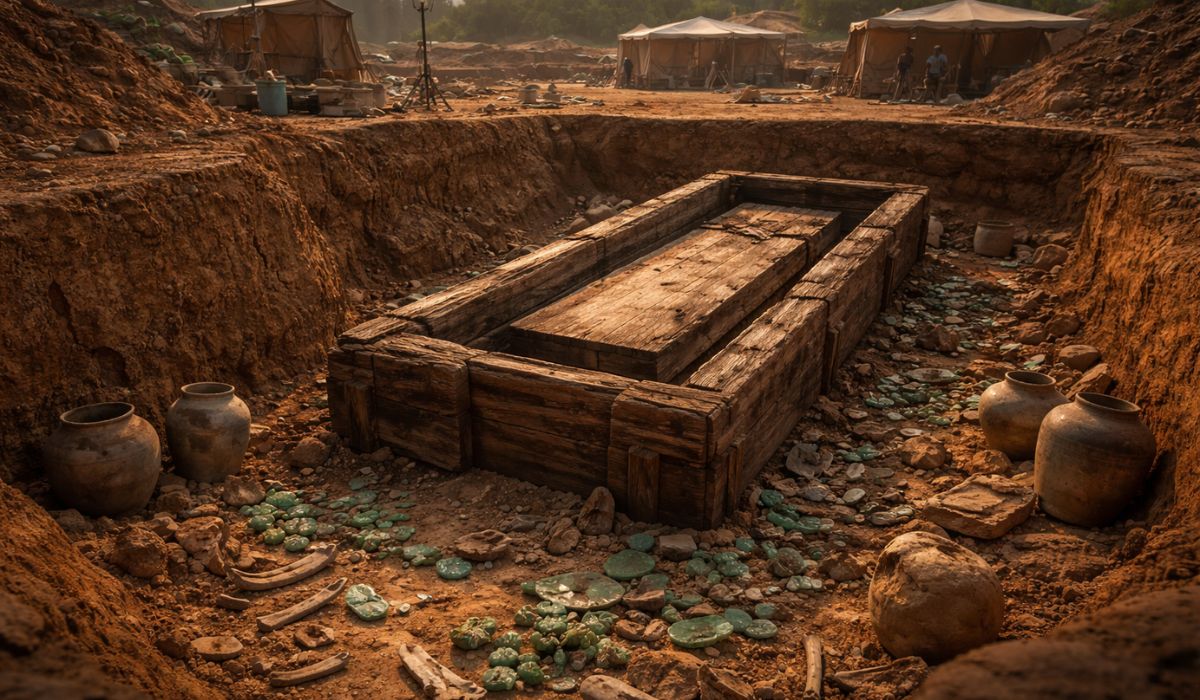
Archaeologists discover in China a 5,000-year-old tomb with over 350 artifacts, nearly 200 jades, and signs of intentional destruction, in a discovery that could be the gateway to a lost prehistoric kingdom.

The thesis dismisses aliens as an automatic explanation and attempts to shift the debate to vibration engineering, with tuning forks as both a symbolic and functional element.
In practice, the hypothesis describes a system where tuning forks would activate a cutting rod, or even a tube, at a frequency compatible with the rod itself. The efficiency would come from resonance coupling, not from the torque of a modern drill.
The argument is that this could produce very regular internal grooves and circumferences in granite, including in pieces attributed to Egypt.
Why Granite Becomes the Center of the Dispute

Granite appears as a reality check because it is made up of interconnected and extremely hard minerals, which wear down tools before any significant advancement, according to the reasoning presented.
If granite resists the method, the entire hypothesis loses traction; if the method explains the marks, it gains relevance.
It is at this point that the debate often cites the Giza plateau, where blocks and drillings in igneous rocks feed comparisons with industrial processes.
Egypt enters as a reference because there are artifacts drilled in granite and diorite, and the discussion tends to oppose two narratives: slow abrasion with sand and tubes, or ultrasonic drilling by vibration.
How Ultrasonic Drilling Would Work in This Scenario
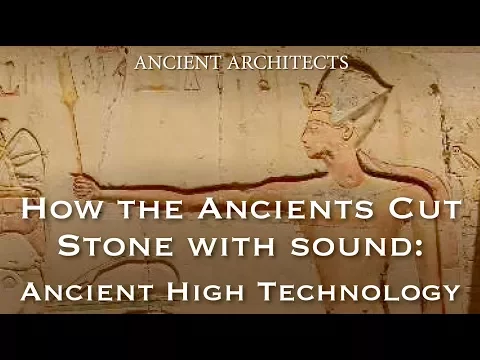

Ultrasonic drilling, in simple terms, would not depend on high rotations; it would rely on vibrational impacts.
The report describes that sound vibrations at a specific frequency, while passing through a metal tube, could act like a high-frequency jackhammer, breaking rock without requiring the drill to spin predominately. This is presented as faster, with less wear and lower energy consumption.
The same reasoning attempts to explain why some holes in granite do not penetrate the entire piece but exhibit a deeper groove around the circumference, suggesting the use of a metal tube.
For supporters, the key is to maintain water flow to remove dust, reduce heating, and prevent jamming, while resonance vibration sustains progress. The critique remains: the leap between physical plausibility and historical application still hinges on evidence.
Resonance, Standing Waves, and the Design of the Instrument
The most technical part of the hypothesis involves standing waves: maximum vibration would occur at the beginning and the end of the rod, with a low vibration point in the middle, where a handle could be fixed.
To illustrate, the report proposes tuning fork teeth about 30 centimeters long and 3 centimeters thick, resonating at 1,100 Hertz, coupled to a rod of approximately 1.5 meters.
This resonance mathematics is used to justify shapes resembling tridents and scepters, connecting instrument and iconography. The argument attempts to show that tuning forks need not be delicate laboratory objects: they would be robust structures capable of vibrating for long periods.
The hypothesis relies on stable coupling, compatible material, and frequency control; without this, ultrasonic drilling becomes merely a metaphor.
Symbols and Accounts That Place Egypt at the Center
A recurring element is the uas scepter, described as a long staff with a bifurcated tip, seen in art and hieroglyphs from Egypt.
The alternative reading suggests that what became a symbol of power could have been a literal instrument of power, associated with tuning forks and resonance. It is also mentioned hieroglyph u 24, from the 1957 guide, which some would interpret as a tuning fork, rather than a conventional hand tool.
There is also a report in an email, dated 1997, describing supposed tuning forks in the Egyptian Museum’s storage, ranging from about eight inches to eight or nine feet, with a wire stretched between the rods and extended vibration when tensioned.
The report itself acknowledges that there is no way to verify the content. Without traceable documentation, this type of evidence remains anecdotal, even when it reinforces the narrative of ultrasonic drilling in Egypt.
Machu Picchu and the Temptation to Generalize the Hypothesis
The hypothesis spreads because it attempts to connect cutting patterns in different locations, such as Machu Picchu, where stone fittings are cited as an example of precision.
The narrative suggests that if resonance were mastered, it could have been applied in different regions, producing similar solutions in diverse environments and cultures, always with tuning forks as the engine of the process.
To support this expansion, the report mentions a line of research called archaeoacoustics, associated with acoustic properties in monuments like Stonehenge and Göbekli Tepe, as well as Adam’s calendar in South Africa.
In this reading, acoustics would not be decorative: it would be functional. The logical leap, however, is significant: favorable acoustics do not demonstrate ultrasonic drilling, nor do they identify tuning forks as operational tools at each site.
What Remains Standing When the Mystery of the Debate is Removed
By removing aliens from the table, the discussion returns to engineering, material record, and process coherence.
The tuning fork hypothesis gains strength when it describes mechanism, frequency, resonance, and marks compatible with a tube; it loses strength when it depends on unverifiable accounts and fails to demonstrate a complete chain between tool, residue, and outcome in granite.
Traditional archaeology, cited in the report, relies on representations of stonework and on tools made of stone and metal for softer rocks, and faces challenges when the focus shifts to older granite and diorite.
Within this framework, Egypt becomes a conceptual laboratory: if ultrasonic drilling were used there, some type of consistent evidence beyond finishing would be expected. Between resonance and abrasive method, what decides is traceability, not admiration.
What makes tuning forks so recurrent in this conversation is the contrast between the apparent simplicity of the instrument and the complexity of the suggested outcome in granite.
While ultrasonic drilling is physically plausible as a concept, the leap from concept to Egypt and Machu Picchu still lives off gaps, not documentation.
If you have ever seen holes or grooves in granite that seem impossible, what detail stands out to you the most: the perfect circumference, the internal striations, or the tight fit? And, if you had to bet, would you consider tuning forks and resonance as real technology, or as an explanation that is too elegant for ultrasonic drilling?






-

-

-

-

-

9 pessoas reagiram a isso.