





 Portuguese
  English
  Spanish
  6 min of reading
  45 comments


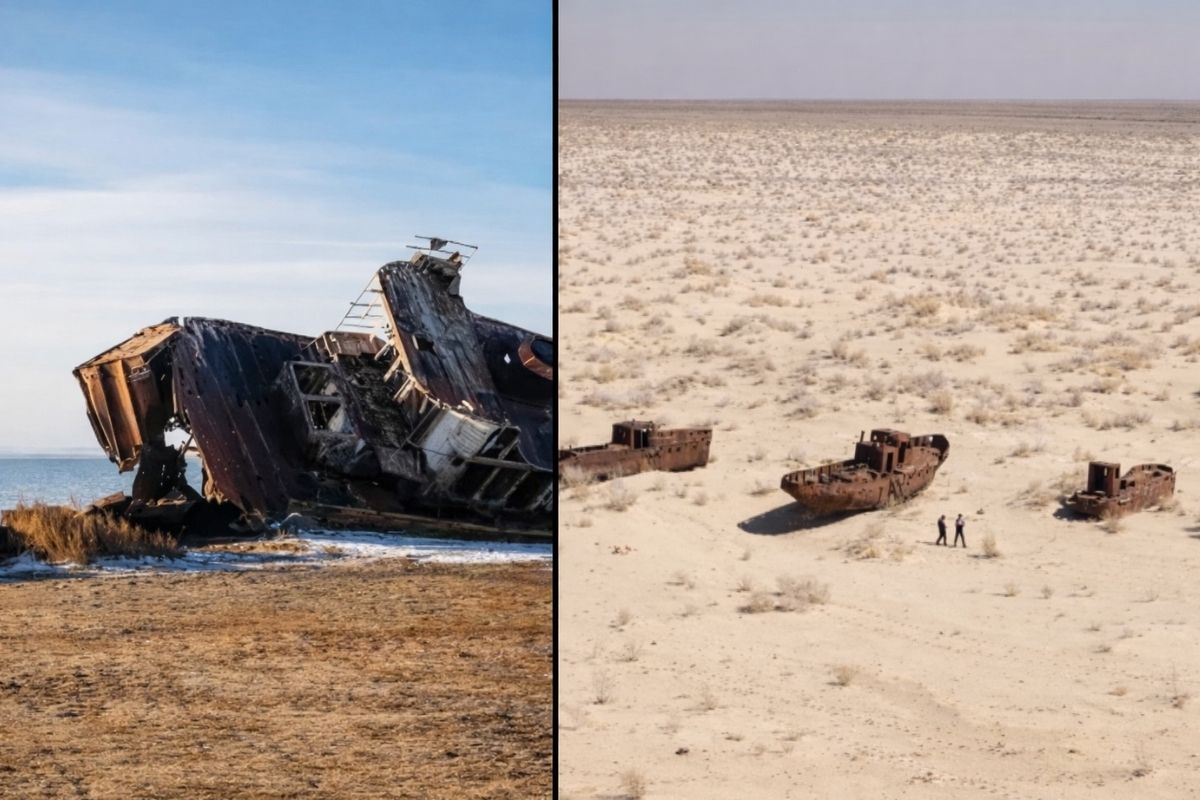


Mass Irrigation Political Decisions Diverted Entire Rivers, Salinized the Soil, Destroyed Fishing and Turned the Aral Sea into a Global Symbol of Man-Made Environmental Disaster.
For a long time, the Aral Sea was a massive saltwater lake that supported entire cities: abundant fishing, busy ports, boats leaving daily, and a regional economy based on water. In less than 40 years, this scene collapsed. What was an inland sea turned into a salty desert, with rusty ships stranded in the sand where waves once were.
Today, what remains of the Aral Sea is a collection of separate water patches, surrounded by salty soil and a harsher climate. Its transformation story is not a product of chance or merely natural processes. It is the direct result of human choices regarding rivers, dams, canals, and large-scale agricultural production.
The Aral Sea Before the Collapse

Before the 1960s, the Aral Sea was the fourth largest lake in the world, covering about 68,000 square kilometers, an area comparable to countries like Ireland or Georgia.
-
Scientists have discovered a gigantic magnetic anomaly hidden beneath the soil of Australia that mirrors the shape of the entire continent and holds geological records of two and a half billion years that could change what we know about the Earth.
-
The heatwave that has been affecting Brazil in recent weeks is coming to an end: a cyclonic vortex is moving in during Holy Week with heavy rains, and a cold air mass is already threatening to lower temperatures in the South starting in April.
-
(VIDEO) Cameras from an astronomical observatory captured two meteors falling over Santa Maria in Rio Grande do Sul with only a one-minute difference and such close trajectories that scientists are now investigating whether the two objects have the same origin.
-
Fireballs shoot across the skies of the USA and meteor explosions draw attention: what is causing this mysterious wave of sightings?

Its salty waters reached depths of up to 40 meters at some points, and its name meant “sea of islands,” reflecting the number of islands scattered across its surface.
It was located in Central Asia, shared by Kazakhstan and Uzbekistan, and was fed by two major rivers, the Amu Darya and the Syr Darya.
This inland sea was rich in life and supported a powerful fishing industry, which drove the economy of the cities along its shores.
Ports, fish processing factories, and entire communities depended on the Aral Sea for survival. The water regulated the region’s microclimate, aided agriculture, and ensured employment and income for thousands of people.
The Irrigation Plan That Turned Its Back on the Aral Sea
After World War I, the Soviet Union decided to transform deserts into productive fields. The strategy was to divert water from the rivers feeding the Aral Sea through large irrigation canals to produce food and, above all, cotton in the arid regions surrounding it.
In the 1940s, these canals were expanded. The problem was that a huge amount of water was lost to leaks and evaporation along the way before reaching the fields. Nevertheless, the amount captured continued to increase, while the lake did not receive sufficient replenishment.
Starting in 1961, the level of the Aral Sea began to drop about 20 centimeters per year. This decline accelerated to reach 70 centimeters annually by 1990.
As the lake shrank, the irrigation plan seemed to succeed in the short term: Uzbekistan became one of the largest cotton exporters in the world.
But the cost was enormous. With less water entering, evaporation began to dominate the water balance. The surface of the Aral Sea visibly receded, the shores moved away from the old ports, and the lake ceased to be a navigable sea to become a shrinking body of water.
Too Much Salt, Too Little Fish, and Abandoned Cities
With the constant reduction in the level of the Aral Sea, the salinity of the waters increased rapidly. Most aquatic life could not withstand it.
Fish species that sustained commercial fishing disappeared or were reduced to residual populations.
The local fishing industry was destroyed. Factories closed, jobs vanished, and the cities that depended on the lake began to wither.
Ports that once stood by the water became kilometers away from the new shores of the Aral Sea, surrounded by sand and salt crusts instead of waves and boats.
The ships that could no longer navigate the shallow areas remained where they were and watched the water recede. Over time, they became completely stranded in dry beds, turning into rusting structures in the midst of a new salty desert.
More Extreme Climate and a Saline Desert in Expansion
The disappearance of the Aral Sea affected not only the economy. The local climate also changed. Without the large body of water to moderate temperatures, summers became hotter and drier, and rainfall decreased.
With the lake’s retreat, the salt deposited in the exposed bed began to be carried by the wind to other areas. This increased the salinity of the soil in neighboring agricultural regions, harming crops and further impoverishing the surroundings of the Aral Sea.
Today, the landscape that replaced much of the lake is a saline desert with patches of weakened vegetation.
The combination of dust, salt, and debris accumulated over the decades has made the former bed a hostile environment, frequently cited as one of the greatest environmental disasters caused by human action.
A Fragmented Sea in the North and South
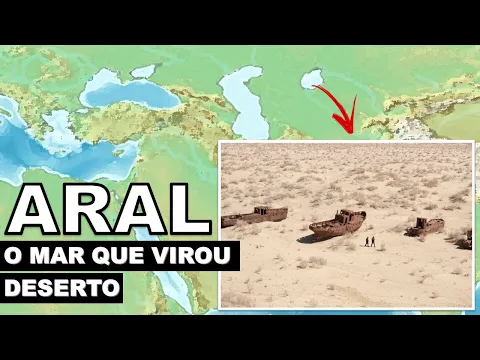

The Aral Sea did not completely disappear, but it fragmented. Today it exists in separate portions: a northern part and a southern part, with the latter further subdivided into central and western sectors.
Currently, the Aral Sea covers only about 30 percent of its original area and maintains around 20 percent of the water volume it had around 50 years ago.
The only portion that has shown significant recovery is the North Aral Sea, thanks to an engineering project.
In 2005, the Kok-Aral dam was built, approximately 12 kilometers long, to reduce the flow of water escaping from the northern part toward the south.
With this dam, the water level in the northern portion of the Aral Sea rose by about 3 meters, salinity decreased, and fishing began to recover in that area.
Meanwhile, the southern part of the Aral Sea continues to collapse. Even receiving about 3 billion cubic meters of water annually from the northern portion, this volume is still insufficient to restore the lake. The trend is continuous shrinkage and expansion of the saline desert around.
Human Decisions, Biological Weapons, and a Warning for the Future

The accelerated disappearance of the Aral Sea is often classified as one of the greatest environmental disasters ever seen.
There are studies indicating that the lake was already undergoing a natural change process over centuries or millennia, but human intervention brutally shortened this time. Instead of centuries, the Aral Sea was practically drained in just a few decades.
The case becomes even more symbolic when remembering that in 1948, the Soviets established a biological weapons base on an island in the Aral Sea, used for decades and abandoned after the end of the Soviet Union.
A sea that supported life, cities, and economy became, at the same time, a desert, a salt repository, and a scene of military experiments.
The story of the Aral Sea shows how production policies focused solely on immediate results can completely ignore the long-term environmental and social costs.
By prioritizing cotton and poorly planned irrigation, a region gained exports for a few years and lost an entire ecosystem forever, or for a time far exceeding the lifespan of those who made those decisions.
In the end, the Aral Sea became a mirror of what human decisions are capable of doing to a large body of water when rivers are treated solely as sources of volume and not as part of a living system.
And you, do you think the story of the Aral Sea should be taught in all schools as an example of the cost of human decisions on water and entire ecosystems?






Sim
Absurda essa situação do Mar de Aral,como foi possível? Inaceitável, ****, pra dizer o mínimo
Este desastre ambiental deve ser propagado,dentre tantos outros, de como “o feitiço pode virar contra o feiticeiro” consequência da ganância e estuticia dos seres humanos. No Brasil corremos este risco com o perigo iminente da diminuição da vazão dos “rios voadores da Amazonia de vido a devastação da floresta Amazonica provocada por projetos agropecuários, construção de ferrovias e rodovias atraindo toda laia de grileiros.