





 Portuguese
  English
  Spanish
  5 min of reading
  0 comments


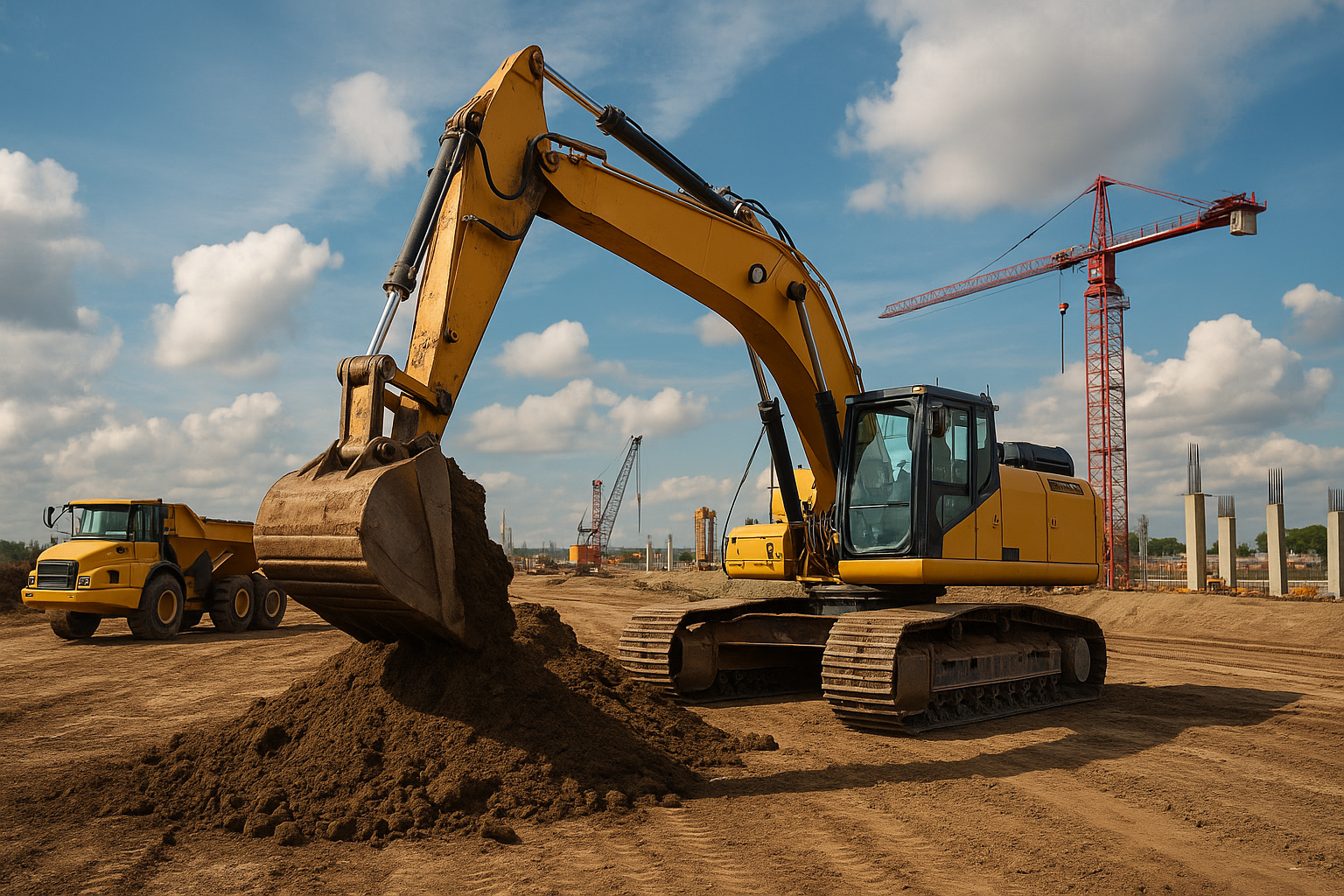
Discover How Technologies in Heavy Construction Transform Works, Optimize Processes, and Impact the Future of Infrastructure with Innovation and Efficiency.
Heavy construction is undoubtedly one of the most fundamental areas for a nation’s development.
In fact, large infrastructure projects such as roads, railways, bridges, dams, ports, tunnels, and airports require advanced techniques, specialized labor, and increasingly, the use of technology.
Therefore, over time, technologies in heavy construction have ceased to be just a differential and have become a requirement for those who want to ensure efficiency, safety, and competitiveness.
-
Abandoned house for 15 years disappears in the woods, shocks owner with unrecognizable scenery and is reborn in an intense transformation after almost 90 hours of work in just 10 days.

-
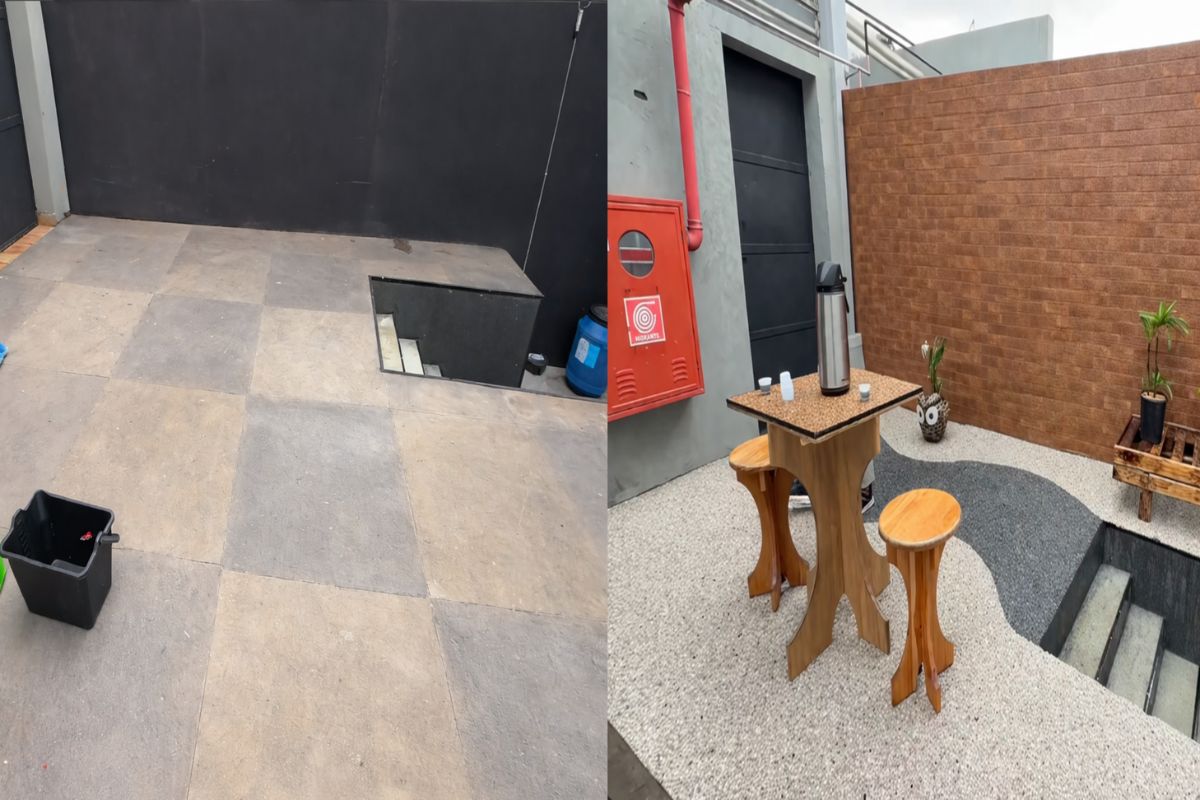
In just three hours, a natural stone floor transforms the entrance of the house with an organic effect, immediate drainage, and a sophisticated non-slip finish that doesn’t puddle water, dries quickly, and impresses with the final result.
-
‘Interlocking brick’ made of earth arrives in the construction industry with cost reductions of up to 40% on the project.

-
Espírito Santo will receive the largest engineering project in its history with the duplication of BR 262, which will have 50 viaducts, 28 bridges, and 2-kilometer tunnels cutting through the most challenging mountainous region of the entire state.


In this guide, we will explore how technological innovations have been transforming this area of civil engineering from its early steps to the present day.
Moreover, you will understand how to master this universe to successfully apply it in large-scale projects.
How Technology Has Always Been Part of Major Works
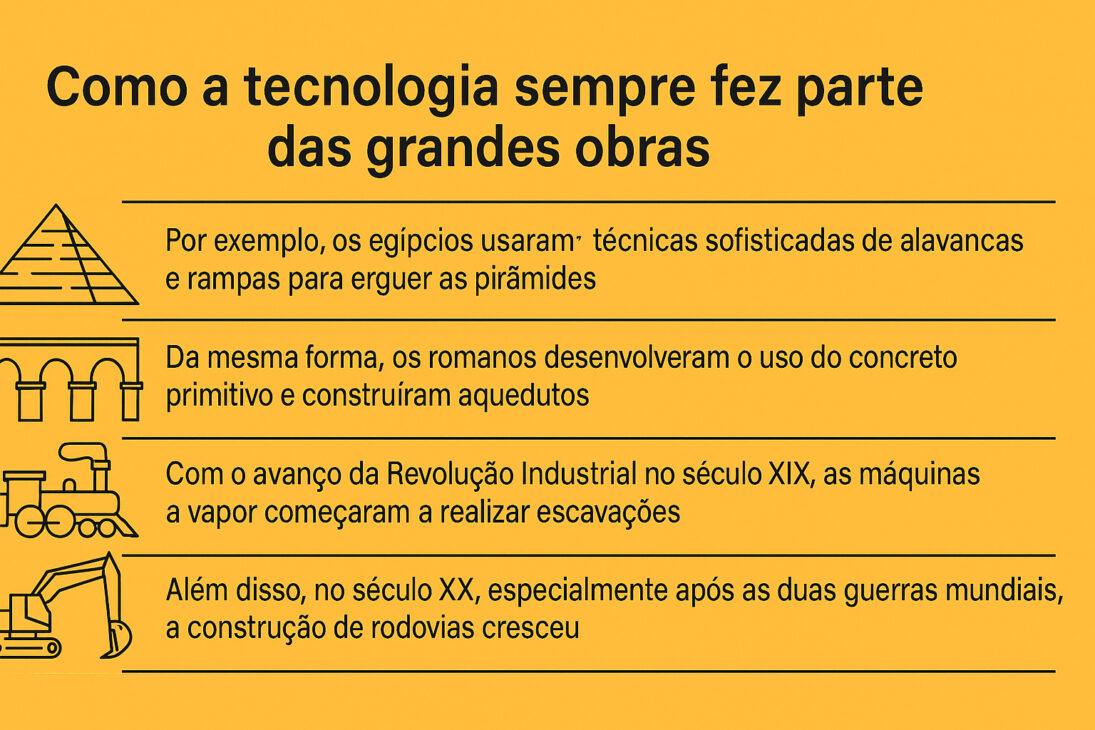
If we go back in time, we will realize that great constructions have always required innovation. For instance, the Egyptians used sophisticated lever and ramp techniques to erect the pyramids.
According to the Brazilian Institute of Geography and Statistics (IBGE), these methods date back to around 2500 B.C. and highlight the creativity applied to major works.
Similarly, the Romans developed the use of primitive concrete and built complex structures like aqueducts and paved roads.
The IBGE emphasizes that these constructions, still preserved in various countries, influence modern engineering to this day.
With the advancement of the Industrial Revolution in the 19th century, heavy construction made an important leap. Steam engines began to perform excavations, transport materials, and move earth.
Furthermore, in the 20th century, especially after the two world wars, the construction of highways, railways, and power plants grew significantly.
According to the Ministry of Infrastructure, the period between 1940 and 1970 was marked by intense modernization of Brazilian infrastructure, driven by equipment such as bulldozers, hydraulic cranes, and excavators.
As we entered the 21st century, the digital age brought new technologies to construction sites.
Modeling software, drones, sensors, and automated machines have begun to integrate into the routine of large contractors, offering more precision and speed to the sector.
Thus, this historical trajectory shows that, despite changes, the main objective of heavy construction has always been the same: to turn ideas and projects into solid, durable, and safe structures.
Today, technology facilitates this process and expands the possibilities of what we can build.
The Main Technologies in Heavy Construction Today
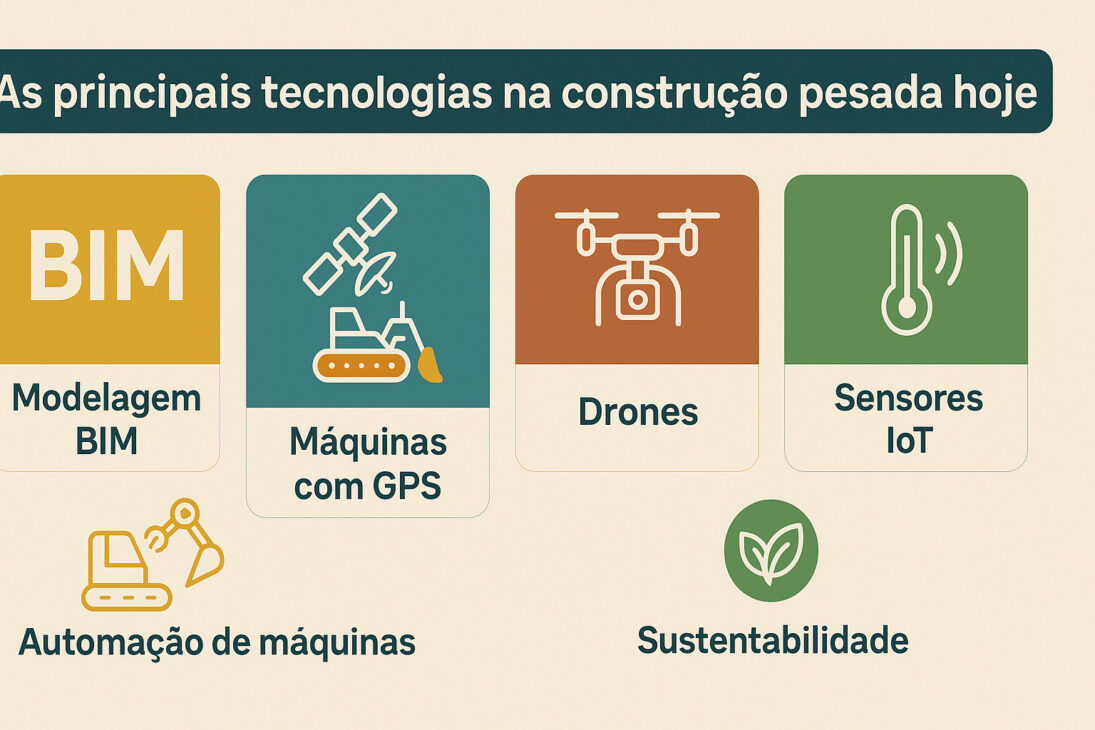
Currently, technologies in heavy construction operate at all stages of a project: from conception to final delivery.
For example, one of the most notable innovations is BIM, a platform that allows users to create three-dimensional models of works and visualize all structural, electrical, hydraulic, and finishing elements in advance.
BIM has been required in several public tenders since 2018, confirming its growing adoption in the sector.
Thus, BIM reduces execution errors, avoids rework, and improves cost and time control.
Additionally, another widely used technology integrates GPS with machines, allowing for excavation or land leveling with high precision. This, in turn, reduces material waste and improves operator performance.
Similarly, drones have become important allies in monitoring large areas, especially in linear works like roads and railways.
They map the terrain, track the progress of the work, and record aerial images in real time.
Moreover, companies use sensors and IoT (Internet of Things) devices to control the vibration of structures, measure the temperature of materials like concrete, and monitor equipment performance.
This technology makes construction sites smarter and safer, preventing failures that could jeopardize the entire structure.
Additionally, machine automation is advancing rapidly.
Equipment that operates partially or fully automatically, guided by artificial intelligence systems, is already in operation in various countries.
Therefore, this automation increases productivity and reduces risks by minimizing workers’ exposure to hazardous environments.
It is also worth highlighting technologies focused on sustainability, such as the use of recycled materials and the implementation of systems to optimize energy and water consumption on construction sites.
According to the Brazilian Environmental Labeling Program (PBE), these practices have received increasing incentives, aligning heavy construction with demands for sustainability.
What to Expect from Heavy Construction in the Coming Years
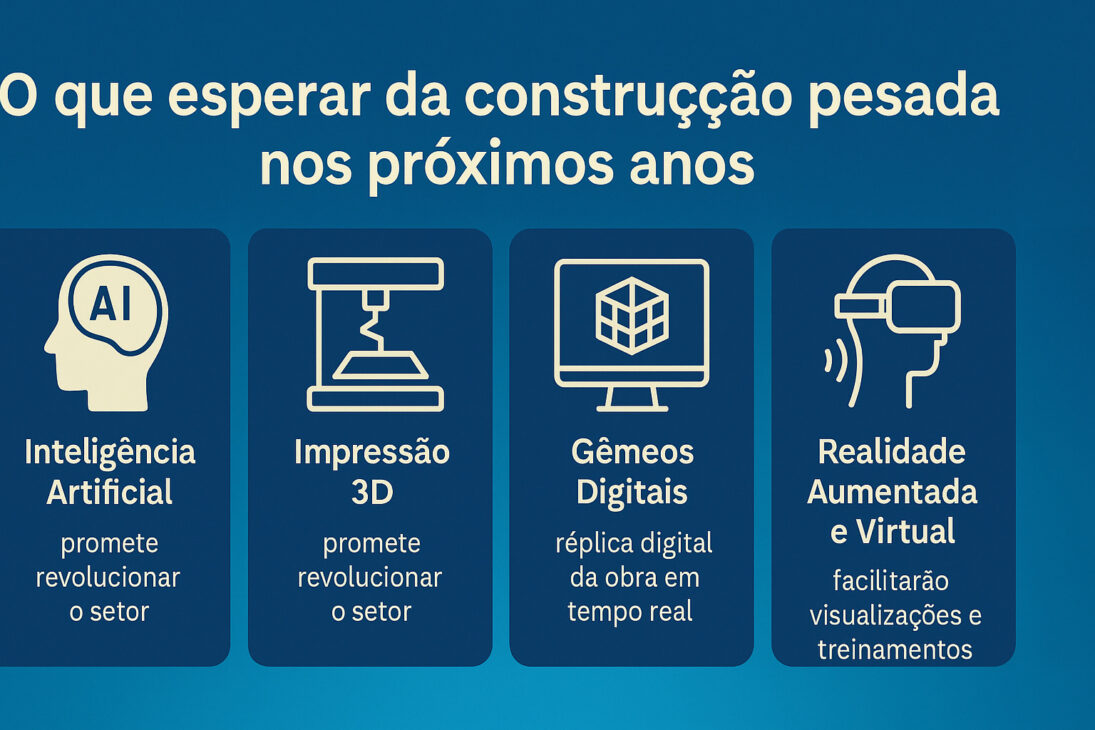
The future of heavy construction will undoubtedly be increasingly technological.
Many countries are already developing the use of artificial intelligence to predict structural failures, manage schedules automatically, and control robots on construction sites.
3D printing promises to revolutionize the sector. Although it is still in the experimental phase for large projects, it is already being used to print concrete structures at full scale.
This technique can drastically reduce production time and costs, in addition to allowing the creation of innovative and more resilient shapes.
Moreover, another trend involves digital twins, which create a real-time digital replica of the work.
This model simulates the behavior of the construction and allows for adjustments even after delivery, assisting in the maintenance and operation of complex infrastructures.
We also expect advancements in augmented and virtual reality that will facilitate training, project visualizations, and virtual inspections.
These technologies allow teams and clients to “enter” the work even while being outside of it, improving communication and decision-making.
With the advent of 5G connectivity, sharing data in real time will be even more efficient, enabling automated systems and smart devices to work together in an integrated and agile manner.
Mastering Technology Is a Matter of Survival
Heavy construction has always faced great challenges and the constant need for innovation.
Today, with so many technological possibilities at hand, the sector can reinvent itself and become more efficient, safe, and sustainable.
Mastering technologies in heavy construction has become a necessity for professionals and companies that wish to stand out.
Therefore, this requires technical knowledge, strategic vision, and willingness to change.
Those who understand the value of innovations and know how to apply them wisely will be ahead in building the future.











Seja o primeiro a reagir!