





 Português
  Inglês
  Espanhol
  5 min de leitura
  0 comentários


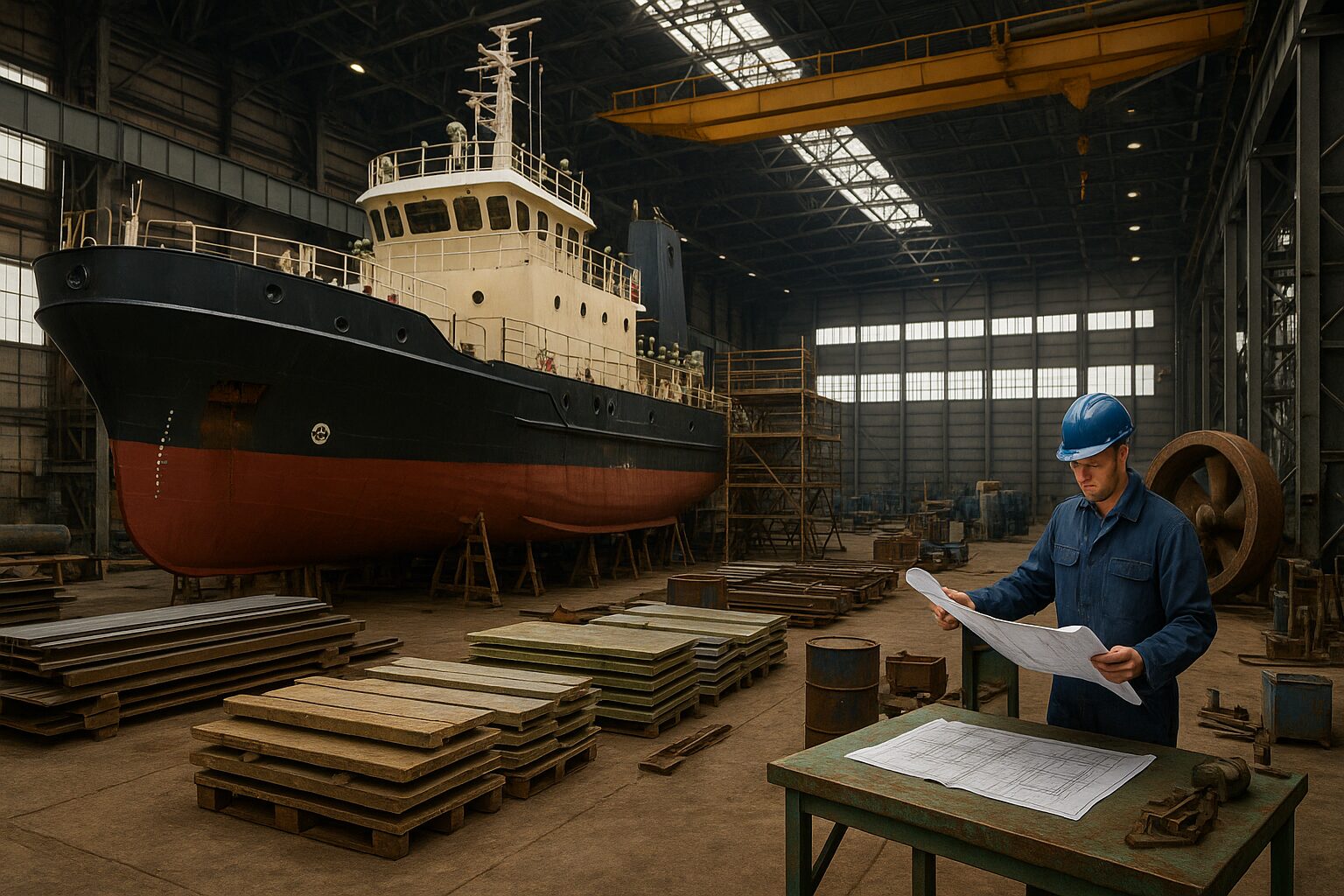
Understand The Main Materials Of The Naval Industry, Their Applications, Resistance And Evolution Over Time. A Complete And Timeless Content For Those Who Want To Know This Fundamental Sector.
The naval industry is one of the oldest and essential in humanity.
From the first wooden vessels, built thousands of years ago, to the modern ships made with advanced metal alloys, the evolution of naval industry materials accompanies the history of transportation, warfare, and global trade.
According to the National Institute for Space Research (INPE), archaeological records indicate that simple wooden vessels existed around 4,000 B.C.
-
Neither the USA nor China: a small European nation has become one of the largest maritime powers on the planet, controlling one of the largest merchant fleets in the world with thousands of ships and dominating the global transportation of oil and strategic cargo.

-
Scotland and the United Kingdom have created a new anchoring system that floats in the water without touching the seabed, after discovering that the current from a conventional anchor destroys up to 50 m² of seagrass meadow per event and that ship-damaged reefs showed no signs of recovery even ten years later.

-
Weighing 175,500 Tons, Measuring 345 Meters Long, and With Capacity for Over 4,300 Passengers, the Sun Princess Becomes the Largest Ship Ever Built by Princess Cruises and Attracts Global Attention for Its Huge Glass Dome Inspired by Santorini’s Architecture Installed on Top of the Vessel

-
TX-10, The Colossus of The Sea: Largest Lifter Ship in The U.S., With Two Giant Barges, 73-Meter Tall Structure, and Strength to Raise 7,500 Tons of Sunken Oil Rigs


In ancient civilizations, such as the Egyptians and Phoenicians, shipbuilding gained strategic and economic importance, marking the beginning of the development of the materials used.
To master this topic, it’s necessary to understand not only the materials used today but also the challenges that the maritime environment imposes on the construction and maintenance of vessels.
Moreover, the development of new technologies and the increasing demand for more efficient and sustainable ships have driven research and innovations in the area of naval materials.
Therefore, knowing the specific characteristics of these materials ensures the safety, durability, and performance of vessels in an increasingly competitive and rigorous global scenario.
A Historical Overview Of Shipbuilding

Firstly, it is important to highlight that the construction of vessels began with the use of wood, especially from trees like oak, pine, and cedar.
These materials were abundant, relatively easy to work with, and when properly treated, resisted for long periods in contact with water.
Thus, civilizations like the Egyptians, Phoenicians, Romans, and Vikings developed ship carpentry techniques that marked their time.
According to the National Maritime Museum of the United Kingdom, between the 1st and 15th centuries, wooden vessels were enhanced with resins and varnishes to increase their durability, allowing for longer and safer voyages.
As a result, vessels ceased to be merely means of transportation and became strategic tools in wars, exploration, and commerce.
However, with the Industrial Revolution in the 18th century, the need for more robust ships with greater capacity led to the introduction of metals in shipbuilding. Iron and, later, steel began to replace wood.
According to the U.S. Department of Energy (DOE), by the mid-19th century, the metallic shipbuilding revolutionized the industry, creating larger and more resilient vessels suitable for long ocean voyages.
This advancement enabled global trade to grow rapidly, as ships became safer and more reliable.
Main Materials Of The Modern Naval Industry
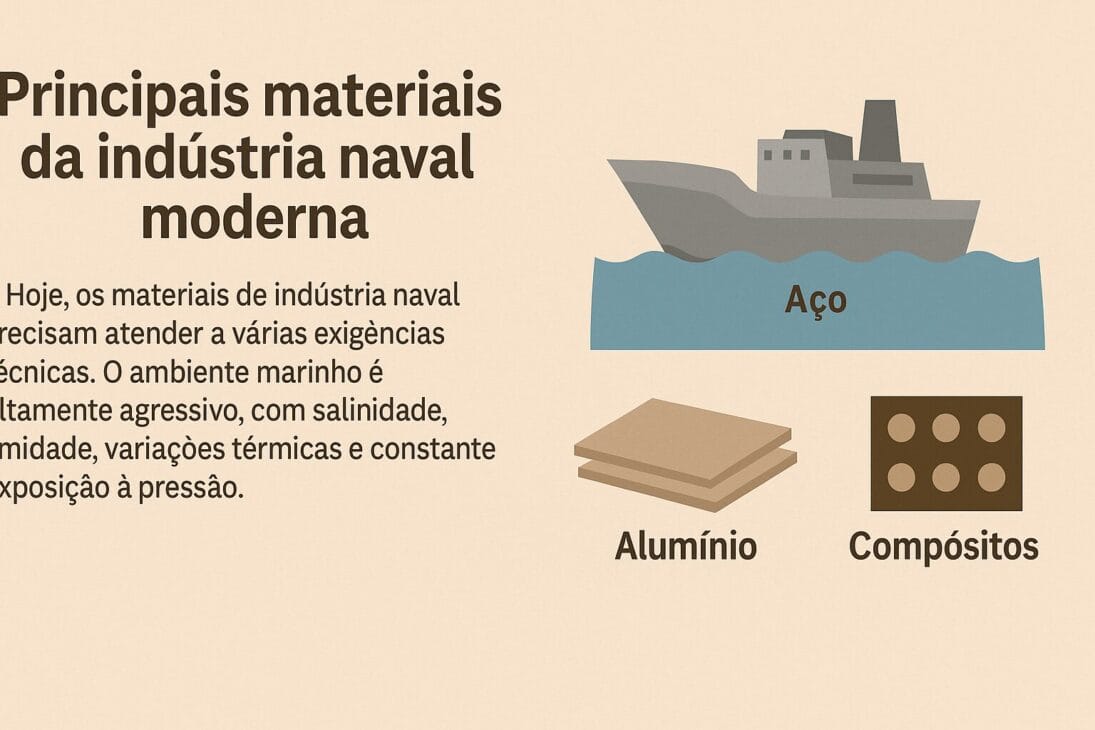
Today, naval industry materials must meet various technical requirements. The marine environment is highly aggressive, with salinity, humidity, thermal variations, and constant exposure to pressure.
Additionally, the materials used must provide durability, corrosion resistance, lightness, and ease of maintenance.
In this sense, naval steel plays a key role in the construction of modern ships.
This metal alloy, specially treated to withstand adverse sea conditions, appears in the hulls of vessels, in internal structures, and in mechanical supports.
Thus, its cost-effectiveness and mechanical resistance make it indispensable in naval engineering.
Furthermore, engineers choose among different types of naval steel, each with specific properties. Some have higher tensile strength, while others are more flexible or better resistant to corrosion.
In this way, this variety allows the ideal material to be applied in each part of the ship, ensuring safety and efficiency.
In addition to steel, other metallic materials are gaining space, such as aluminum, which is lighter and corrosion-resistant.
It primarily appears in smaller vessels, speedboats, and in components requiring weight reduction, such as superstructures.
According to the U.S. Naval Research Laboratory (NRL), the use of aluminum in shipbuilding has grown by more than 30% since the 1980s, especially in military and leisure vessels.
Finally, composites also play an important role. Formed by the combination of two or more materials, such as fiberglass or carbon with resins, they increase structural efficiency in specific parts of the vessel, bringing advantages such as lightness and greater design flexibility.
The Brazilian Institute of Naval Technology (IBTN) highlights that the application of composite materials has grown significantly in the last decade due to their properties and contribution to reducing fuel consumption.
Applications And Strategic Uses Of Materials

Each material serves a specific function within a vessel. While steel is used for the hull and main structures, aluminum appears in ladders, coverings, and movable parts.
Composite materials are used in propellers, cabins, and propulsion system components.
Additionally, materials such as special rubbers, technical fabrics, and reinforced plastics act in sealing, insulation, and internal comfort.
Depending on the type of vessel, the materials used vary. For example, cargo ships require high structural resistance, while luxury yachts value lightness and aesthetics.
Military vessels, in turn, incorporate stealth technology that demands special materials to avoid radar detection.
In addition to traditional applications, the naval industry is investing in smart materials that react to changes in the environment or pressure.
These materials increase the safety and performance of vessels and promise to revolutionize naval construction and operation.
The Importance Of Technical Knowledge
Mastering naval industry materials goes beyond knowing which are used. It is essential to deeply understand their properties, limitations, and application methods.
Naval engineers, technicians, and manufacturers constantly study new materials, track technological innovations, and apply creative solutions to solve daily challenges in the construction and maintenance of vessels.
Moreover, technical knowledge facilitates decisions in critical moments, such as choosing materials for repairs, replacements, or structural adaptations.
This directly impacts the safety of crew members, operational efficiency, and even fuel economy.
Continuous training and the exchange of experiences among professionals strengthen the development of the sector.
Therefore, courses, conferences, and partnerships with universities accelerate the application of new technologies.
Finally, whether for engineers, technicians, or sea enthusiasts, knowing the materials of the naval industry opens the doors to a rich, dynamic universe fundamental for the movement of the modern world.











Seja o primeiro a reagir!