





 Portuguese
  English
  Spanish
  4 min of reading
  1 comment


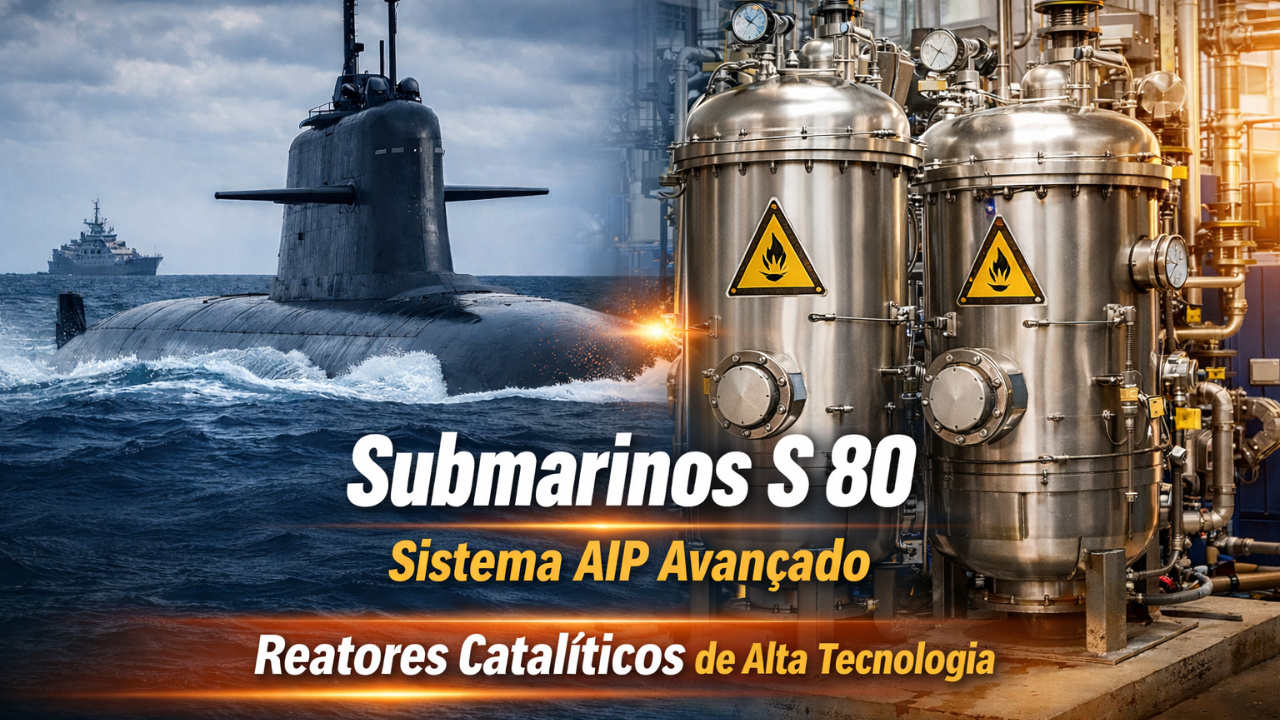


S 80 Submarines Gain Catalytic Reactors in AIP System, Technology That Increases Underwater Autonomy and Improves Safety Onboard.
The Spanish company Amper has completed the delivery of catalytic reactors intended for the atmospheric support system of the S 80 Submarines, developed by Navantia submarines, in Spain.
The equipment was supplied through the engineering firm Proes-OSL Iberia and will be installed on the S-83 “Cosme García” and S-84 “Mateo García de los Reyes” units.
The goal is to enhance the AIP System (air-independent propulsion) and increase Underwater Autonomy, allowing submarines to remain submerged for extended periods with breathable air onboard.
-
Around 7,000 jobs are expected to emerge in Navegantes with a new billion-dollar order from Petrobras, which closed R$ 11 billion in contracts to build four hybrid propulsion vessels equipped with underwater robots for the pre-salt layer at the Santa Catarina shipyard.

-
Uncrewed and over 1,000 tons, new warship targets future naval operations

-
Ship that departed from China on March 30 arrives in Salvador with 44 containers, 1,550 metal pieces, and over 800 tons of equipment, marking the beginning of the largest bridge over the sea in Latin America, a mega-project of 12.4 km that will use unprecedented technology on the continent.

-
While modern pilots respect a minimum altitude of 300 meters, a P-51 flew under the Eiffel Tower chasing a Bf 109 in 1944.


The project began in 2022 and has already received official certification after technical tests conducted by Navantia.
The new systems are responsible for eliminating potentially hazardous gases inside the vessel, reinforcing crew safety and contributing to longer submerged operations.
With this technological integration, the Navantia submarines advance in the strategy to enhance the operational capacity of the S-80 class, considered one of the most modern in Europe.
Catalytic Reactors Reinforce Safety in S 80 Submarines
The catalytic reactors delivered by Amper fulfill an essential function within the air revitalization system.
They operate in the removal of carbon monoxide (CO) and hydrogen (H₂), gases that can accumulate in the compartment where the AIP System operates.
To perform this task, the technology uses a process known as catalytic combustion.
This mechanism allows for the controlled neutralization of gases, transforming potentially harmful substances into less harmful compounds.
As a result, the internal environment remains within safe levels for the crew, which is fundamental for prolonged underwater missions.
Furthermore, maintaining air quality is a decisive factor for Underwater Autonomy, as it reduces the need to surface or ventilate the interior of the vessel.
AIP System: Technology That Allows Weeks Underwater
The AIP System installed on the S 80 Submarines uses a solution developed by the Spanish naval industry called BEST (Bio-Ethanol Stealth Technology).
This system generates hydrogen onboard through a reformer that uses bioethanol stored on the submarine. Then, hydrogen is combined with oxygen in fuel cells.
This process produces enough electricity to power various systems of the vessel while it remains submerged.
In this way, submarines can reduce their dependence on traditional batteries, significantly increasing their Underwater Autonomy.
While conventional submarines need to surface frequently to recharge energy, the AIP System allows for much longer periods of immersion.
Underwater Autonomy and Operational Discretion
According to Navantia, the BEST system was designed specifically to increase submerged endurance in different environmental conditions.
As a result, the Navantia submarines can reduce the need to interrupt operations for energy management or internal ventilation.
This feature increases the patrol area and improves discretion during missions.
The company even uses the term “Zero Indiscretion Coefficient” to describe this capability, indicating a lower likelihood of detection while the submarine remains in operation.
Therefore, the technological evolution of the AIP System is directly linked to the tactical efficiency of modern submarines.
What Modern S 80 Submarines Are Like
The project of the S 80 Submarines was conceived to meet the needs of prolonged oceanic operations.
The vessel is approximately 80 meters long and about 7 meters in diameter. When submerged, its displacement reaches nearly 3,000 tons.
Additionally, the submarine can exceed speeds of 19 knots underwater and operate at depths greater than 300 meters.
The highly automated system allows the vessel to be operated by a crew of 32 sailors, with additional space for eight onboard professionals.
Thus, this combination of technology and automation reinforces the role of the S-80 class as one of the most advanced submarine platforms being developed in Europe.
Technology Defining the Future of Underwater Autonomy
At first glance, the catalytic reactors may seem like just another component within the complex array of systems of a modern submarine.
However, this equipment is part of a broader naval engineering strategy aimed at prolonged immersion.
Each system integrated into the AIP System contributes to sustaining continuous operations without altering the submarine’s navigation profile.
As new units of the series are incorporated with these technologies integrated from the start, the S-80 program is expected to demonstrate all the potential of this architecture.
Thus, the Navantia submarines reinforce a clear objective of contemporary naval engineering: to continuously enhance Underwater Autonomy, ensuring greater discretion and efficiency in strategic missions.
See more at: Amper Delivers Catalytic Reactors to Navantia That Will Be Part of the AIP System for Submarines S-83 and S-84







Dá-lhe Espanha 🙏👍🥰💖🙌👏👏