





 Portuguese
  English
  Spanish
  5 min of reading
  11 comments


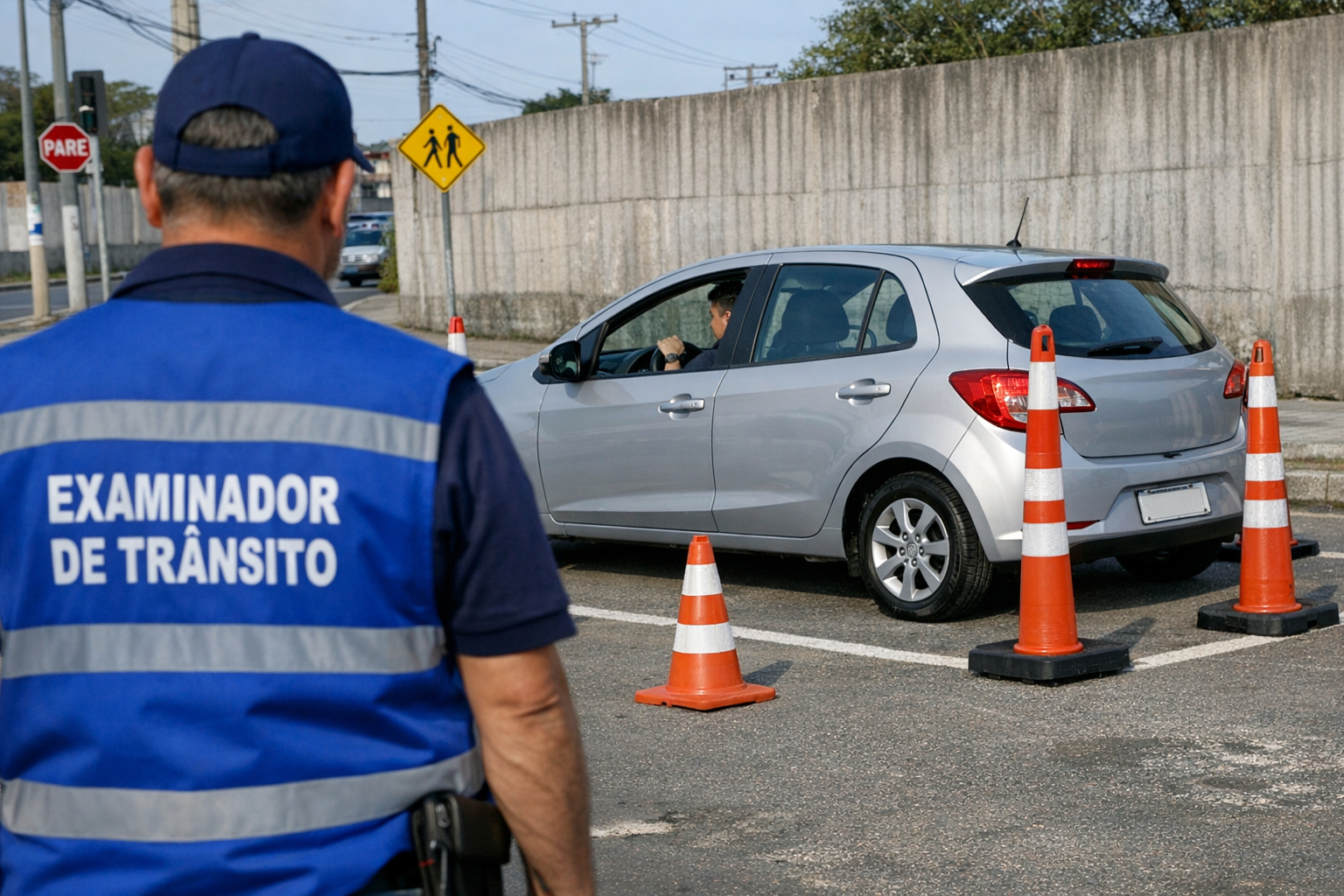


New Model of the Practical Driving Test Enters Into Force and Changes the Logic of Licensing in Brazil
The Contran Resolution No. 1,020/25 represents one of the largest transformations ever implemented in the process of driver training in Brazil. Published with immediate effect, the regulation profoundly changes the practical vehicle driving test, a decisive stage for obtaining the National Driver’s License (CNH). The official proposal is to make the system more accessible, flexible, and less bureaucratic, but in practice, the changes raise questions about standardization, oversight, and road safety.
The information was released by the Traffic Portal, which analyzed point by point the new text of the resolution and its direct impacts on candidates, driving schools, instructors, and the state Detrans themselves. Although the rule is already in effect, its effective application will depend on the operational capacity of each traffic agency, which may generate significant differences between states.
Furthermore, experts warn that the reduction of formal stages may further transfer responsibility to the practical test, which will now serve as the main filter of minimum skills for safe driving in Brazilian traffic.
-
The noise law will no longer be in effect at 10 PM starting in June with a new rule valid during the 2026 World Cup.

-
The Chamber opens a debate on driver’s licenses at 16 years old as part of a reform that includes around 270 proposals to change the Brazilian Traffic Code and may redesign rules for licensing, enforcement, and circulation in the country.
-
The new Civil Code could revolutionize marriages in Brazil with “express divorce” and changes that could exclude spouses from inheritance.
-
Banco do Brasil sues famous influencer for million-dollar debt and intensifies debate on delinquency, risks of seizure, and direct impact on Gkay’s credibility.


When Candidates Can Take the Practical Driving Test
Under the new rules, the practical vehicle driving test can only be taken after fulfilling two mandatory requirements. First, the candidate must pass the theoretical test. Second, there must be a record of the minimum required hours of practical classes in Renach (National Registry of Enabled Drivers).
For candidates for categories A or B, the system will only release the practical test after confirming at least two hours of practical classes, a significantly lower number than required in the previous model. This point is considered one of the most sensitive aspects of Resolution 1,020/25, primarily because it drastically reduces the minimum training time before the final evaluation.
In processes aimed exclusively at Authorization to Drive Moped (ACC), the flexibility is even greater. In these cases, the candidate may take the practical test immediately after passing the theoretical exam, without a minimum requirement for previously registered practical classes.
This change reinforces the role of the test as a central element of the process, but also broadens the debate about the sufficiency of the practical training offered before the evaluation.
Who Administers the Practical Test and How the Evaluation Process Will Work

The practical test remains under the responsibility of the traffic executive bodies or entities of the States and the Federal District, that is, the Detrans. The test must be conducted within the candidate’s home jurisdiction, on a route previously defined by the traffic agency itself.
Until the publication of the Brazilian Manual of Vehicle Driving Tests, as provided in the resolution, the Detrans may maintain their current routes and procedures, as long as they comply with the general guidelines of the new regulation. This means that, in the short term, the model may vary from state to state.
In the new format, the evaluation will follow more objective criteria. The candidate starts the test with zero points, and points are added for each infraction committed during the course. Each infraction generates a base point, multiplied by its specific weight:
- Minor infraction: weight 1
- Medium infraction: weight 2
- Serious infraction: weight 4
- Very serious infraction: weight 6
To pass the practical test, the candidate cannot exceed 10 points at the end of the test. The final decision rests solely with the examination board, which may also stop the test if it identifies technical incapacity or emotional instability that poses a risk to traffic safety.
The committee will be composed of three members, at least one of whom must hold a license equal to or higher than the category sought by the candidate. During the course, the candidate will be accompanied by a Detran representative, responsible for providing instructions, ensuring safety, and recording relevant occurrences for evaluation.
Electronic Monitoring, Vehicle Use, and New Attempts at the Practical Test
Another relevant point of Resolution 1,020/25 is the possibility of adopting electronic monitoring during the practical test. The use of this technology is conditioned to generating administrative efficiency gains and reducing operational costs.
If electronic monitoring is adopted, the candidate will have the right to full access to the recorded information, may use the data to contest the result, and, in some cases, the committee itself may evaluate the test remotely. If the vehicle used belongs to the candidate, the installation of the equipment must occur at no additional cost.
Regarding the vehicle, the practical test may be conducted using a car or motorcycle provided by the Detran, a vehicle belonging to the candidate, or even a vehicle from third parties. In all cases, the automobile must comply with the Brazilian Traffic Code (CTB) and the standards of Contran, without special adaptations beyond those already provided.
The new rule also maintains the possibility of multiple attempts. A failed candidate may retake the test as many times as necessary, with the second attempt able to be scheduled without an additional fee. There is also a provision for a new attempt on the same day, provided there is operational availability.
How to Execute a Perfect Parking Maneuver in Any Popular Car

According to Celso Mariano, director of the Traffic Portal and Tecnodata Educacional, the new model requires increased attention from public authorities. He believes that reducing stages does not necessarily mean improving training. “The practical test gains even more weight in this scenario because it becomes practically the only real filter of minimum skills for safe driving,” he evaluates.
He also warns that evaluating does not replace training. “If practical training is insufficient, the test tends to become just a survival test in traffic, and not a test of effective preparation,” he states.
As a result, the role of the Detran becomes even more strategic. It will be up to state agencies to guarantee adequate routes, clear technical criteria, qualified committees, and rigorous oversight to prevent distortions or trivialization of the test. Although the resolution is already in effect, states like Mato Grosso have chosen to suspend its application until local regulation is established.
Until the new model is fully structured, the CNH practical test becomes not only an examination but the main thermometer of road safety in the licensing process in Brazil.
Do you think the Detran in your state is prepared to apply the new model of the practical test with fair criteria and adequate oversight?









O Detran de Goiás disse que é protagonista e que já está na frente e até agora quase todos Detrans já estão realizando sob o novo formato, vamos aguardar.
Detran RN nao está preparado para aplicar esses testes já que não tem uma pista adequada para isso,deveria ser obrigado a todos Detran ter uma autopista com tudo o necessário para avaliação
Só que os carros do Detran tem revisão sempre,e carro que aprendemos na auto escola não tem