





 Portuguese
  English
  Spanish
  6 min of reading
  11 comments


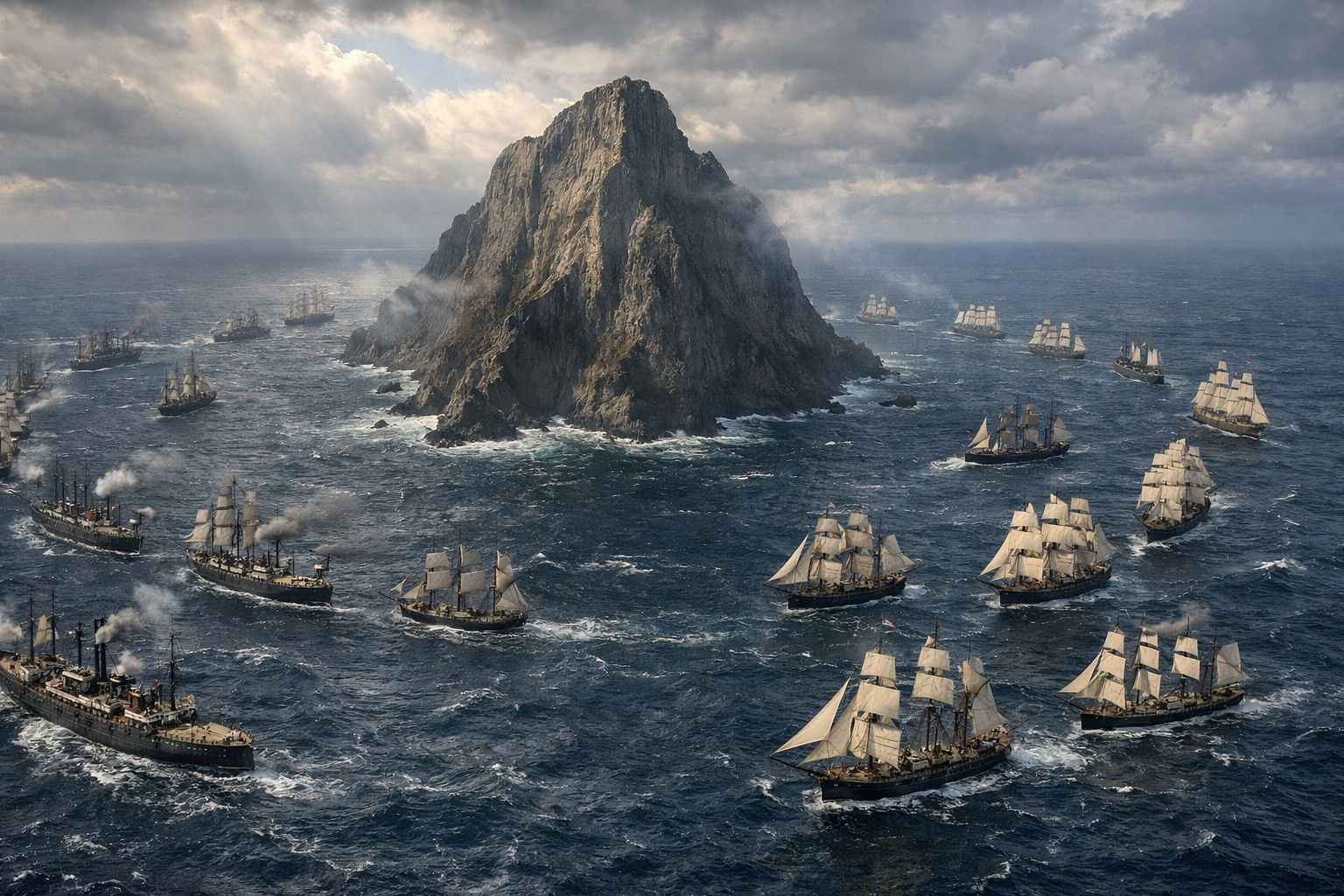


At The Peak Of European Imperialism, A Young South American Republic Used Historical Documents, Diplomatic Strategy, And International Law To Confront The World’s Greatest Naval Power And Preserve Its Sovereignty In The Southern Atlantic
July 1895. The Southern Atlantic crashed violently against black volcanic rocks more than 1,100 kilometers off the coast of Espírito Santo. Amid the ocean, isolated, inhospitable, and swept by constant winds, Trindade Island seemed just an irrelevant dot on the map. However, that month, it would become the center of one of the most silent — and most impressive — diplomatic victories in Brazil’s history.
When the fog lifted on the gray horizon, the steel silhouette of the British cruiser HMS Barracouta broke the solitude of the sea. For the Royal Navy, that island was not Brazilian. It was merely another piece available on the vast board of an Empire where the sun never set. Within minutes, boats were launched, soldiers disembarked, and the flag of the United Kingdom was raised at the highest point of the rock.
Without firing a single shot, England had taken Brazilian territory. The government in Rio de Janeiro was still unaware, but a diplomatic crisis of historical proportions had just been triggered.
-
Oldest tree on the planet reappears after 130 years of searches: Wattieza, 385 million years old, was 10 meters tall and had no leaves or seeds; Gilboa fossils in New York solved the mystery in 2007.

-
A 48-square-meter house assembled in hours with 4,000 bricks made of recycled plastic that does not absorb moisture, has natural thermal insulation, and costs less than 90,000 reais in a complete kit.

-
Luciano Hang revealed that Havan’s air fleet has already accumulated more than 20,000 landings, 10,000 flight hours, and 6 million kilometers traveled, and he says that without the planes, the company would never have grown so quickly.

-
A historical discovery in the Andes Mountains reveals a gold deposit valued at 770 billion reais hidden over 4,000 meters above sea level on the border between Chile and Argentina, and the whole world is watching.

This information was disclosed by the channel “Forgotten Legacy,” based on historical records, diplomatic documents, and official accounts from the period, revealing how a fragile and politically unstable republic was forced to confront an almost impossible dilemma: accept humiliation or confront the world’s greatest military power.
A World Dominated By British Cannons And The Real Reason Behind The Invasion

To understand the gravity of the episode, it is necessary to look at the international scenario at the end of the 19th century. It was the peak of European imperialism. England and France were dividing entire continents as if they were vacant territories. Africa was sliced, Asia was subjected, and the rule was clear: those with the largest cannons made the laws.
The Royal Navy controlled trade routes, strategic ports, and, above all, the most valuable technology of the time: underwater telegraph cables. They were the Victorian internet, responsible for transmitting financial information, military orders, and political decisions on a global scale.
Contrary to what many believe, the dispute over Trindade Island did not involve apparent natural resources. There was no visible gold, oil, or easy occupancy conditions. Potable water was scarce, and the terrain was hostile. The real interest lay on the seabed.
The British company Brazilian Submarine Telegraph Company intended to install a new cable connecting Brazil to Europe and Argentina. For this, it needed a relay station in the middle of the Atlantic, and Trindade Island offered the ideal geographical point. The problem was simple and decisive: the island already had an owner.
A Weakened Brazil, Pressured Internally And Cornered By The Greatest Power In The World
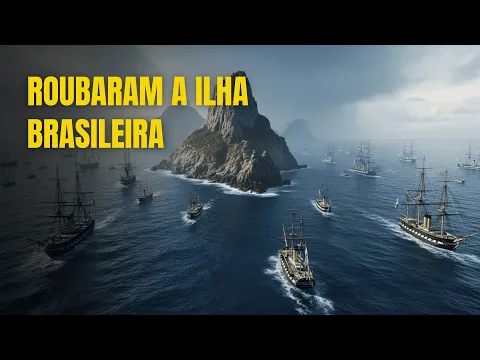

When the news of the occupation reached Rio de Janeiro months later, the impact was devastating. The Republic had been proclaimed just six years earlier, in 1889. The country was facing economic crises, political instability, and internal revolts, such as the remnants of the Federalist Revolution.
President Prudente de Morais, the first civilian to hold the position, governed a divided country with still fragile institutions. The Brazilian Navy was outdated, the cannons were obsolete, and any direct confrontation with the Royal Navy would mean a naval blockade, the bombing of the capital, and economic collapse within days.
On the streets, the popular reaction was immediate. Newspapers published fiery headlines, students gave speeches demanding war, and the British consulate was even stoned. National honor was wounded. However, behind the scenes of Itamaraty, the atmosphere was one of absolute silence and apprehension.
The government knew that reacting militarily would be suicide. At the same time, accepting the invasion would mean opening a dangerous precedent, reducing Brazilian sovereignty before foreign powers.
The Battle That Left The Cannons And Was Decided In The Libraries
Faced with the impasse, Brazil decided to play its last card. If it couldn’t win by force, it would win by intellect. The dispute left the sea and was transferred to archives, libraries, and ancient maps.
The Ministry of Foreign Affairs gathered jurists, historians, and cartographers with a clear mission: to prove, irrefutably, that Trindade Island was Brazilian long before any English presence. It was a race against time, as the British were already constructing structures on the island, trying to consolidate their possession.
The strategy was based on the principle of uti possidetis, a concept in international law that recognizes sovereignty based on historical and prior possession. The Brazilian team delved into 16th-century documents and found the decisive proof.
Historical records showed that the island had been discovered in 1502 by João da Nova, a Galician navigator in the service of Portugal — nearly two hundred years before the alleged visit of English astronomer Edmund Halley. Furthermore, ship logs, old maps, and colonial documents proved military visits, attempts at occupation, and continuous Portuguese and later Brazilian administration.
Brazil did not present a request, but an impeccable historical dossier, dismantling the British argument of “abandoned land”.
The Diplomatic Move That Pitted The British Empire Against Its Own Reputation
Even in light of the evidence, there was an evident risk: England could simply ignore the documents. After all, it held the largest naval fleet in the world. It was at this point that Brazilian diplomacy executed its smartest move.
Instead of confronting London with threats, Brazil proposed international mediation and suggested that Portugal — the power responsible for the original discovery — serve as a documentary reference. By agreeing to the debate, England found itself trapped by its own image as a civilized nation and defender of international law.
Rejecting clear historical evidence would mean presenting itself to the world as a pirate empire, something unacceptable to its diplomacy. After analyzing the documents, the British arguments crumbled.
In August 1896, just over a year after the invasion, the British government officially recognized Brazilian sovereignty over Trindade Island.
From Silent Victory To Strategic Importance That Echoes To This Day
On January 24, 1897, a Brazilian expedition returned to the island. There was no confrontation. The British sailors lowered the Union Jack, folded the flag, and left. Then, the Brazilian flag once again waved at the top of the rock.
Without firing a shot, without losing a soldier, Brazil made the greatest war machine in history retreat solely with documents, strategy, and historical knowledge.
The Importance of Trindade Island, however, did not end there. In 1914, during World War I, the area was the scene of a naval battle between the German ship SMS Cap Trafalgar and the British RMS Carmania. In World War II, the fear of Nazi submarine bases led Brazil and the United States to maintain a permanent garrison at the site.
Today, the island houses an advanced oceanographic post of the Brazilian Navy and grants the country a vast Exclusive Economic Zone in the Southern Atlantic, known as the Blue Amazon, essential for the exploration of oil, minerals, and strategic resources on the seabed.
The Trindade Island Crisis remains a timeless lesson: sovereignty is not maintained solely with weapons, but with intelligence, preparation, and mastery of one’s own history. Had Brazil accepted the invasion as a fait accompli, the country’s map would be smaller, and its geopolitical position much more fragile.








This story has nothing to do with Trinidad and Tobago, as the headline suggests.
Viva Catholic Brazil 🇧🇷. Please recite the rosary everyday, the rosary crushes all evils.
Hail Mary full of grace the Lord is with thee blessed art thou amongst women and blessed is the fruit of thy womb Jesus.
Holy Mary mother of God pray for us Sinners now and at the hour of our death amen. 🙏🙏🙏🙏
E o cabo submarino como gicou