





 Portuguese
  English
  Spanish
  6 min of reading
  0 comments


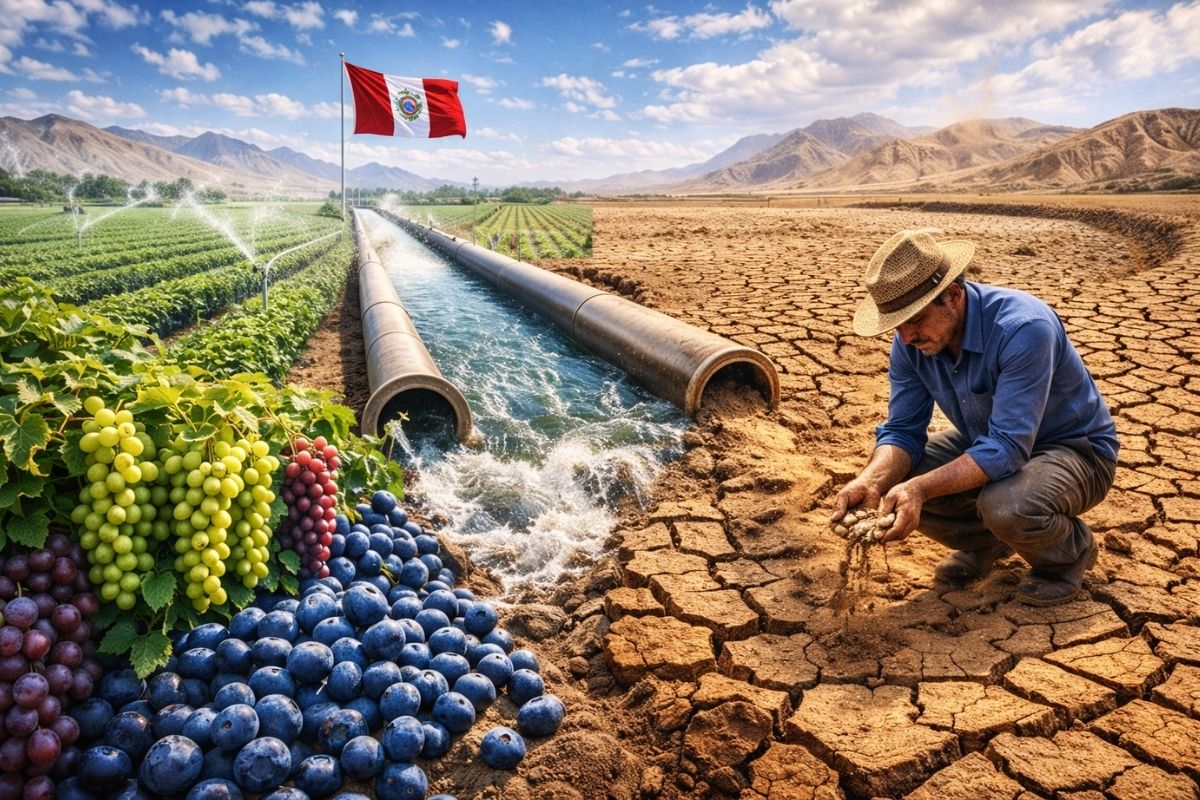
In A Few Decades, Peru Transformed Desert Into Agro-Exporting Power, Boosted Billion-Dollar Agricultural Exports, and Raised An Agricultural Empire In The Desert, Now Pressured By Water Crisis.
In A Few Decades, Peru Transformed Desert Into Agro-Exporting Power, Became A Leader In Fruits Like Grapes And Blueberries, And Attracted Billions In Exports, But Water Use Has Already Called The Future Of This Model Into Question.
The vast arid plains of the Peruvian coast, once seen as lost territory for agriculture, have been reshaped with irrigation, technology, and large investments. In less than thirty years, the country transformed desert into a power of fruits, creating an agricultural corridor that supplies high-value markets in North America, Europe, and Asia, while tensions are growing over the water crisis that could limit this advance.
How Peru Transformed Desert Into Fruit Power

Until the end of the last century, the region of Ica and much of the Peruvian desert coastline were synonymous with sand, wind, and extreme aridity.
-
The sugar-energy sector advances with agricultural technology, but agricultural productivity still raises concerns.

-
The eggshell that almost everyone throws away is made up of about 95% calcium carbonate and can help enrich the soil when crushed, slowly releasing nutrients and being reused in home gardens and vegetable patches.

-
This farm in the United States does not use sunlight, does not use soil, and produces 500 times more food per square meter than traditional agriculture: the secret lies in 42,000 LEDs, hydroponics, and a system that recycles even the heat from the lamps.

-
The water that almost everyone throws away after cooking potatoes carries nutrients released during the preparation and can be reused to help in the development of plants when used correctly at the base of gardens and pots, at no additional cost and without changing the routine.


The idea of producing high-value fruits on a large scale seemed unfeasible. The coastal desert was seen as a productive void, compressed between the Pacific and the Andes, with challenging soils and structural water scarcity.
This scenario began to change when the country realized it could occupy a strategic space in global supply windows.
The Peruvian coast has a climate described by experts as a kind of natural greenhouse, with constant brightness, little rain, and moderate temperature variations.
These conditions, combined with technology, allowed Peru to transform desert into a exporting power during the periods when the northern hemisphere faces climatic limitations, ensuring a competitive advantage in blueberries, grapes, mangoes, and avocados.
Economic Reforms, Risk, and Technology In The Field
The basis of this turnaround was built in the 1990s when the Peruvian government adopted economic reforms to recover a country marked by deep crisis and hyperinflation.
There were reductions in tariff barriers, incentives for foreign investment, and deregulation of processes.
Initially focused on mining, this more open environment allowed a new business elite to see the chance for profit in export-oriented agriculture.
Even so, no law could alone solve the biggest problem: the natural limitations of the territory. The low-fertility soils of the Amazon, the rugged geography of the Andes, and the lack of water in the coastal desert imposed real barriers.
It was in this context that large producers, less averse to risk, began to finance technologies still little known in the country, such as large-scale drip irrigation, precision water distribution systems, and water transfer projects.
Technical information indicates that this private investment enabled an unprecedented technological leap. Irrigation technologies transformed areas once considered unproductive into highly productive orchards, and what was once sand began to host rows of blueberries, grapes, and other high-value fruits.
The estimate is that the cultivable area of the desert has increased by about 30%, incorporating lands that were previously off the agricultural map.
New Varieties, Export Records, and Global Leadership
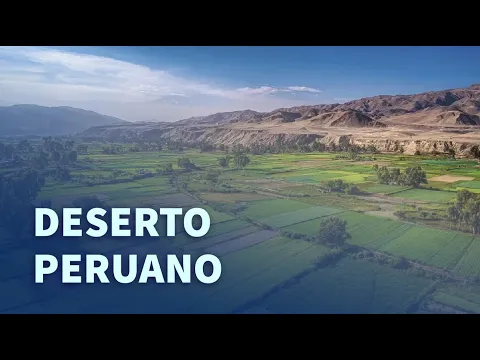

Besides the irrigation infrastructure, there was a decisive component in the genetic field. Producers and technicians began to work with varieties adapted to the local climate, with emphasis on blueberry cultivars adjusted to conditions of high brightness and low rainfall.
This opened up space for Peru to compete in historically dominated markets by traditional powers of fruit production.
According to data from the Ministry of Agrarian Development and Irrigation of Peru, agricultural exports grew between 2010 and 2024 at an annual average of 11%, reaching a record of 9.185 billion dollars in 2024.
During this period, the country established itself as the world’s largest exporter of grapes and blueberries, crops that practically did not exist in Peruvian territory until the 2000s.
In no time, Peru transformed desert into an agro-exporting power capable of influencing prices and supply in distant markets.
Regions like Ica and Piura became dynamic hubs of agribusiness. Market information indicates that, in 2024, agricultural exports began to represent 4.6% of Peru’s GDP, up from 1.3% in 2020.
In a short period, export agriculture elevated the relevance of the sector within the national economy and reinforced the country’s image as “orchard in the desert” geared towards the world.
Work, Income, and New Social Configuration In The Desert

The agro-export boom was not limited to macroeconomic figures. Economic data shows an increase in labor formalization, growth in average income, and higher professional qualifications in areas directly impacted by agricultural advancement.
Companies began to demand more specialized labor in management, logistics, quality control, and export.
However, the benefits were not distributed evenly. Small farmers face increasing difficulties to compete with large groups, pressured by higher labor costs and unequal access to water.
With the appreciation of land in irrigated regions, many small owners opted to sell their land to large companies, reshaping the social and land structure of the coast.
Despite these tensions, local families also reap indirect gains, especially through the inclusion of their members in the agro-industry labor market.
The same movement that transformed desert into agricultural power also profoundly reconfigured the lives of those who previously depended on subsistence economies.
The Water Crisis That Threatens The Agricultural Empire
If agriculture transformed the desert, it also opened a serious crisis around water. Ica, one of the driest regions in Peru, hardly receives significant rainfall. The dependence on the underground aquifer is total, both for the population and for large farms.
Information compiled by local organizations indicates that many human settlements rely on water trucks for potable water, while large companies rely on deep wells, reservoirs, and advanced irrigation systems.
The growing perception among residents is that of imbalance in access to a resource that is becoming increasingly scarce.
Field reports indicate that, in rural areas, the water table that was once reached just a few meters deep now requires excavations of dozens of meters, making drilling unfeasible for small producers.
In parallel, recurring complaints point to difficulties for inspections by the National Water Authority, as private properties limit access to areas where there are possibly irregular wells.
Experts warn that crops intended for export, such as grapes for Peruvian pisco and other high-value fruits, require large volumes of water.
In practice, Peru ends up exporting water in the form of fruits and derivatives, which intensifies the debate on water justice and supply security.
In 2011, the National Water Authority had already signaled an imminent risk of over-exploitation of the aquifer, recommending more stringent monitoring.
A Successful Model Under Test
As the competition for water becomes more visible, there is a growing consensus that the current model needs to be adjusted.
Studies and diagnostics converge on the need to balance Peru’s role as an agro-exporting power with the protection of ecosystems and human supply in desert regions.
Field information suggests that without effective water management, the very economic engine of Ica and the entire agro-export corridor of the coast could collapse.
The same country that transformed desert into fruit power now faces the challenge of preventing water scarcity from destroying this advance.
The issue is increasingly prominent in electoral campaigns and public debates, but structural solutions have yet to be fully implemented.
The Future Of Those Who Transformed Desert Into Power
Peru built, in a few decades, one of the most impressive agricultural empires in the world, using technology, irrigation, and private investment to reassign a territory once viewed as unproductive.
By transforming desert into agro-exporting power, the country proved that the combination of favorable climate, engineering, and capital can redrawing entire agricultural maps.
But this success comes with a central dilemma: without robust water management policies, the model may become unviable in the long run.
The balance between external competitiveness, social justice, and environmental sustainability will be the factor that defines whether this green empire continues to grow or becomes a victim of its own advancement.
After understanding how Peru transformed desert into the fruit power, what do you think should come first: limiting agricultural expansion to protect water or investing in new technologies to produce more with fewer water resources?








-

-

-

-

-

11 pessoas reagiram a isso.