





 Portuguese
  English
  Spanish
  3 min of reading
  0 comments


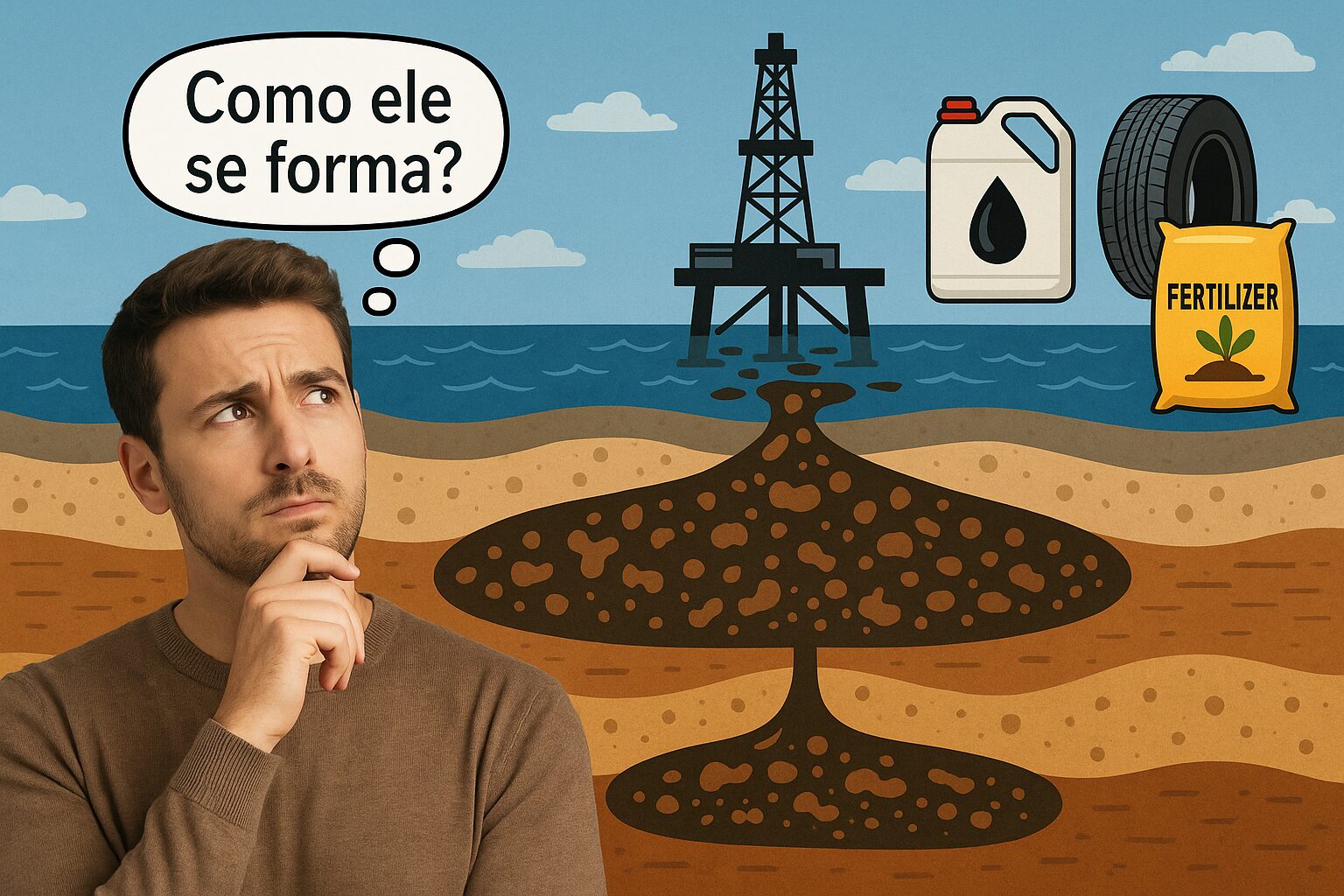
From the Depths of the Oceans to Major Powers: Understand How Oil Is Formed, Its Uses in Daily Life, and Why It Still Dominates the Global Energy Matrix
Oil is one of the main sources of energy today. Its role goes far beyond the fuel that powers cars and airplanes. It is the base for thousands of everyday products, from the plastic industry to fertilizer production. However, despite all its importance, oil is also a non-renewable resource and highly polluting.
How Is Oil Formed?
The formation of oil occurs in very specific locations on the planet. It arises from the accumulation of carbon-rich organisms that settle at the bottom of the oceans.
Over time, this organic matter is covered by sediments and settles into porous rocks, such as sandstone. For this process to occur, an environment with low oxygen, adequate pressure, and temperatures between 65° and 75°C is necessary.
-
Lula reveals a masterstroke by Petrobras to undo a deal made by Bolsonaro, which involves the return of an important refinery that currently produces less than half of what was expected and makes Brazil dependent on international diesel.
-
A study confirms that the natural gas sector will reduce greenhouse gas emissions in Brazil by 0.5% and accelerate the energy transition by 2026.

-
Petrobras implements a severe adjustment and confirms a 55% increase in the price of aviation kerosene with a proposal for installment payments for the companies.

-
The rise in oil prices could ensure an extra revenue of R$ 100 billion for the Federal Government, indicates a recent economic study.


These conditions allow organic matter to be transformed, over millions of years, into a viscous material known as crude.
This initial stage of crude oil is composed of hydrocarbons — structures formed by atoms of hydrogen and carbon. This crude slowly moves between layers of porous rocks until it encounters a barrier, such as an impermeable rock, where it becomes trapped.
Extraction and Characteristics
To bring oil to the surface, it is necessary to drill through the rocks that block its path. Then, specialized equipment pumps the material until it can be utilized.
Visually, oil has a dark appearance, is viscous, and has a strong odor. Despite these simple characteristics, it plays an essential role in modern society.
Oil Derivatives and Uses
Oil is used in various ways. In addition to fuels like gasoline and diesel, it is also found in products such as plastics, rubbers, paints, and fertilizers. Therefore, its presence is constant across several industrial sectors.
This versatility ensures that oil continues to be, even today, the primary source of energy on the planet. Countries with significant oil reserves, such as Saudi Arabia, Russia, and China, play a strategic role in the global economy.
At the consumer end, the largest buyers are the United States, China, and Japan.
Geological Migration Process
The path to oil extraction also involves two processes known as primary migration and secondary migration.
In primary migration, oil forms in the sedimentary rock and begins to move to upper layers. In secondary migration, it shifts until it finds an impermeable rock, where it remains trapped until discovered and extracted.
Summarized Stages of Formation
The formation of oil can be divided into four stages:
- Depositing and accumulating organic matter at the ocean floor, forming sedimentary basins.
- Action of microorganisms, pressure, and heat over millions of years.
- Infiltration into porous rocks and movement to areas of lower pressure.
- Trapping in fissures or pores of rocks, forming reserves.
Last Relevant Information
Despite advances in renewable sources, oil remains the economic backbone of many nations. Dependence on this resource continues to influence global geopolitics and the direction of the energy industry.
With information from Curiosity Site.









Seja o primeiro a reagir!