





 Portuguese
  English
  Spanish
  5 min of reading
  0 comments


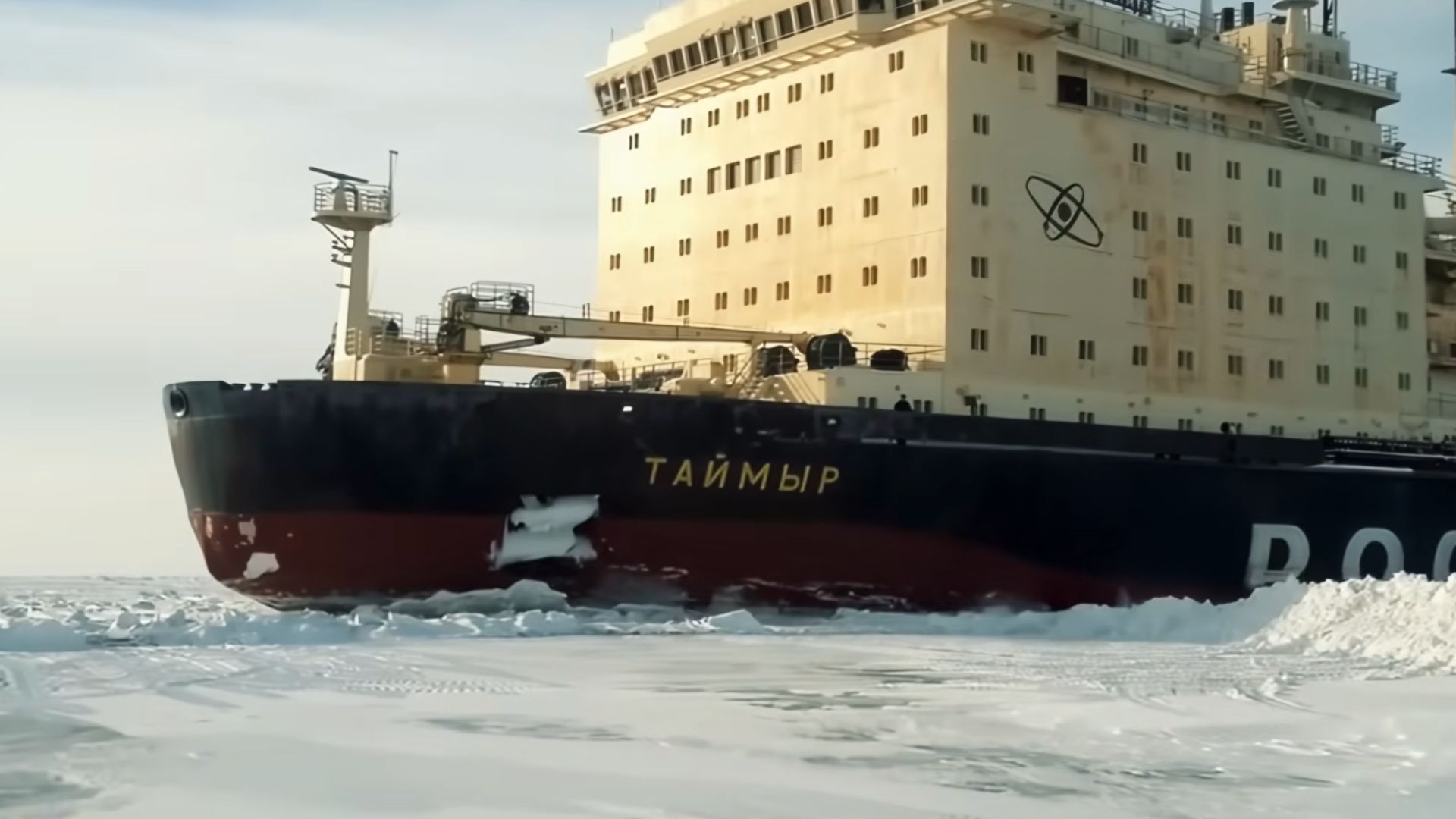
Understand Why These Giant Vessels Can Break Through Layers of Up to 3 Meters Thick, Operate at -35 °C, and Reduce Maritime Routes by Nearly 40%, Transforming Global Trade and Arctic Geopolitics
During Winter, ice nearly completely covers the Arctic Ocean and reaches, on average, 2.5 meters thick, easily exceeding 3 meters. In the face of this extreme scenario, an inevitable question arises: how does an icebreaker ship work? After all, not just any vessel can traverse ice blocks larger than a house, operate in temperatures dropping to -35 °C, and maintain a constant speed.
The information was released by “Energia Inteligente,” according to content published and supplemented by technical analyses of polar naval engineering. Furthermore, recent data shows that Russia leads the development of these vessels, particularly in the nuclear category.
But, after all, what makes these machines so impressive?
-
Friends have been building a small “town” for 30 years to grow old together, with compact houses, a common area, nature surrounding it, and a collective life project designed for friendship, coexistence, and simplicity.

-
This small town in Germany created its own currency 24 years ago, today it circulates millions per year, is accepted in over 300 stores, and the German government allowed all of this to happen under one condition.

-
Curitiba is shrinking and is expected to lose 97,000 residents by 2050, while inland cities in Paraná such as Sarandi, Araucária, and Toledo are experiencing accelerated growth that is changing the entire state’s map.

-
Tourists were poisoned on Everest in a million-dollar fraud scheme involving helicopters that diverted over $19 million and shocked international authorities.


How the Icebreaker Ship Really Breaks Through Blocks of Up to 4.1 Meters
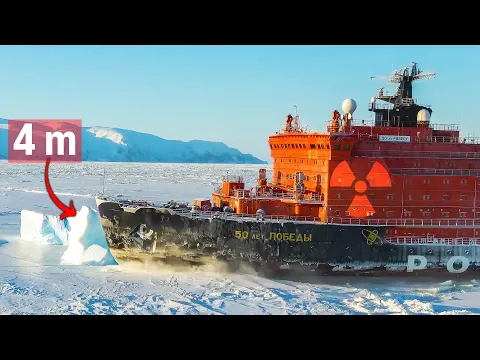

The operation of the icebreaker ship involves principles of structural engineering and materials physics. Unlike a conventional ship, which has a bulb at the bow to reduce wave resistance, the icebreaker eliminates this component. This is because, upon encountering a thick block, a regular ship would simply crash head-on without managing to break the frozen layer.
The icebreaker operates in two main ways.
First, when striking the ice head-on, the hull applies an axial compressive force. This pressure increases the bending stresses on the block. Since ice exhibits a certain elastic behavior—due to the molecular structure of water—it can bend up to its elasticity limit. When this limit is exceeded, buckling occurs, and the ice breaks.
However, when the thickness is greater, especially above 3 meters, the second technique comes into play: the ship slides and rises over the ice. At this moment, the weight of the vessel generates a tremendous vertical force downward, flexing and breaking the frozen layer with much less effort than during a head-on impact.
In some cases, the ship needs to reverse and advance repeatedly until it can completely break the surface.
In the case of more advanced models, like the Russian project that can break through 4.1 meters of thickness at a constant speed of 3.7 km/h, the power involved is impressive.
Reinforced Structure, Special Steel, and Operation at Extreme Temperatures

To withstand continuous impacts and severe temperatures, the hull receives significant structural reinforcements. The Arctic water has an average temperature of -1.8 °C, while the air can reach -25 °C to -35 °C in winter.
Therefore, the steel used must be high strength, as the material becomes more brittle under extreme cold. Additionally, the hull features a double bottom and side walls, ensuring greater structural safety.
Another essential detail lies in the angles of the bow. They need to be as small as possible concerning the waterline, facilitating sliding over the ice. The shape can vary between square, V-shaped, or “spoon”—the last considered the most efficient currently.
Some models also feature:
- Ice knife under the hull
- Azimuth thrusters that rotate 360 degrees
- Air bubble systems to reduce friction
- Reinforced propellers that also chop ice
This bubble system pumps a large volume of compressed air to the bottom of the hull. As the bubbles rise, they create a current that reduces friction and prevents ice from sticking. If the ship gets stuck and the water around it freezes, the system can free the vessel in about 10 to 20 minutes.
However, all this efficient design on ice reduces hydrodynamic efficiency in open sea. Therefore, engineers often need to balance polar performance and conventional ocean navigation.
Why Do Nuclear Icebreakers Dominate the Arctic?
Energy generation is another determining factor.
While many models use a diesel-electric system, where the diesel engine powers a generator that feeds electric motors, Russia heavily invests in nuclear propulsion.
And the reason is simple: autonomy.
A nuclear icebreaker can operate for over 7 years without refueling, limited only by food, which lasts about 6 months and can be replenished by helicopter. An emblematic example was the ship Arktika, which in 2008 remained 357 days without entering a port.
In addition, energy efficiency is impressive. A Russian nuclear ship of 55.2 megawatts would consume more than 100 tons of fuel per day if powered by diesel. However, by using nuclear energy, it consumes less than half a kilo of uranium on the worst day of intense operation breaking through ice nearly 3 meters thick.
Project 22 220, currently the most powerful in the world, has 60 megawatts of power on the shaft and maintains a constant speed of 13.7 km/h breaking through ice of up to 3 meters. The new project 10, on the other hand, promises 120 megawatts, double the power, described as up to 10 times stronger than Russian diesel models.
Impact on Maritime Routes and Global Trade

The growing interest in Arctic routes is explained by the significant reduction in distances.
For example:
- Rotterdam (Netherlands) → Yokohama (Japan) via Suez Canal: 20,700 km
- Via Northwest Passage: 14,000 km
- Via Northern Sea Route: 12,800 km
This reduces travel time from 46.7 days to 31.5 days or even 28.9 days, depending on the route—a savings of up to nearly 20 days.
After the grounding of the Ever Given ship in 2021 in the Suez Canal, interest in Arctic routes increased even further. Additionally, it is estimated that the Arctic contains 13% of the undiscovered oil and 30% of the natural gas, as well as minerals such as gold, silver, titanium, graphite, and uranium.
Currently, Russia leads with 75 icebreakers in operation, with 5 nuclear and 15 under construction, of which 5 are also nuclear. In comparison:
- Finland: 12
- Canada: 11 (plus 6 planned)
- China: 8 (including 2 heavy ones)
- United States: 1 heavy (Polar Star, from 1976) + 3 smaller ones
Brazil, in turn, has the Ary Rongel (up to 80 cm of ice) and the Almirante Maximiano (up to 40 cm), but no dedicated icebreaker.
Conclusion: Extreme Engineering for One of the Most Hostile Environments on the Planet
The icebreaker combines physics, structural engineering, advanced metallurgy, and high-power energy systems. It compresses, flexes, slides, rises, and literally crushes the ice to make way.
At the same time, it transforms trade routes, strengthens geopolitical strategies, and redefines the future of polar navigation.
Now I ask you: would you have the courage to embark on a months-long journey facing ice up to 4.1 meters thick in the middle of the Arctic?










-

2 pessoas reagiram a isso.