





 Português
  Inglês
  Espanhol
  9 min de leitura
  0 comentários


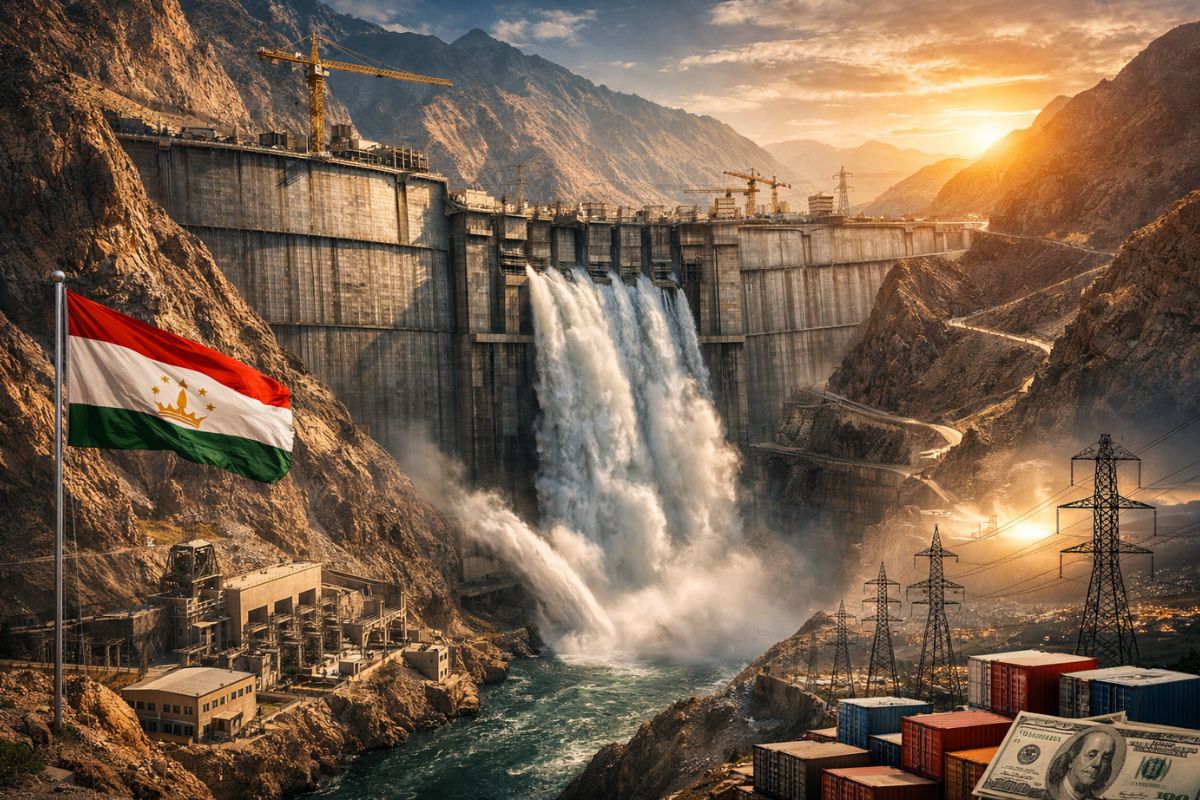
Designed in the Soviet era, interrupted by civil war and resumed as a national mission, the highest dam in the world concentrates the hope of a country without sea, without oil, and with severe winter, trying to transform rivers, altitude, and internal sacrifice into electricity, economic stability, and lasting regional geopolitical weight.
The highest dam in the world has become much more than an infrastructure project for Tajikistan. In a small, mountainous country with no sea access and no significant oil and gas reserves, it has come to represent a concrete attempt to face severe energy shortages, reduce external economic dependence, and reorganize its destiny based on what the territory abundantly offers: rivers and natural elevation.
At the same time, the grandeur of the project explains why it generates so much expectation and apprehension. What is at stake is not just a 335-meter dam, planned to generate 3,600 MW, but the possibility of converting a historical fragility into a strategic advantage. If it works as the country hopes, Rogun could change Tajikistan’s position in Central Asia; if it fails, it could deepen the financial, political, and regional risks that have accompanied the project for decades.
A Country Surrounded by Mountains and Pressed by Energy Shortage
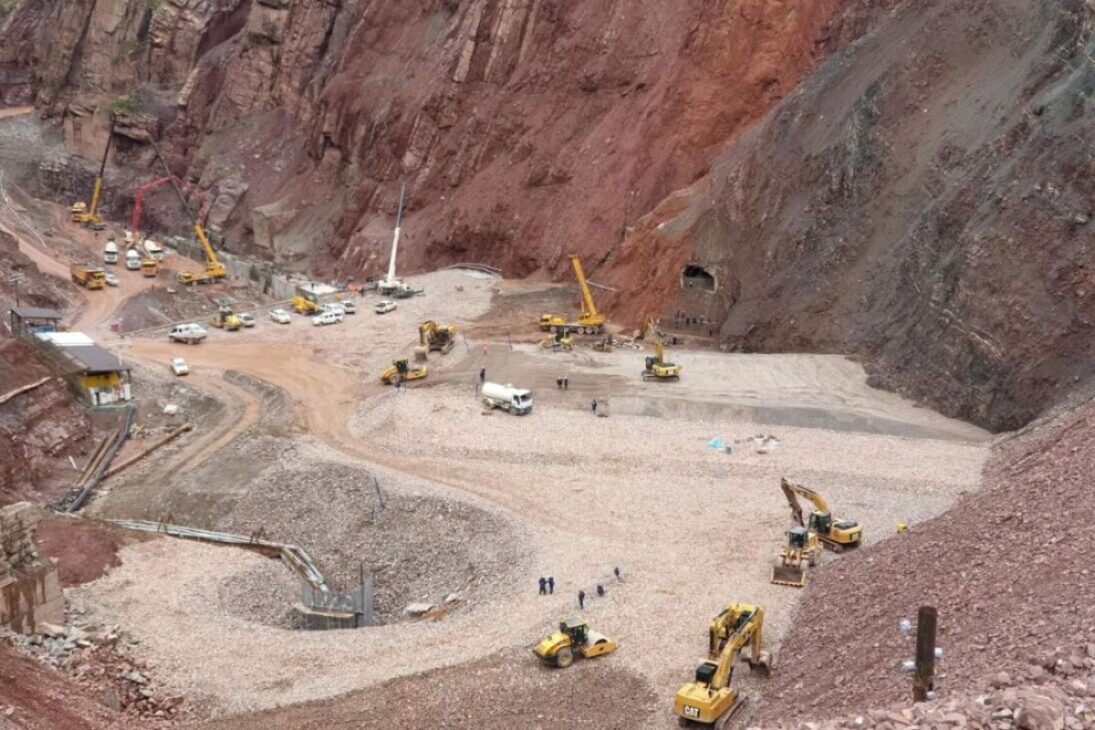
To understand why Tajikistan decided to invest in the highest dam in the world, one must start with the country itself. It is a nation marked by extreme terrain, with more than 90% of its territory covered by mountains, no access to the sea, and no fossil energy base comparable to its neighbors. Instead of oil or gas on a large scale, what exists there are rushing rivers, narrow valleys, and a geography that favors hydroelectric generation.
-
With more than 635,000 doctors, Brazil sees competition increasing in large cities, and recent graduates are competing for shifts at an accelerated pace while the countryside still faces shortages.

-
The world’s first octopus farm wants to open in the Canary Islands and is already provoking an international reaction: the plan aims to produce 3,000 tons per year.

-
Drought may be creating stronger superbugs in the soil and helping antibiotic resistance reach hospitals, warns a study highlighting a problem that could grow alongside extreme weather.

-
The biggest scam in history: Napoleon’s France deceived the United States by selling them a territory that was Spanish.


This natural landscape intersects with a persistent economic vulnerability. In some years, remittances sent by workers emigrating to Russia represented more than 30% of the national GDP, a clear sign of external dependence. In winter, when demand rises and supply becomes insufficient, power cuts can reach up to 12 hours a day. It is not just a matter of domestic discomfort; it is a structural limitation affecting hospitals, heating, production routines, and social stability. In this context, building a large power plant ceased to be merely a technical plan and became seen as a national necessity.
The dam is still under construction and has not been completed. The main body of the dam is expected to reach its final height (335 meters) around 2029, with the total filling of the reservoir planned to occur by 2036. The project began supplying energy in 2018.
The Soviet Origin of a Project Designed to Challenge Limits
The Rogun dam did not originate as a recent response to the energy crisis. Its origin dates back to the Soviet era when the Soviet Union sought to consolidate power through mega-projects capable of demonstrating dominance over nature and industrial capability. In the 1960s, engineers identified the Vakhsh River as one of the most promising sites in the world for hydroelectric generation, thanks to its narrow valley, high rocky walls, and significant drop in elevation.
In 1976, the project was officially launched with an ambitious goal: to build a structure that would surpass all others in height. The target of 335 meters placed Rogun above any dam ever built, including Nurek, also in Tajikistan, which reaches 300 meters. Construction began with tunnel excavations, mobilization of workers, and transformation of the valley into a vast construction site. However, the dissolution of the Soviet Union in 1991 abruptly halted this advancement. Tajikistan became independent, plunged into a civil war that lasted until 1997, leaving more than 50,000 dead, while the project was abandoned for decades. The promise of greatness was paralyzed precisely when the country needed the capacity to complete something of that scale the most.
From Water Rivalry to Financing Turned into a National Cause
When Tajikistan decided to resume the project in the 2000s, resistance came not only from financial limitations but also from the geopolitics of water. The Vakhsh River flows into the Amu Darya, a vital axis for agriculture in Uzbekistan, a country heavily dependent on this water system. The prospect of a reservoir with a capacity of 13 cubic kilometers heightened fears that controlling the river’s flow could affect irrigation, food production, and the safety of entire populations downstream.
This impasse raised the project to a sensitive regional level. In 2012, then-Uzbek president Islam Karimov stated that water disputes in Central Asia could lead to war. This phrase encapsulated an old fear, aggravated by the memory of the degradation of the Aral Sea, devastated by decades of disastrous water management. For years, Uzbekistan pressured multilateral organizations, complicated financing, and reinforced the isolation of the project. The World Bank only agreed to get involved after demanding independent studies on environmental and regional impact, in a lengthy and costly process.
Without easy access to external capital, the Tajik government resorted to a politically delicate solution. In 2010, President Emomali Rahmon launched a national campaign for the purchase of shares in Rogun. Public officials, teachers, doctors, and military personnel were pressured to contribute, and in many cases, this was treated as an obligation. There were criticisms from human rights organizations, which pointed out the coercive nature of this measure. Still, the mobilization showed the symbolic place that the highest dam in the world came to occupy in the official discourse: not as a simple project, but as a project of economic survival and national affirmation.
This scenario began to change after 2016, with the death of Karimov and the rise of Shavkat Mirziyoyev to power in Uzbekistan. The new stance opened the door for more pragmatic negotiations on water and electricity, reducing some regional tension. Consequently, institutions like the European Bank for Reconstruction and Development, the Asian Development Bank, and private investors began to view Rogun from a different perspective. Construction gained new momentum, and in 2018, the first two turbines were activated. Still far from completion, the dam ceased to be just a promise and started producing electricity in fact.
Why Rogun Is One of the Most Complex Projects Ever Attempted
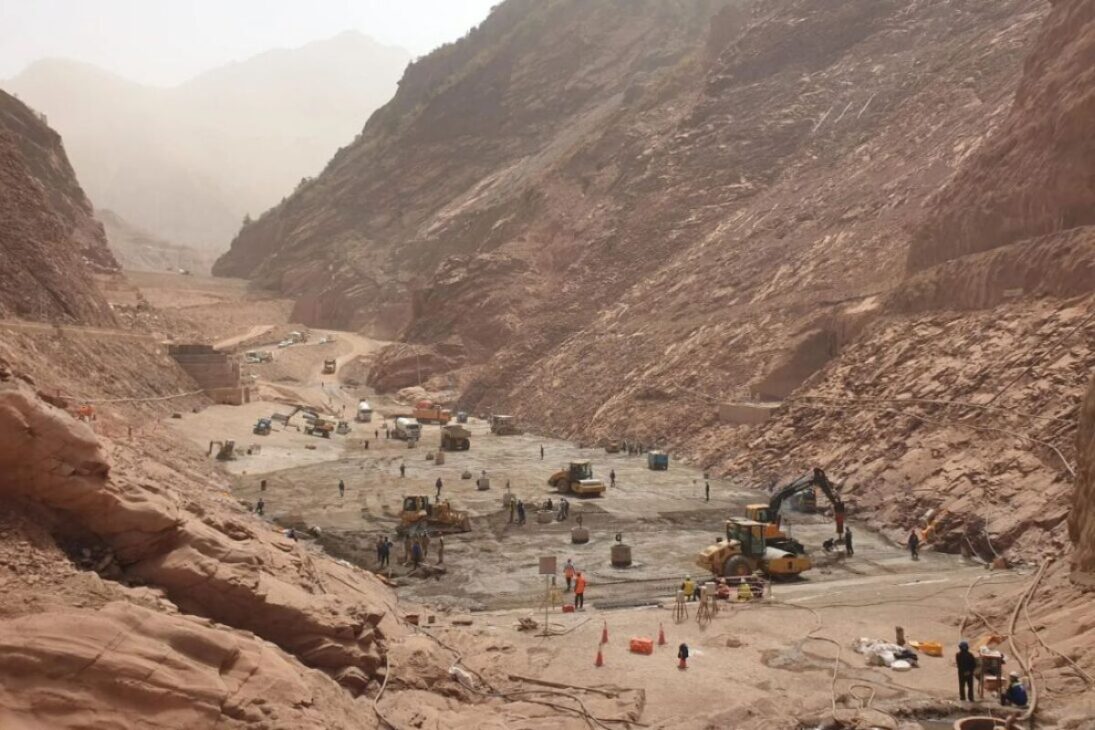
The symbolic dimension of Rogun is inseparable from its technical difficulty. The highest dam in the world was not conceived as a conventional concrete wall, but as a rockfill dam with a clay core. This means that the main body of the structure consists of huge volumes of rock and gravel compacted in layers, while a central waterproof clay core acts as a seal against the passage of water.
Even before raising the dam, it was necessary to divert the course of the Vakhsh River. To achieve this, four tunnels were excavated through the mountains, two of which were inherited from the Soviet phase and later rehabilitated. Each one is over a kilometer long, with diameters reaching several meters. These tunnels allow the river to continue its course alongside the construction area, making gradual advancement of the main structure possible. After that, the dam is built layer by layer, with constant monitoring of deformation, water pressure, and temperature. It is engineering that does not allow for improvisation, as any anomaly must be detected before it becomes a real threat.
The projected energy scale helps explain why so much effort was concentrated there. The reservoir is expected to store 13 cubic kilometers of water, and total filling is projected for around 2036. The plant was designed to operate with six turbines, each with 600 MW, totaling 3,600 MW. In theory, this would be enough to double the current electrical production of all of Tajikistan. In other words, Rogun was not designed to provide a temporary relief to shortages; it was thought to completely restructure the country’s energy system.
The Seismic Risk and the Weight of a Choice with No Comfortable Margin
If the technical ambition is already gigantic, the geology makes everything even more delicate. The Vakhsh valley is located in a seismically active region, in the Pamir mountain system, one of the most geologically complex areas in Asia. Earthquakes are part of the local reality, and this condition imposes a type of requirement that cannot be treated as a minor detail.
The engineering of Rogun had to start from the principle that the structure must withstand an environment where the zero risk simply does not exist.
There is also historical concern about the presence of geological faults in the project area, including the Mukri fault, mentioned in Soviet studies. According to these assessments, the structure could withstand with the appropriate design, but that has never eliminated the gravity of the scenario.
A catastrophic rupture in a dam of this size would release a devastating wave of water and mud along the valley, with potentially severe consequences for hundreds of kilometers. For this reason, Rogun is both a symbol of solution and a permanent reminder of the cost of building at the limits of the possible.
This dilemma helps explain why the project is treated almost as a forced choice. For a country with intense cold, chronic power cuts, and few alternatives for large-scale economic transformation, retreating also comes with a cost.
Remaining dependent on external remittances, continuing to be exposed to seasonal electricity shortages, and giving up a domestic source of regional power would mean accepting prolonged structural fragility. The bet on Rogun, in this sense, arises not only from ambition but also from a lack of equivalent routes.
The Climate Crisis May Accelerate Opportunity and Shorten the Horizon
The Rogun dam is also surrounded by an irony hard to ignore. The climate crisis increases the urgency for clean energy sources while simultaneously introducing uncertainties about the durability of the water system that supports the project.
The Vakhsh River is fed by the glaciers of the Pamir, and the accelerated melting of these ice masses alters the flow behavior in scales that are not trivial for a project of this magnitude.
In the short term, increased melting may enhance water availability and favor electricity generation. But in the longer horizon, critical reduction of the glaciers could compromise the stability of the water regime and decrease the flow that currently supports the expectation of operation for decades.
Adding to this are more irregular rains, prolonged droughts, and more intense floods, elements that make managing such a large reservoir even more complex. In other words, the same climate that reinforces the need for clean energy could also rewrite the conditions under which that energy will be produced.
Despite this risk, the geopolitical potential of the project remains enormous. Should the excess production materialize, Tajikistan could export electricity to markets such as Afghanistan and Pakistan, positioning itself more decisively in regional energy corridors that have been discussed for years.
In this scenario, the highest dam in the world would cease to be merely a domestic response to shortages and would begin to function as a tool of influence. A small country, without oil and without a sea, could gain relevance through the energy it generates in the mountains.
Between Economic Survival and Strategic Ambition, What Does Rogun Really Represent
Rogun encompasses several layers of meaning at the same time. It is a response to energy poverty, a legacy of Soviet engineering, a regional dispute over water, a work surrounded by seismic uncertainty, and an attempt to transform natural resources into political capacity. Few projects in the world gather, so intensely, issues of infrastructure, sovereignty, security, and climate within the same physical structure.
That is why the dam transcends the purely technical debate. When a country with about 10 million inhabitants decides to invest billions of dollars in a single project, it is doing more than building concrete, rock, and tunnels. It is trying to reorganize its historical position.
If the highest dam in the world delivers stable electricity, increases self-sufficiency, and paves the way for exports, Tajikistan could alter its trajectory. If the political, financial, climatic, or geological balance weighs too much, the project could go down in history as one of the most risky bets ever made by an entire nation.
In the end, Rogun summarizes a question that goes far beyond Central Asia: how far can a small country go when it decides to turn vulnerability into strategy? I want to know your opinion in the comments: do you see this dam as a rational exit for Tajikistan’s energy crisis or as too great a risk to be sustained for so long?








Seja o primeiro a reagir!