





 Portuguese
  English
  Spanish
  5 min of reading
  2 comments


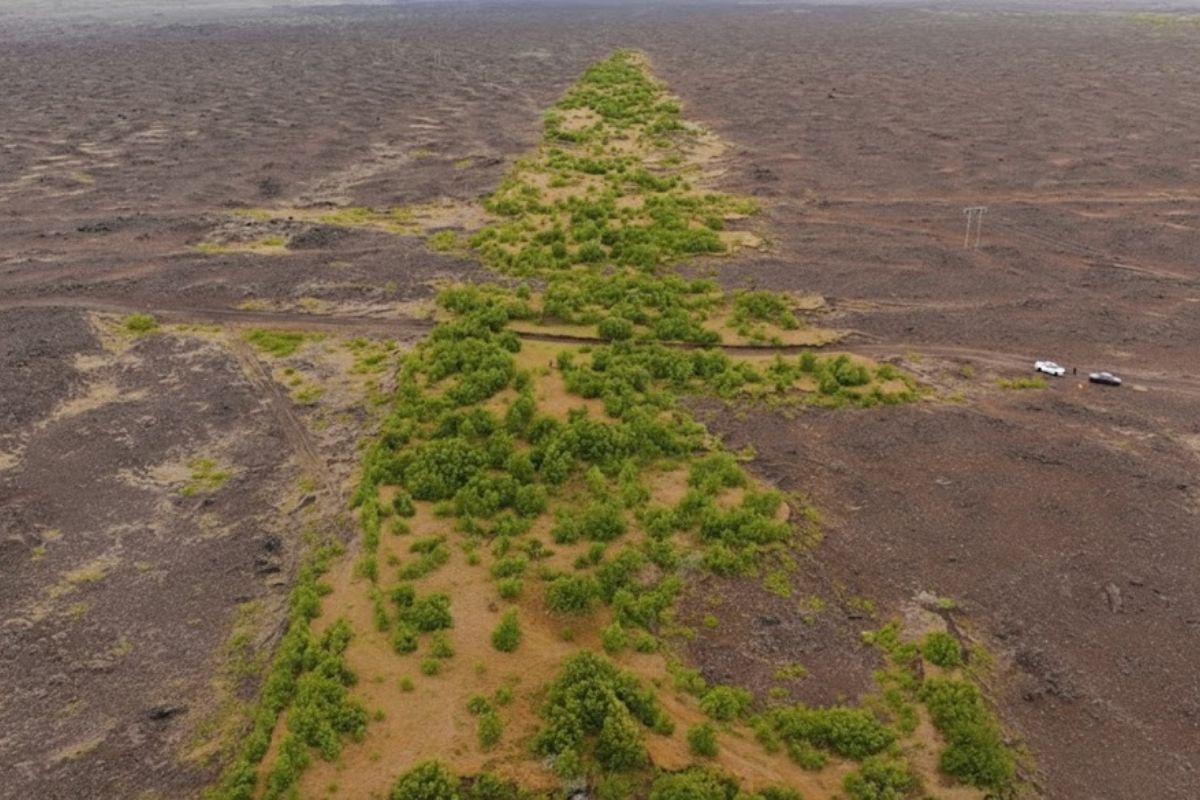


From 0.5% Forest Cover to Daily Planting of Thousands of Seedlings, the Nearly Tree-Less Country Transforms Iceland into a Laboratory: Birches Sprout from Ancient Roots, Sheep Become an Obstacle, and the Heckler Volcano Spreads Ash and Wind That Rob Soil for Decades with Fertilizer and Patience to Recover Ecosystems.
In the nearly tree-less country, Iceland faces a technical paradox: the territory is known for glaciers and volcanoes, but the real crisis occurs on the ground, where soil disappears with wind and volcanic ash. It is in this scenario that forest regeneration has become a long-term policy, slower than any election cycle.
The strategy combines native birches, foreign species, and sheep management, because the challenge is not only to plant but to ensure the seedling survives. The Heckler Volcano, the ash, and the sandstorms are counted as permanent variables, demanding shelter, species selection, and repetition.
The Old Wound of a Nearly Tree-Less Country

When Viking settlers arrived in Iceland, the cover of birches was part of everyday life.
-
Motorola launched the Signature with a gold seal from DxOMark, tying with the iPhone 17 Pro in camera performance, Snapdragon 8 Gen 5 that surpassed 3 million in benchmarks, and a zoom that impresses even at night.

-
Satellites reveal beneath the Sahara a giant river buried for thousands of kilometers: study shows that the largest hot desert on the planet was once traversed by a river system comparable to the largest on Earth.

-
Scientists have captured something never seen in space: newly born stars are creating gigantic rings of light a thousand times larger than the distance between the Earth and the Sun, and this changes everything we knew about stellar birth.

-
Geologists find traces of a continent that disappeared 155 million years ago after separating from Australia and reveal that it did not sink, but broke into fragments scattered across Southeast Asia.

Centuries of logging for firewood, combined with grazing, reduced the forest to a remnant: the nearly tree-less country ended up with about 0.5% forest cover, and vast areas began to behave like deserts.
In the 19th century, the process became visible in the terrain.
Volcanic sandstorms could last weeks, tearing away the fertile layer and leaving eroded hills.
In 1882, a three-week storm removed soil from large stretches; a narrow strip was spared where a mountain served as a windbreak, a detail that today guides reforestation.
Sheep, Ancient Roots, and the Battle for Survival

Sheep are part of Iceland’s rural culture, but they also appear as the biological bottleneck of regeneration.
In areas where birches are trying to sprout from ancient roots, constant nibbling prevents sprouts from gaining height, keeping young trees at seedling size for years and, in some cases, for decades.
Therefore, sheep control is treated as ecological infrastructure.
Fences and protected areas determine whether the forest returns or remains stalled.
In regions close to the Heckler Volcano, the logic is straightforward: without interruption of grazing, birches do not close their canopy; without a canopy, the soil remains exposed, and soil erosion restarts with each event of wind and ash.
Windbreak, Foreign Species, and Unpopular Decisions
In a nearly tree-less country, planting the right species in the wrong place often becomes a waste of energy.
The strategy described by Icelandic technicians uses tolerant pioneers to create a microclimate and, only afterwards, introduces more demanding species.
An example is the use of Sitka spruce for its salt and wind tolerance, providing shelter for birches and other trees to have a chance.
The introduction of foreign species is also considered a soil tool, not an aesthetic one. Volcanic soil has minerals but lacks a crucial element: nitrogen.
Therefore, the purple flower known as lupin was used to enrich the soil and speed up stages, at the cost of an internal debate about invasion and conservation.
The controversy arises from the same technical dilemma: without functional soil, there is no forest.
The Heckler Volcano as a Constant Factor in the Project

The Heckler Volcano is not just a landmark on the horizon; it defines the operational risk.
Ash and volcanic sand, combined with wind, act like sandpaper on already fragile areas, stripping away the good part of the soil and scattering particles far and wide.
Where vegetation is still sparse, the impact is greater, and recovery may become unviable without intervention.
The response includes planting in mosaic and taking advantage of protected points, repeating the lesson of the shelter from 1882.
It also includes accepting that some trees grow better under initial protection: birches, willows, and pioneers stabilize the ground, while other species are introduced when the microclimate improves.
Practically speaking, the forest is used as engineering against soil erosion.
Planting at Scale and Patience as Technology
The numbers help to understand why Iceland treats reforestation as an operation.
In planting areas, trays can hold up to 67 seedlings each, and teams can plant thousands per day, with reports of around 6,000 trees daily when fertilization occurs.
The goal mentioned in projects in the south is to reforest an area equivalent to 140,000 soccer fields around the Heckler Volcano.
At the same time, real results are measured in decades.
In areas fenced since 1924, natural regeneration and planting have expanded the coverage from a few hundred hectares to thousands, with the forest literally “creeping” up the hill.
The logic is simple and harsh: in a nearly tree-less country, time is part of the budget.
Biodiversity, Climate, and What Changes When Trees Return
The return of trees alters wildlife, as it creates habitat and reduces exposure to wind.
There are records of birds arriving or settling as tree cover increases, functioning as an indirect indicator of biodiversity.
Even in birch areas, the presence of shade and physical barrier changes local humidity and soil stability.
The challenge, however, is not static.
Warming projections, cited by local experts, point to a scenario where Iceland would approach a milder climate over the century, which affects which species withstand it, in addition to increasing risks of pests and diseases.
Therefore, the strategy includes genetic diversity and a variety of species, keeping the debate on foreign species always open, especially in a nearly tree-less country.
In your city, what would you accept to recover degraded areas: penning sheep, using foreign species, or waiting decades for birches, even with the Heckler Volcano and wind pressing the soil? Share which choice you would make and why, with a concrete example from your place.








Espécie estrangeiras resistentes e não haveriam pragas em curto prazo, mas se u dia tiver, trata-se
Caros Amigos : A Islândia investe muito em Biotecnologia, Ciências médicas, TI e Data Centers. Sua população 100% escolarizada e em grande parte trilíngue (islandês, dinamarquês e inglês). E está desde os 50’s investindo em reflorestamento e pesquisas. Já conseguiram criar próxima a capital uma floresta. Agora o resto é continuar plantando e investindo em pesquisas ! 👍