





 Portuguese
  English
  Spanish
  8 min of reading
  0 comments


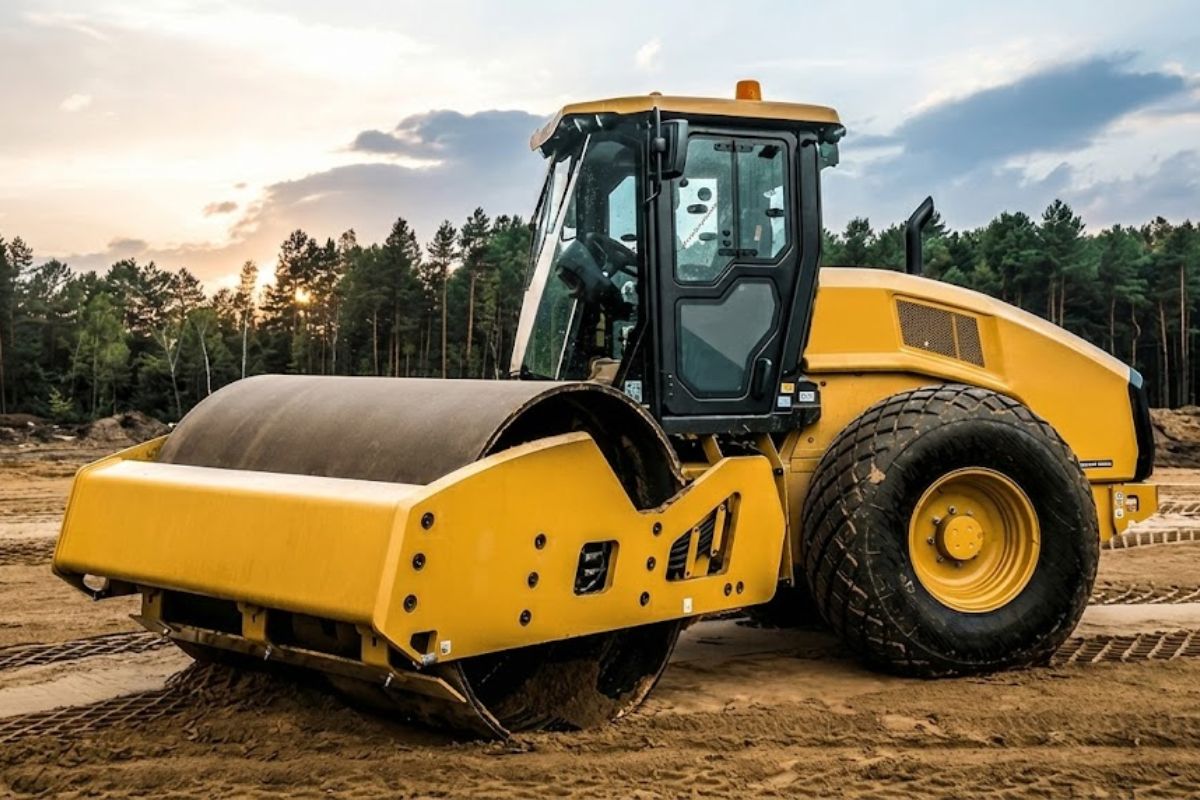
The Roller Compactor Seems Simple, But It Uses Hydrostatic Transmission, Central Articulation, and a Vibrating Drum with an Eccentric Shaft to Eliminate Soil Voids. Without an Accelerator, It Maintains a Constant Speed and Adjusts Vibration According to the Material, Creating Deep Compaction. With Damping, Double Brakes, and Cooling, It Works for Hours Safely.
On a construction site, almost everyone pays attention to excavators, cranes, and trucks. But there is a machine that moves back and forth, discreetly, and decides whether the project will last for years or start to fail too soon. It’s the roller compactor.
The roller compactor is not there to “smash” the ground by weight. What it does is smarter: it changes the internal structure of the soil, eliminates voids between particles, and creates a base with density sufficient to support busy highways, airport runways, and the foundation of large buildings, bridges, and parking lots.
What the Roller Compactor Really Does with the Soil

The function of the roller compactor seems simple: to pass over the ground repeatedly until everything is firm. However, the real effect is invisible to the naked eye.
-
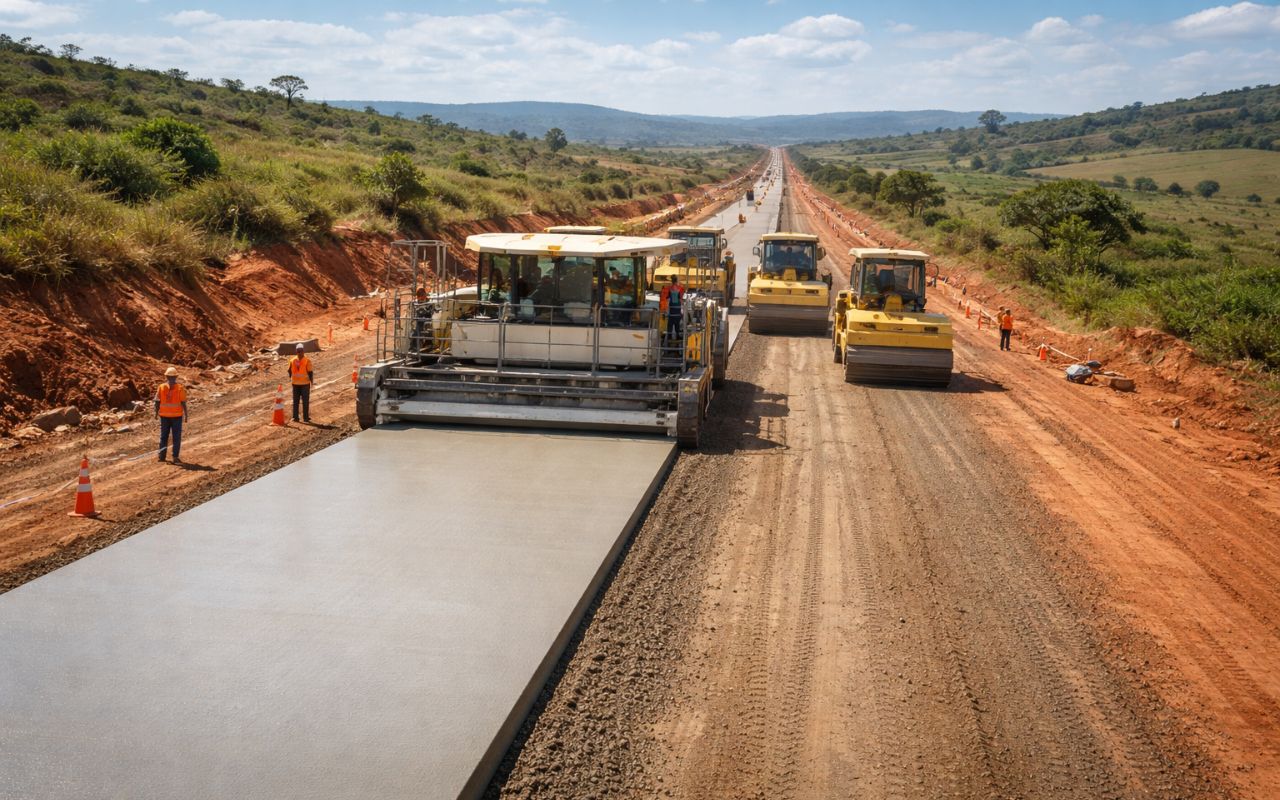
New CCR concrete paving technology promises roads up to 3x more durable, less maintenance, and cost reduction in Brazil.
-
Made from recycled plastic, plastic wood is gaining space in the construction industry because it does not rot, resists moisture, and reduces maintenance costs over the years.

-
Florianópolis will receive a million-dollar BRT that will begin construction in 2026 with nearly 400 million in funding from the federal government and the Inter-American Development Bank, and the map already shows the routes for the exclusive bus corridors.

-
Without a blueprint, without an engineer, and using scrap from the dump, a father spends 15 years building an 18-room castle for his daughter, featuring tram tracks, 13 fireplaces, and over 700 m², which may now be demolished.


Soil, even when it seems solid, has empty spaces between grains of dirt, sand, rocks, and other materials.
When the roller compactor compresses and reduces these voids, the ground gains density and starts to support heavy loads without yielding or sinking over time.
This detail separates a stable project from one that will face problems.
Without proper compaction, the soil settles unevenly after the structure is already built. This paves the way for:
- Cracks in the asphalt
- Dangerous sinkholes on the track
- Loss of uniformity in parking lots and roads
- Compromised structural stability in entire constructions
That’s why, before there’s a beautiful finish, there’s a solid base. And that base almost always depends on the roller compactor.
Why the Roller Compactor Doesn’t Have an Accelerator
One of the most counterintuitive curiosities is that the roller compactor does not have an accelerator pedal. It seems strange until you remember what compaction requires: absolute constant speed throughout the course.
If the speed fluctuates, the compaction becomes irregular.
The soil receives different amounts of energy in each section. This can create areas with distinct densities, which later become weak points.
The solution was to integrate speed control into the steering system, with a lever in the cab.
The operator sets the desired speed, and the roller compactor maintains that pace steadily, allowing the operator to focus on path, alignment, and intensity of work.
Diesel Engine: Constant Torque, Not “Power Explosions”
Almost all roller compactors use diesel engines, and this is not due to tradition. It’s out of necessity.
The roller compactor needs constant and reliable torque during long shifts, maintaining stable performance from start to finish of the shift.
Unlike equipment that requires quick power spikes, such as trucks accelerating uphill or loaders lifting loads, the roller compactor works for hours at low RPM, facing heat, dust, and heavy work routines.
In the most modern models, the engine integrates with intelligent electronic systems that monitor and automatically adjust the RPM according to demand, ensuring optimal performance without fuel waste and unnecessary overload.
Hydrostatic Transmission: The Invisible Control That Keeps Everything Smooth
If there is one point that explains why the roller compactor moves “calmly” and accurately, it’s the transmission.
Instead of mechanical transmissions with gears and clutch, many modern roller compactors use hydrostatic transmission.
In practice, the engine drives a special hydraulic pump. This pump pressurizes oil and sends it through hoses and pipes to hydraulic motors installed directly on the drums or wheels. These hydraulic motors drive the machine.
The gain is enormous: absurdly precise control. The operator can adjust the speed smoothly and gradually, even moving forward at 2 or 3 km/h with stability.
There are no gear shifts, no jolts, no bumps. The roller compactor maintains a constant speed throughout the entire path.
This happens because the hydraulic pump adjusts the oil flow proportionally and continuously.
When the command goes forward, the flow progressively increases, and the machine accelerates smoothly. When it returns to neutral, the flow decreases and it decelerates without shaking the ground.
How the Roller Compactor Makes Turns Without Losing Compaction
Another detail that goes unnoticed: the roller compactor does not turn the wheels like a car or truck. It makes turns through a central articulation, literally bending the machine in half.
This system exists because the roller compactor needs to keep the drums always parallel to the ground and in full contact with the surface.
If the wheels turned, there would be a loss of traction and uneven compaction on curves.
With the central articulation, the front and rear parts move independently, while the drums continue pressing the ground evenly, avoiding compaction failures on curved paths.
The Secret Inside the Drum: Extreme Vibration, Not Just Weight
Many people think that the roller compactor compacts only with its own weight, crushing the soil by gravity.
But this would create a more superficial compaction, concentrated in the layer that is in direct contact with the drum.
What differentiates the roller compactor from a “mass of steel” is the vibratory system.
The drum shakes thousands of times per minute as it passes over the ground, generating vibrational waves that propagate like small controlled earthquakes.
The physics behind it is straightforward. Weight alone compresses the surface. Vibration makes soil particles, sand, and stone literally “jump” and rearrange into more compact positions, taking up less space and reducing voids in deeper layers.
It’s like shaking a box of stones: they fit together better, and the occupied volume decreases. In soil, this translates to density.
Eccentric Shaft and Centrifugal Force: How the Drum Vibrates for Real
The heart of the vibratory system is an eccentric shaft installed within the steel drum. This shaft has unbalanced weights attached at the ends, intentionally off-center.
When hydraulic motors make this shaft spin at high speed, the unbalanced weights create a powerful centrifugal force.
This force pulls the drum up and pushes down rapidly and repeatedly.
Depending on the model and the type of soil, the drum can perform between 2,000 and 4,000 vibrations per minute, which equates to 30 to 60 “hits” per second.
The operator can also adjust the frequency directly from the cab, choosing the ideal intensity for each material and each layer.
This is what allows deep and uniform compaction, creating a solid and durable base capable of supporting heavy loads for decades.
How the Machine Doesn’t Destroy Itself and the Operator Doesn’t Become a Victim of Vibration
If the drum vibrates thousands of times per minute, why doesn’t the entire machine shake? And why can the operator work inside it for hours?
The answer is a sophisticated damping system that acts as a barrier between the vibrational chaos of the drum and the rest of the equipment. It uses a combination of:
- Special rubber mounts
- Reinforced industrial springs
- Hydraulic dampers strategically placed between chassis and drum
These components absorb and dissipate energy before the vibration propagates. Without them, the scenario would be critical: accelerated structural fatigue, cracked welds, loosening screws, failing electronics, and the operator subjected to harmful vibrations, with extreme fatigue and problems in the spine and joints.
With adequate damping, the roller compactor keeps the drum working at maximum, while the structure remains protected, and the cab stays stable enough for continuous operation.
Double Brakes: Why Stopping a Roller Compactor Requires Redundancy
A roller compactor can exceed 15 tons, and stopping this mass on ramps or sloped terrain requires layered safety.
That’s why the machine operates with two independent brake systems.
The first is the service brake, used on a daily basis. It operates with hydraulic disc brakes installed on the drive axles.
Activating the pedal pushes oil under high pressure against the brake pads onto metal discs, creating friction for controlled deceleration.
The second is the parking brake, also known as the spring brake.
It works oppositely to conventional brakes: it is naturally locked by extremely strong springs and only releases when there is hydraulic pressure keeping it open.
If there is a hydraulic failure or the machine is turned off, the springs automatically lock the axles and prevent movement.
It’s a safety logic that does not depend on luck or the operator’s perfect attention.
Cooling: The Invisible System That Prevents Chain Failures
Few people associate roller compactors with heat, but they generate a lot of heat during operation.
The diesel engine runs hot, the hydraulic oil heats up when pressurized and circulated continuously, and the brakes generate heat with each application.
If this thermal energy is not dissipated, damage can occur quickly:
- The oil loses lubricating properties
- Rubber seals dry out and crack
- The engine can seize
- Hydraulic components lose efficiency
That’s why the roller compactor relies on radiators sized for hostile environments full of dust and debris. Powerful fans force air through these radiators, removing accumulated heat.
Some models also use additional heat exchangers to cool hydraulic oil, circulating it through pipes near metal fins bathed in fresh air.
That’s what allows the roller compactor to work for hours on end without collapsing from overheating.
Types of Roller Compactors: Why They Change Externally
On the inside, the principle repeats. On the outside, the roller compactor changes because each construction demands specific behavior.
The most common is the smooth roller, with a cylindrical steel drum. It is ideal for compacting asphalt and creating smooth surfaces.
The sheep’s foot roller has hundreds of metallic protrusions in the shape of pins on the drum. It is designed to penetrate and compact clay soils at deeper layers.
The pneumatic roller replaces the drum with a series of rubber tires side by side. It is excellent for final finishing on asphalt pavements without damaging the surface.
There are also combined rollers, which mix a smooth drum in the front with tires or a sheep’s foot behind, offering versatility for different stages of the work.
Why the Roller Compactor Is One of the Most Underestimated Machines on the Job Site
The roller compactor doesn’t attract attention for lifting things in the air or digging giant holes. It draws attention when it’s missing.
When compaction fails, the project pays with interest: cracks, deformations, sinkholes, and costly maintenance.
When it works, it doesn’t show up. It only delivers what no one sees, but everyone uses: a solid, uniform, and durable base.
And now a quick question for you to comment: Had you noticed that the roller compactor doesn’t have an accelerator and that vibration is the secret of deep compaction?









Seja o primeiro a reagir!