





 Portuguese
  English
  Spanish
  5 min of reading
  0 comments


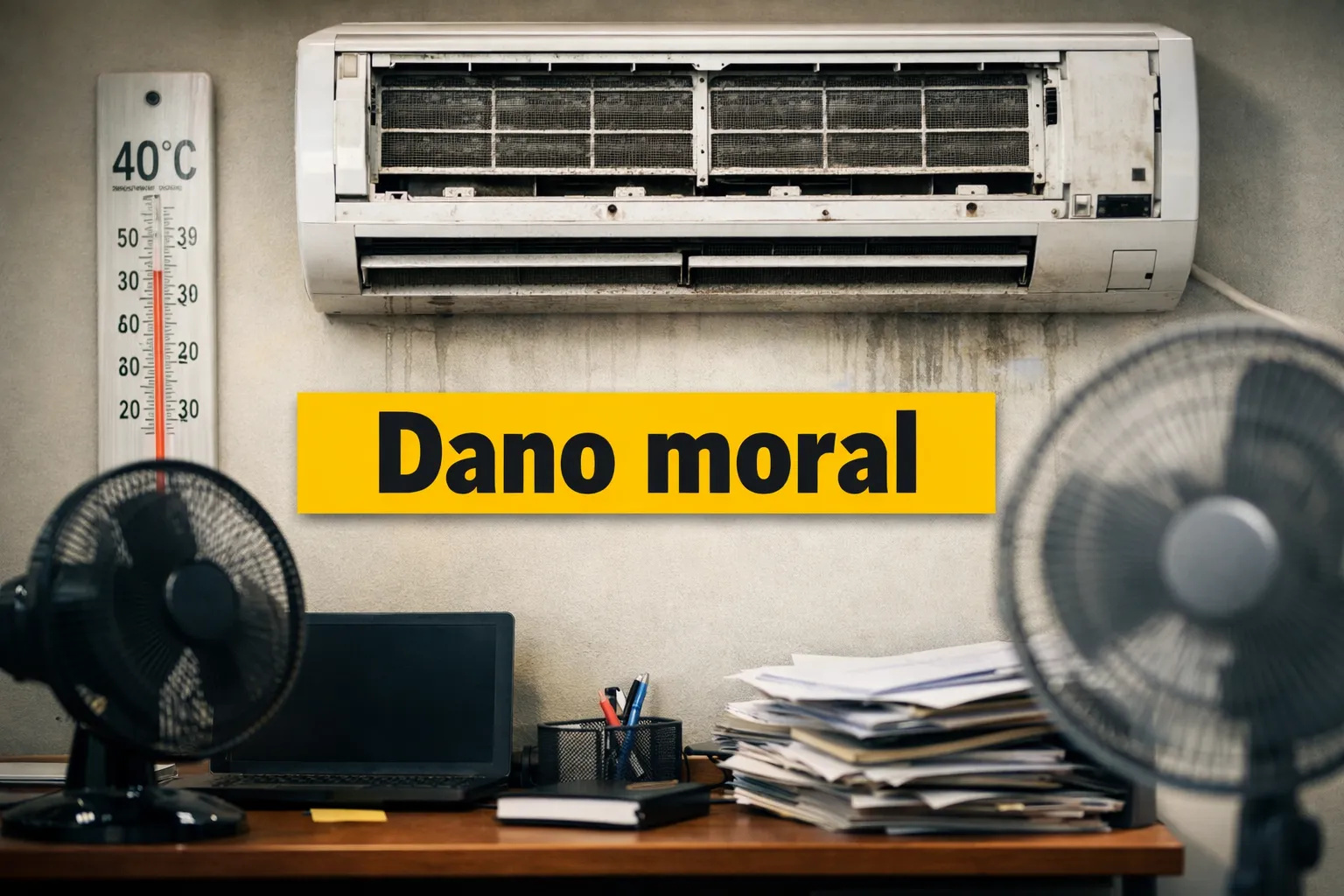
The Tenth Panel of the TRT-MG Confirmed the Conviction of a Security and Services Company in Unaí to Pay R$ 1,500 for Moral Damages After Finding a Violation of the Thermal Comfort Rules of NR-17, with an Indoor Environment Without Adequate Air Conditioning During Months of Work
The Tenth Panel of the TRT-MG confirmed the conviction of a security and services company in Unaí to pay R$ 1,500 for moral damages to a worker exposed to high temperatures without air conditioning, recognizing a violation of NR-17 of Ordinance No. 3,214/1978, in a unanimous decision.
The Labor Court concluded that the company was negligent in failing to ensure minimum conditions for thermal and acoustic comfort in the office where the employee worked, contrary to applicable legal standards for indoor environments requiring constant attention.
The conviction was initially issued by the Labor Court of Unaí and upheld by the judges of the Tenth Panel of the Regional Labor Court of Minas Gerais, who rejected appeals presented by both parties in the case.
-
The noise law will no longer be in effect at 10 PM starting in June with a new rule valid during the 2026 World Cup.

-
The Chamber opens a debate on driver’s licenses at 16 years old as part of a reform that includes around 270 proposals to change the Brazilian Traffic Code and may redesign rules for licensing, enforcement, and circulation in the country.

-
The new Civil Code could revolutionize marriages in Brazil with “express divorce” and changes that could exclude spouses from inheritance.
-
Banco do Brasil sues famous influencer for million-dollar debt and intensifies debate on delinquency, risks of seizure, and direct impact on Gkay’s credibility.


Work Environment and Employee Claims
In the request, the employee stated that she carried out her activities in an office without any type of ventilation or air conditioning, being exposed to intense heat during her shift, in a context aggravated by the high temperatures recorded in the municipality.
According to the records, the city of Unaí reaches temperatures above 40º at certain times of the year, which, for the plaintiff, made the environment inadequate and incompatible with the internal work protection standards.
The employee maintained that she spent months performing intellectual functions in a place without air conditioning, a situation that allegedly caused continuous discomfort and damage to her dignity, justifying the claim for indemnification for moral damages.
Company Defense and Panel Analysis
In its defense, the company claimed to fully comply with the legal framework, stating that it offers a healthy work environment to employees and denying that the plaintiff remained the entire shift without air conditioning or was subjected to excessive heat.
The employer also argued that it sought to resolve the reported technical issues, asserting that there was no deliberate omission and that the conditions were not sufficient to characterize indemnifiable moral damages.
Upon analyzing the case, the reporting judge Taísa Maria Macena de Lima understood that the evidence demonstrated a failure to comply with the thermal and acoustic comfort norms set forth in NR-17 of Ordinance No. 3,214/1978.
Technical Standards and Legal Parameters Applicable
In the decision, the reporting judge cited item 17.8.4 of NR-17, which mandates the adoption of acoustic and thermal comfort measures in indoor environments with activities that require intellectual engagement and constant attention.
It was also highlighted sub-item 17.8.4.2, which establishes the obligation to control temperature, air velocity, and humidity, observing the range of 18 to 25 °C for air-conditioned environments.
For the judge, the failure to comply with these parameters constituted an objective fault of the company, regardless of repair attempts, characterizing a violation of the legal duty to protect the worker.
Testimonies and Witness Evidence
In her testimony, the employee reported that the air conditioning in the office did not work properly, stating that technicians were called several times, but the equipment experienced recurring failures after about 20 minutes of use.
The plaintiff indicated that she had to bring her own fan to work and that the company only rented a cooler about a week before the end of her employment contract, which did not solve the issue.
A coworker, heard as a witness, confirmed that the air conditioning did not work and that several calls and complaints were made, including through a supervisor, without effective results throughout the period.
The witness further stated that she brought a fan from home and described instances where elderly clients felt unwell, necessitating redirecting the fan to them, highlighting the thermal discomfort in the environment.
Recognition by Supervision and Legal Grounds
The company’s own supervisor acknowledged in court that Unaí has a very hot climate and that the location was without air conditioning for a period, attributing the problem to failures in the electrical network that were identified later.
According to the supervisor, after technical investigations, the company made a cooler available, although it claimed there were no formal complaints from employees or clients feeling unwell, a version not fully accepted by the panel.
For the reporting judge, the burdens of the enterprise fall on the employer, according to Article 2 of the CLT, and it is insufficient to claim technical difficulties to justify the absence of easily installed and operational equipment.
In the ruling, it was noted that the principle of alterity imposes on the employer the responsibility of assuming the risks of economic activity, and they cannot transfer the consequences of their negligence to the employee, which constituted moral damage in re ipsa.
The judge emphasized that moral damage arises from the very offense to the extrapatrimonial sphere and is presumed upon proof of the fact, since there is no direct means to measure pain, suffering, or humiliation.
Maintenance of the Indemnification Amount
The employee appealed requesting an increase in the indemnification from R$ 1,500 to R$ 10,000, arguing that the amount did not reflect the extent of the damage, which occurred over about six months, nor the educational character of the conviction.
In turn, the company requested a reduction of the amount, advocating the application of moderation as the guiding principle of jurisdictional activity, considering the circumstances of the specific case and the proportionality of the penalty.
The reporting judge maintained the established amount, considering the degree of fault of the offender, the seriousness of the damage, the balance between the parties, and the economic capacity of the company, which has a share capital of over three million reais.
It was also considered that the damage did not have great extent, did not exceed the period of the offense, nor did it have wider repercussions in other areas of the employee’s personal life, in addition to the brief duration of the contract, which was approximately six months.
In the end, the Tenth Panel denied the appeals, fully maintaining the sentence and registering that the decision was unanimous in process PJe No. 0010109-33.2024.5.03.0096, concluding the case within the TRT-MG.










Seja o primeiro a reagir!