





 Portuguese
  English
  Spanish
  4 min of reading
  0 comments


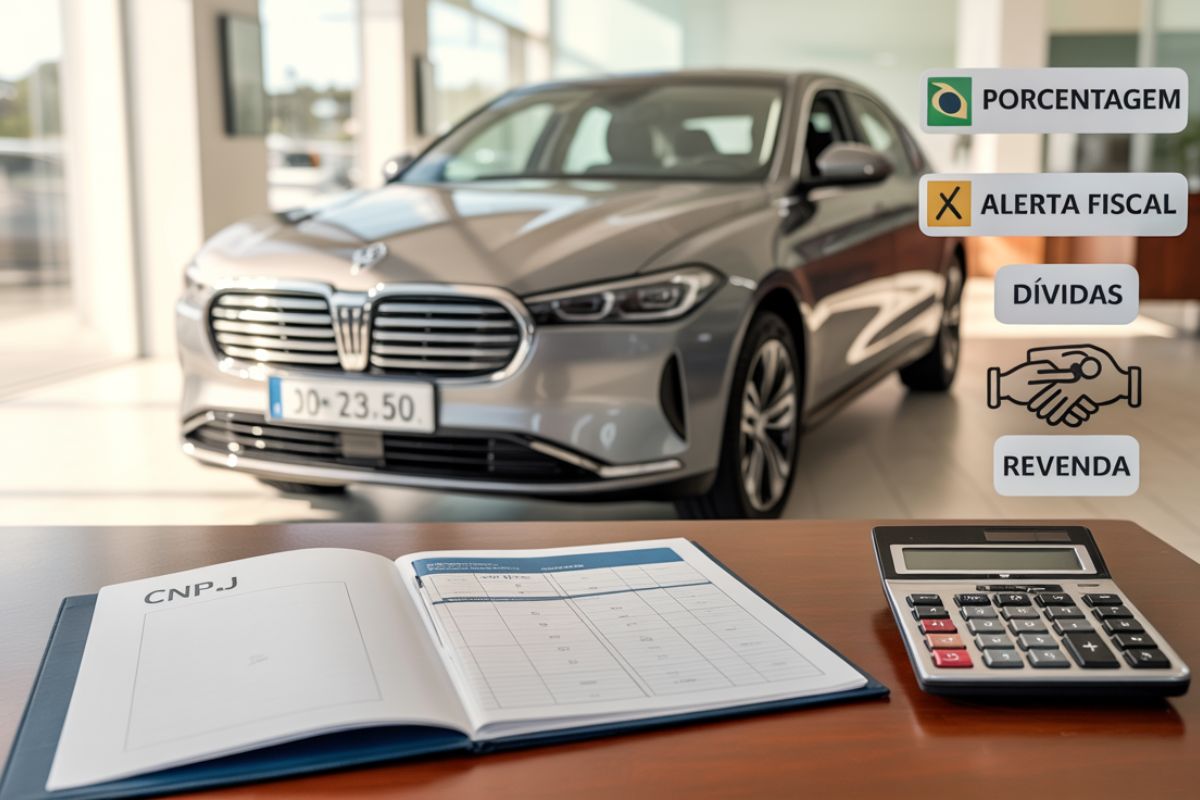
The Discount of Up to 30% Is Tempting, But Understand the Risks Involving Taxes, Debts, and the Sale of the Vehicle Before Deciding to Buy a Car in the CNPJ.
The possibility of buying a car under the CNPJ and obtaining a significant discount is one of the biggest attractions for entrepreneurs in Brazil, from MEI to owners of small and medium-sized enterprises. Salespeople at dealerships often present this option as an irresistible business, transforming that top-of-the-line model into an apparently achievable dream.
However, this initial advantage can turn into a big headache. What many don’t realize are the hidden costs, tax obligations, and legal risks that come with the purchase. Before getting carried away by the discount, it’s crucial to understand that the car will not be yours, but your company’s, and this small difference has big consequences.
Why Does the Discount for CNPJ Exist?
The main reason for the lower price is the tax reduction. When the sale is made directly from the factory to a company (a B2B operation), there is exemption or reduction of taxes such as IPI (Tax on Industrialized Products) and ICMS (Tax on Circulation of Goods and Services). This tax benefit is passed on to the buyer in the form of a discount.
-
Oil surged to $115 a barrel due to the war in the Middle East, and diesel in Brazil has already risen to R$ 7.45 per liter, while the United States…

-
Brazilian city bets on the business environment to generate jobs and attract investments in the energy sector — secretary reveals strategy at Macaé Energy 2026.

-
50 viaducts, 4 tunnels, 28 bridges, and 40 kilometers of bike paths: BR-262 in Espírito Santo will receive 8.6 billion reais for the largest engineering project in the state’s history, inspired by the Immigrant Highway in São Paulo.

-
Brazil produces too much clean energy and doesn’t know what to do with it: over 20% of solar and wind capacity was wasted in 2025 while investors flee and 509 renewable generation projects were abandoned in the last year.


Trap 1: The Car Is Not Yours, It’s the Company’s
This is the most important point and the one that generates the most confusion. When buying a car under the CNPJ, the vehicle becomes an asset of your company, not yours.
- Implications:
- The car does not enter your individual income tax declaration. It belongs to the company’s assets.
- Risk of Seizure: If your company has any type of debt (tax, labor, with suppliers), the car can be seized and auctioned by the court to settle the debts.
Trap 2: The MEI in the Sights of the Federal Revenue
For the Individual Microentrepreneur (MEI), with an annual revenue limit of R$ 81,000, purchasing a car worth R$ 100,000 or more is a huge red flag for the Federal Revenue. The numbers simply don’t add up, and the tax authorities may (and will) call you to explain the source of the money, which can lead to the disqualification of the MEI and the collection of retroactive taxes with fines and interest.
Trap 3: The “Surprise” Tax at the Time of Sale
This is the trap that catches the unsuspecting the most. For the Federal Revenue, a company vehicle undergoes a book depreciation of 20% per year. This means that, after 5 years, the book value of the car is zero.
If you sell this car for R$ 80,000, for example, for the tax authorities, you made a capital gain of R$ 80,000. On this amount, your company will have to pay 15% of Income Tax (IRPJ), which would amount to R$ 12,000 in our example. This tax can completely nullify the discount you received at the time of purchase.
Trap 4: You Cannot Sell the Car When You Want
Most manufacturers require in the contract that the car purchased with a CNPJ discount remains with the company for a minimum period, usually 12 months. If you need to sell the vehicle before this period due to an emergency, you will have to return the discount amount with adjustment.
Trap 5: More Expensive Financing and Bureaucracy
- Interest: Obtaining financing with “zero rate” is common for individuals but very rare for CNPJ. The interest on the transaction can make the final purchase price under the CNPJ more expensive than it would be under the CPF.
- Delay in Delivery: Since the sale is direct from the factory, the delivery time is usually much longer, often exceeding 30 days.
- Invoice on Sale: When selling the car, your company is required to issue a sales invoice for fixed asset, which can be a bureaucratic process for those who are not used to it.
Is It Worth Buying a Car Under the CNPJ?


The purchase can be advantageous for companies that truly need the vehicle for their operations (transport of goods, visits to clients) and plan to rotate their fleet every few years.
For the MEI or small businessman who is only looking for the discount to buy a personal use car, the risks and hidden costs usually do not outweigh the initial savings. The apparent advantage can turn into a significant loss in the future.
And you, have you ever thought about buying a car under the CNPJ? Were you aware of all these risks? Share your experience in the comments!










Seja o primeiro a reagir!