





 Portuguese
  English
  Spanish
  4 min of reading
  0 comments


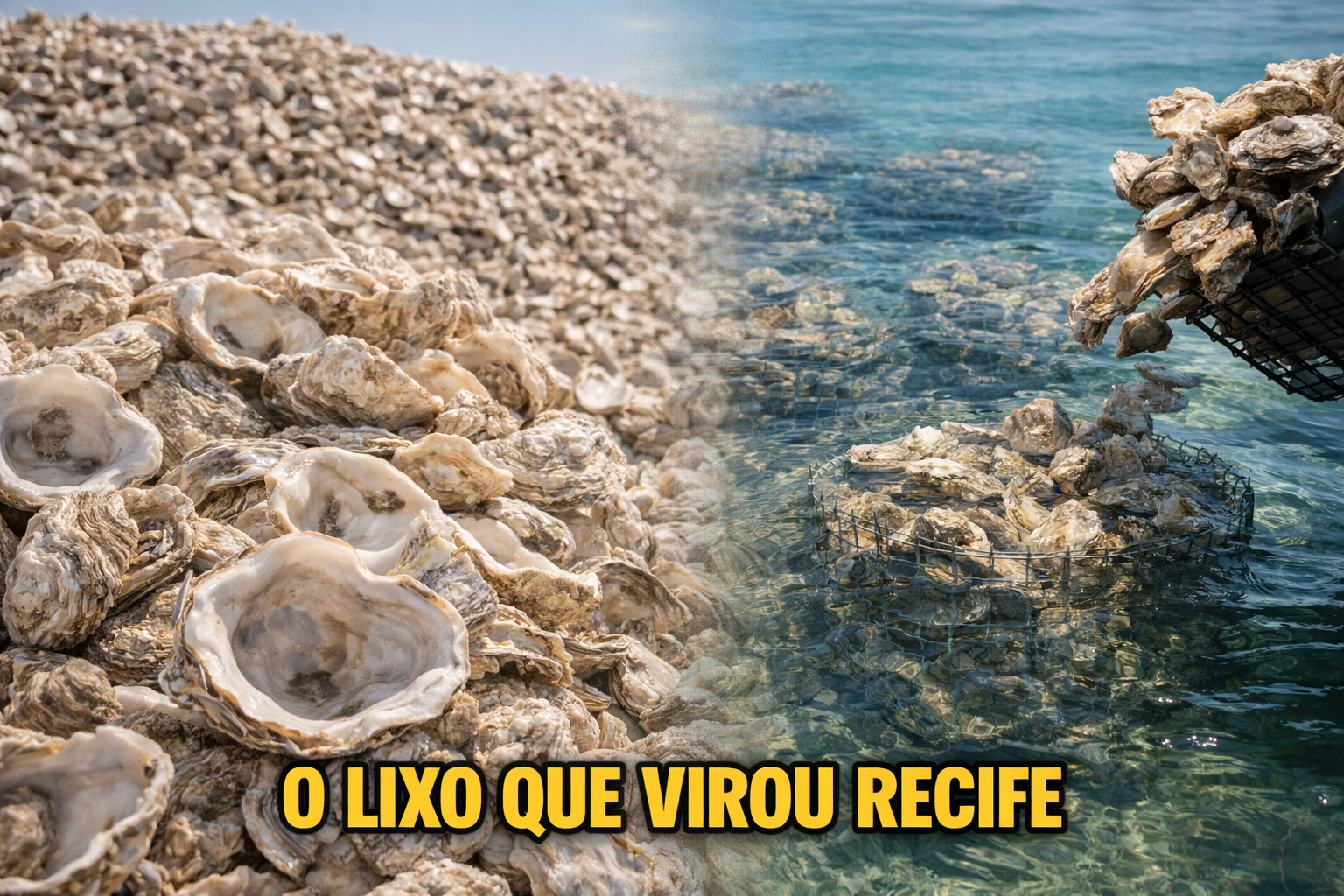
Discarded Oyster Shells in Louisiana Are Becoming Reefs That Restore the Coast, Protect Cities, and Multiply Marine Life in the Gulf of the U.S.
When looking at an abandoned oyster shell on a plate, it is hard to imagine that there is anything beyond a worthless waste. In the state of Louisiana, in the United States, this has become an economic, environmental, and urban fact documented by universities and the state government. The logic is simple: the Louisiana coast has been sinking, eroding, and being invaded by the ocean for decades; meanwhile, the entire country throws away millions of tons of oyster shells every year. Starting in 2014, organizations like the Coalition to Restore Coastal Louisiana (CRCL), universities, and fishermen initiated the Louisiana Oyster Shell Recycling Program. From that point, restaurants began collecting shells and sending them to drying and treatment centers. What was trash turned into coastal infrastructure.
According to NOAA (National Oceanic and Atmospheric Administration), Louisiana has lost over 5,000 km² of coastal wetlands since the 1930s due to erosion, geological subsidence, canal construction, hurricanes, and rising sea levels. At the same time, according to the Louisiana Department of Wildlife and Fisheries, the state is the largest producer of oysters in the U.S. This coincidence created the basis for a rare coastal restoration project in the world: using discarded shells to rebuild the coast and defend entire cities.
Why Shells Have Become Coastal Infrastructure
The oyster reef is one of the most efficient ecosystems in the world. It serves as a natural barrier against waves, harbors species, improves water quality, and stabilizes sediments. When destroyed, the coast loses a fundamental defense.
-
Motorola launched the Signature with a gold seal from DxOMark, tying with the iPhone 17 Pro in camera performance, Snapdragon 8 Gen 5 that surpassed 3 million in benchmarks, and a zoom that impresses even at night.

-
Satellites reveal beneath the Sahara a giant river buried for thousands of kilometers: study shows that the largest hot desert on the planet was once traversed by a river system comparable to the largest on Earth.

-
Scientists have captured something never seen in space: newly born stars are creating gigantic rings of light a thousand times larger than the distance between the Earth and the Sun, and this changes everything we knew about stellar birth.

-
Geologists find traces of a continent that disappeared 155 million years ago after separating from Australia and reveal that it did not sink, but broke into fragments scattered across Southeast Asia.


An adult oyster can filter tens of liters of water per day, removing particles that reduce clarity and affect plankton. Reefs increase hydraulic roughness, decreasing wave strength and allowing sediments to accumulate. This protects marshes, mangroves, and wetlands. In areas like New Orleans, Houma, and St. Bernard Parish, this literally means preventing neighborhoods from disappearing.
Discarded shells are the ideal substrate because oyster larvae (called spat) need limestone surfaces for attachment. Artificial reefs made of plastic, concrete, or tires work, but not with the same ecological efficiency. That’s why recycled shells lead current initiatives.
How the Shell Recycling Program Works
According to CRCL, the Louisiana Oyster Shell Recycling Program was officially launched in June 2014. Participating restaurants began storing shells, removing organic remains, sorting materials, and sending everything to drying areas. The material is exposed to the sun for months to over a year for natural sterilization, eliminating pathogens and fresh matter.
After the process, the shells are transported to strategic locations along the coast, where they are used to form linear artificial reefs. These reefs are placed near the tide line to dissipate wave energy. In some sections, environmental engineers and biologists delimit areas with biodegradable geotextiles to accelerate sediment accumulation.
According to data released by CRCL and verified by reports from The Times-Picayune and the Coastal Protection and Restoration Authority (CPRA), over 10,000 tons of shells have already been recycled since the program started. This volume has allowed for the construction of miles of reefs that have been nonexistent for decades, capable of withstanding storms and protecting rapidly shrinking wetlands.
Where Reefs Are Being Installed and What They Protect
The majority of installations occur in coastal parishes such as St. Bernard, Plaquemines, and Jefferson Parish, historically vulnerable areas. These regions form a delicate transition between cities, rivers, and the Gulf of Mexico. Without reefs, the sea advances and consumes marshes, paving the way for the direct impact of hurricanes.
It is important to highlight that Louisiana is not the only state with a shell program, but it is the one that relies most on this strategy to protect human infrastructure. The state is responsible for one of the largest combinations of industrial areas and swamps in the country, something rare in the world. This creates a paradox: oil platforms, refineries, ports, and waterways share territory with migratory birds and endemic plants. Restoration is not an aesthetic issue; it is a matter of national and economic security.
Ecological Result: Shells Not Only Protect but Also Support Life
The most impressive aspect of this program is not the creation of physical barriers but rather the return of life. According to researchers from LSU (Louisiana State University) and the Pontchartrain Institute, repurposed reefs have recorded increasing densities of native oysters, crabs, small fish, and shrimp just months after installation. Artisanal fishing benefits, as do birds and filter-feeding species.
Over time, artificial reefs made of shells become natural reefs because oysters start to grow on top of each other, generating thickness and height. The substrate becomes self-repairing and self-expanding, something impossible in conventional concrete barriers.
Urban Result: Protecting Cities and Reducing Storm Damage
Storms in the Gulf of Mexico are not rare events. Strong hurricanes hit the region in 2005 (Katrina), 2008 (Ike), 2012 (Isaac), 2020 (Laura, Delta), and others. Every advance of the sea represents billions of dollars in losses. Programs like the shell recycling program do not eliminate hurricanes but reduce the intensity of the impact on shorelines and marshes.
When a marsh is destroyed, buildings, roads, and neighborhoods are exposed. When the marsh is protected by reefs, it acts as a natural buffer. That’s why coastal engineers treat these reefs as “green infrastructure.” It can be summed up this way: without reefs, there are no marshes; without marshes, there are no barriers; without barriers, the ocean enters the cities.







-

-

-

-

-

-

29 pessoas reagiram a isso.