





 Portuguese
  English
  Spanish
  5 min of reading
  0 comments


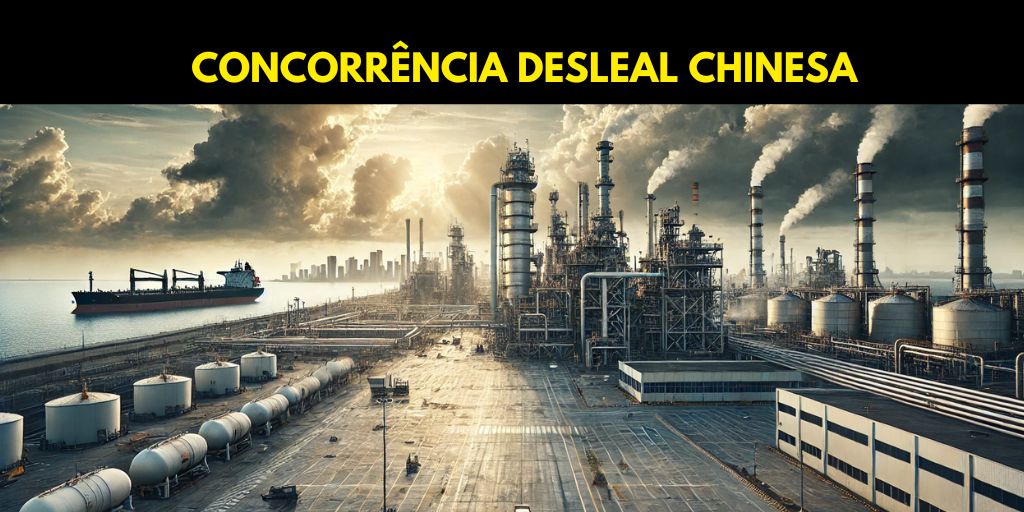
Brazil Is On The Verge Of Losing Its Chemical Industry To Unfair Competition From Asia. With The Closure Of Fortal And Rhodia, Thousands Of Jobs Are At Risk. Will The Government Act In Time To Save The Sector?
You may not notice, but the Brazilian chemical industry is facing a real storm. Companies that seemed solid and unbeatable are closing their doors, leaving behind thousands of unemployed workers and a trail of uncertainty.
But what really lies behind this chaotic scenario? Is it a matter of local inefficiency, or is Brazil suffering the consequences of a global trade war, where giants like China are playing hard to dominate the market?
Closed Factories And Rising Imports: The Portrait Of A Sector In Crisis
-
Future profession with immediate earnings: Specialist reveals how a solar energy technician earns R$ 8,000 per month by taking advantage of the explosion in demand across the entire country.

-
Work from 8:30 AM to 5:30 PM with a 1-hour break at Sicredi as a Customer Service Assistant and receive a salary + benefits such as life insurance, dental plan, partnerships, Gympass, and much more in job openings across various states.

-
Subsea7 has job openings: the company has offshore and onshore positions available in 2026 for operators, pilots, supervisors, engineers, and much more.
-
Unimed is hiring candidates with and without experience! More than 10 job openings for Assistants, Analysts, Kitchen Assistants, and much more!


The crisis is worsening. Recently, two of Brazil’s largest chemical companies, Fortal Química and Rhodia, decided to halt their operations.
Fortal, belonging to the Formitex group, indefinitely suspended its activities in Candeias, Bahia, while Rhodia, controlled by the Belgian conglomerate Solvay, announced the closure of its unit in Paulínia, São Paulo, which had been active since 1980. The reason? The fierce competition from chemical products coming, especially, from Asia, at unbeatable prices.
According to the Brazilian Chemical Industry Association (Abiquim), the share of imported products in the national market has skyrocketed.
Between 2000 and 2023, this share rose from 21% to 47%, putting pressure on the local industry, which is already experiencing the highest level of idleness in its history.
In 2024, the sector’s trade deficit reached nearly 22 billion dollars in the first half, an alarming figure.
Pressure On The Government: The Dilemma Of Import Tariffs
With the national market succumbing to imports, Abiquim has pressured the Brazilian government to take drastic measures.
On the 18th, the Executive Committee of the Foreign Trade Chamber (Gecex) will analyze a request from Abiquim to temporarily raise tariffs on 63 imported products.
According to the entity, this is one of the few viable solutions to curb the advancement of imports and protect local industry.
André Passos Cordeiro, president of Abiquim, has been one of the most critical voices regarding the impact of imports.
He directly blamed the government’s delay in making decisions, stating that this led to the closure of Fortal and Rhodia’s factories.
The Rhodia plant, which produced bisphenol A – a fundamental substance for the manufacture of plastics and industrial coatings – is the only one operating in South America.
The lack of gas and energy at competitive prices, combined with the rise in imports, forced the company to cease its activities.
The Bisphenol Battle: The Case Of Rhodia
Bisphenol A, produced by Rhodia, is used in two key markets: the manufacture of polycarbonates and epoxy coatings. These products have wide applications, from eyeglass lenses and car headlights to the construction industry.
But what really put Rhodia in a tight spot was the rise in bisphenol imports, particularly from China.
According to the Abiquim report, bisphenol imports doubled between 2022 and 2023, while prices dropped 32%.
In a letter sent to Vice President Geraldo Alckmin, the president of Solvay Group Latin America, Daniela Rattis Manique, highlighted the difficulty of maintaining competitiveness in Brazil.
The high cost of gas and energy in the country was one of the decisive factors for the closure of Rhodia’s operations.
Fortal Química: More Victims Of Unfair Competition
The case of Fortal Química follows a similar line. The company, which produced HPMC (hydroxypropyl methylcellulose), was unable to compete with the extremely low prices of products from Asia.
While production costs in Brazil hovered around US$ 2 per kilogram, China was selling the same product in the Brazilian market for similar prices, making it difficult for Fortal to remain competitive.
Other major suppliers like Taiwan and South Korea also entered this game, further increasing the pressure on the Brazilian company.
Asian Subsidies And Gas Prices: The Stumbling Blocks Of The Brazilian Industry
But the problem goes beyond the low prices of imported products. In China, there are more than 1,180 subsidy programs for the chemical industry, something that simply does not exist in Brazil, as highlighted by André Passos Cordeiro.
The only existing stopgap measure in the country is the Special Regime for the Chemical Industry (Reiq), which exempts the sector from PIS/Cofins.
Another crucial point is the price of gas. While in the United States gas costs less than US$ 2.5 per million BTU, in Brazil this price can reach up to US$ 14.
This brutal difference hinders the competitiveness of the Brazilian chemical industry, which relies on gas as one of its main raw materials.
Since the beginning of the war in Ukraine in 2022, Russia has been offering gas at very low prices to Asian countries like China and India, further increasing the competitiveness of those markets.
Both the United States and the European Union have adopted measures to protect their industries, including raising import tariffs temporarily.
Anti-Dumping Investigation: A Slow And Costly Solution
Although Abiquim has also considered the possibility of an anti-dumping investigation, which occurs when a country exports products at prices below cost, this process is extremely time-consuming and expensive.
According to Passos Cordeiro, such an investigation can take up to a year and cost between R$ 1 million and R$ 1.5 million for the companies involved.
Therefore, he advocates that the temporary increase of import tariffs is the most adequate measure to save the sector.
The Future Of The Brazilian Chemical Industry: Is There A Way Out?
With the growing competition from Asian products and the lack of subsidies and effective public policies, the future of the chemical industry in Brazil seems uncertain.
Rhodia denies that there will be layoffs.
In a statement sent to CPG, Rhodia explained that its employees will be reassigned. Read in full:
Rhodia informs that it has decided to interrupt the production and commercial operations of Bisphenol at its industrial unit in Paulínia starting December 31, 2024.
This decision is part of a strategic review of the company’s portfolio, aligned with its commitment to sustainable growth in the essential chemicals segment.
Therefore, the company opts to direct its future investments to other product lines that meet its customers’ demands. Rhodia also emphasizes that no job position will be affected at the factory, with only internal reallocations occurring.
The company will continue to operate with the same commitment and dedication to serve its customers during this transition period.
Will other factories follow the path of Fortal and Rhodia? If the government does not act quickly, the sector risks an irreversible collapse, with devastating consequences for the national economy.








Seja o primeiro a reagir!