





 English
  Francês
  Alemão
  Italiano
  Japonês
  Norueguês
  Portuguese
  Spanish
  4 min of reading
  0 comments


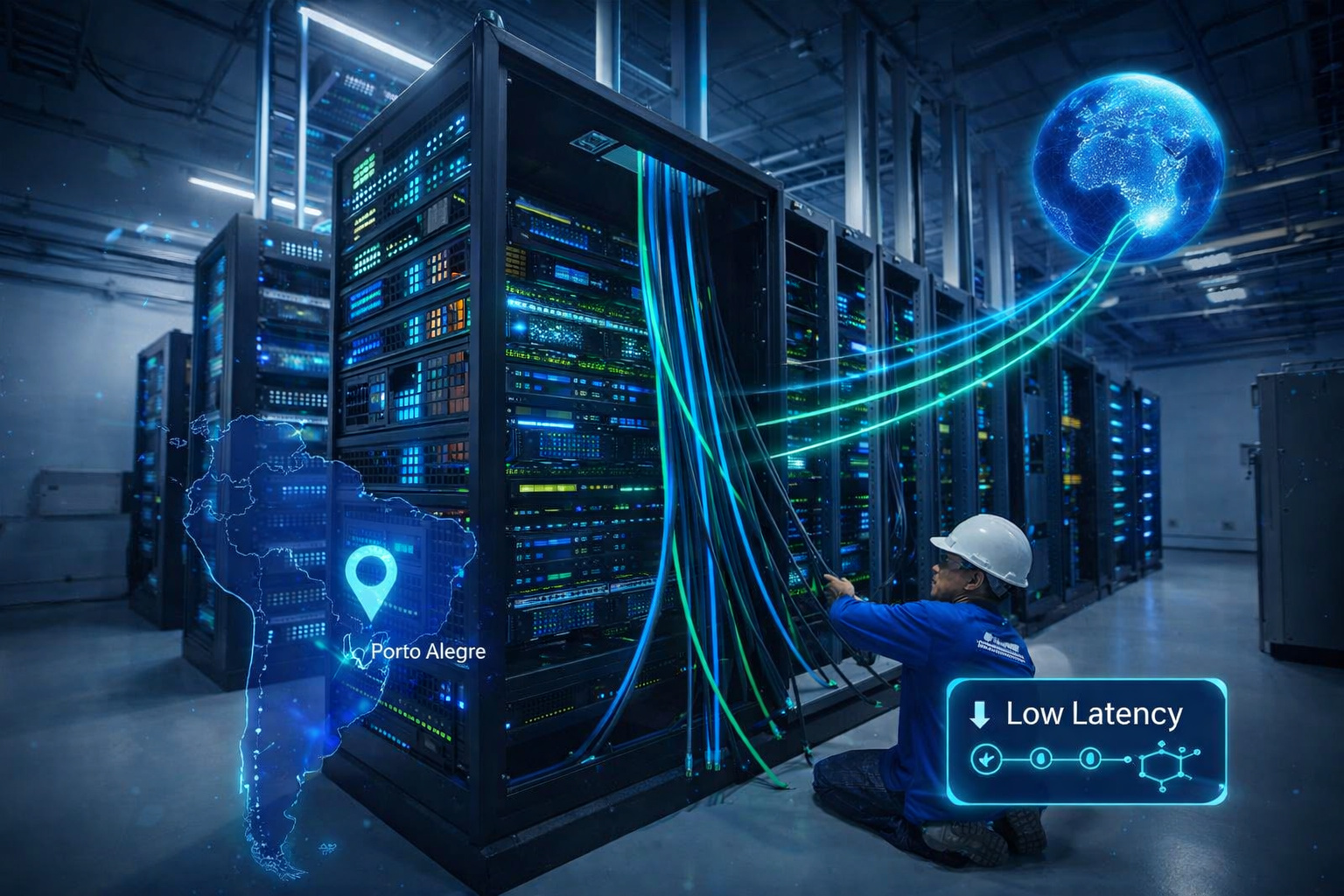
Study Evaluates Connection of the Gaucha Capital to the Oceanic Structure That Totals 1.4 Million Kilometers Worldwide and Can Boost Data Centers, Innovation, and Regional Competitiveness
The Digital World depends on an invisible yet absolutely strategic infrastructure. Currently, at least 570 submarine cables connect continents and countries, transporting data at high speed along the ocean floors. If laid out in a straight line, these cables would exceed 1.4 million kilometers, equivalent to three and a half times the distance from the Earth to the Moon. However, despite this impressive global network, none of these cables currently land on the coast of Rio Grande do Sul. Still, this reality may change in the coming years.
The information was released by a report from Agência RBS, which detailed ongoing studies to connect the State to one of the cables that pass along the coast of Rio Grande do Sul towards Argentina. If the project moves forward, the fiber optic cable would run from the coast and travel overland directly to Porto Alegre, placing the Capital at a new level of competitiveness.
Project May Reduce Latency and Attract Technology Companies
Currently, companies operating in Rio Grande do Sul rely on terrestrial connections that carry internet traffic to São Paulo, Rio de Janeiro, or Fortaleza. Only after that do data continue via maritime cables to their final destination. Consequently, the more interconnection points there are, the greater the latency tends to be — that is, the internet response time.
-
350-year mystery may have been solved: remains of a soldier who inspired the hero of The Three Musketeers found beneath a church in the Netherlands.

-
NASA photographed a nearly perfect square with 3 km sides on Mars, 13 times larger than the Great Pyramid of Giza, but the official explanation is natural erosion; still, no one has explained why the four sides have almost identical lengths.

-
Starlink breaks the barrier of 10,000 satellites in orbit and takes its expansion to an unprecedented level, with a direct impact on global internet, technological competition, and the race for space.

-
Japan finds an alternative to oil amid rising prices by transforming ocean balance into electricity with a new technology that maintains efficiency even when the sea changes.
Therefore, by creating a direct connection with a submarine cable, Porto Alegre could significantly reduce this response time. This reduction in latency represents an important competitive advantage, especially for technology companies, innovation, and data centers.
Sources from the Technology Sector and the city hall assess that it is highly likely that the connection will occur within a couple of years. The company responsible for the project, V.tal, confirms that it is working on the initiative, although it has not yet provided official timelines.
At the moment, we are conducting technical and financial feasibility studies, says the vice president of Engineering at V.tal, Cicero Olivieri.
Moreover, V.tal has already demonstrated the capacity to execute projects of this magnitude. In 2021, in partnership with Meta, the company responsible for Facebook and Instagram, it launched 2,600 kilometers of the cable called Malbec, connecting Rio de Janeiro and São Paulo to Argentina. Since then, there has been an expectation that Porto Alegre could become another strategic connection point.
Fortaleza Is a Reference in Brazil and Shows the Potential of the Model
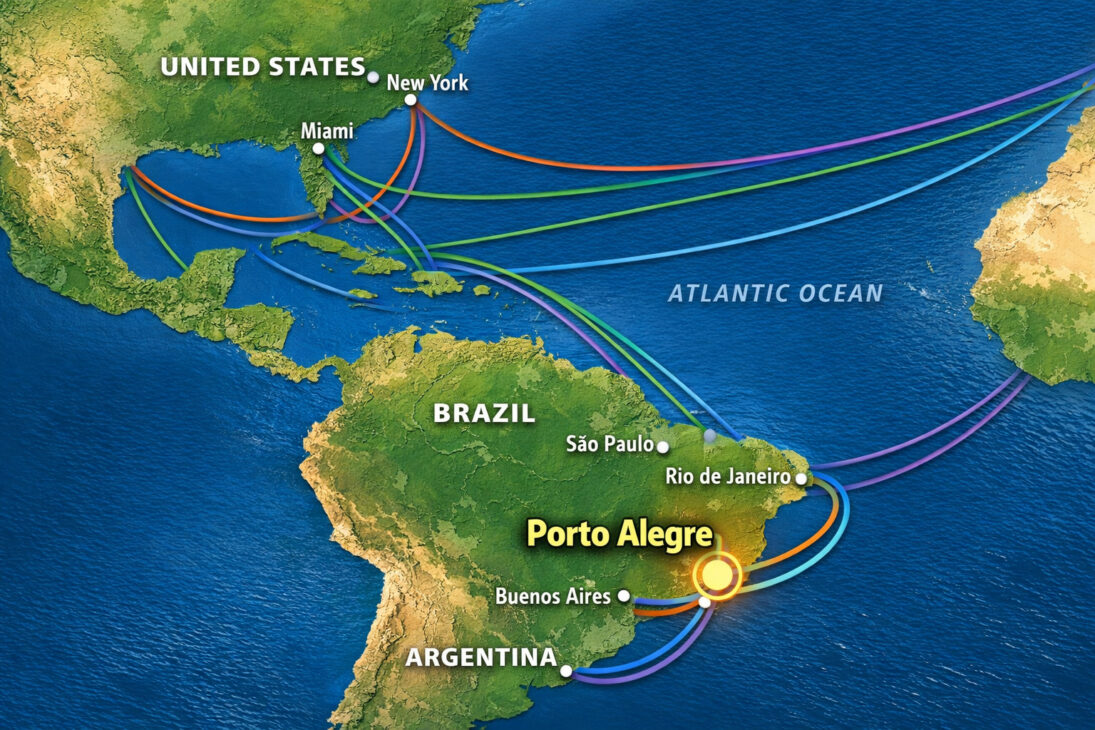
Today, Fortaleza (CE) occupies a prominent position as the main arrival and departure point for submarine cables in Brazil. The Ceará coast has dozens of connections, which explains why the city has established itself as a national reference in attracting data centers and technology companies.
This occurs primarily due to its proximity to the United States and Europe. Thus, servers located in the U.S. can transmit signals to Brazil via these cables, which then complete the journey through terrestrial networks.
According to Cleber Braz, senior vice president of Customer Experience at the data center company Scala, Porto Alegre can assume a similar role in the southern part of the country.
Currently, traffic in Brazil goes over land to São Paulo, Rio de Janeiro, or Fortaleza, from where it then follows to the final destination via maritime cable. The more interconnection points along the way, the worse the signal becomes. So we have various companies evaluating what the cost and latency reduction would be if, instead of going up to Fortaleza, it were more direct. We believe Porto Alegre can be a new center for distributing this traffic, says Braz.
Additionally, the Gaucha Capital has a relevant geographical advantage: its proximity to Uruguay and Argentina. According to Braz, Porto Alegre could especially serve the Argentine market, where current socioeconomic conditions are not considered ideal for infrastructure investments.
Global Investments May Reach US$ 10 Billion
The growing demand for data, streaming, voice calls, and digital services drives the expansion of this submarine infrastructure on a global scale. Estimates indicate that, between 2022 and 2024, investment in the construction of fiber optic cables may reach US$ 10 billion, equivalent to about R$ 50 billion.
In light of this scenario, Porto Alegre seeks to secure a share of this amount. After all, directly integrating into the submarine network not only reduces latency but also strengthens the city’s image as a technological and logistical data hub.
Therefore, if the project progresses in the next two years, the Gaucha Capital could change its strategic position on the digital map of South America.
Do you believe this connection can really transform Porto Alegre into a new technology hub in Brazil?







Seja o primeiro a reagir!