





 Portuguese
  English
  Spanish
  6 min of reading
  11 comments


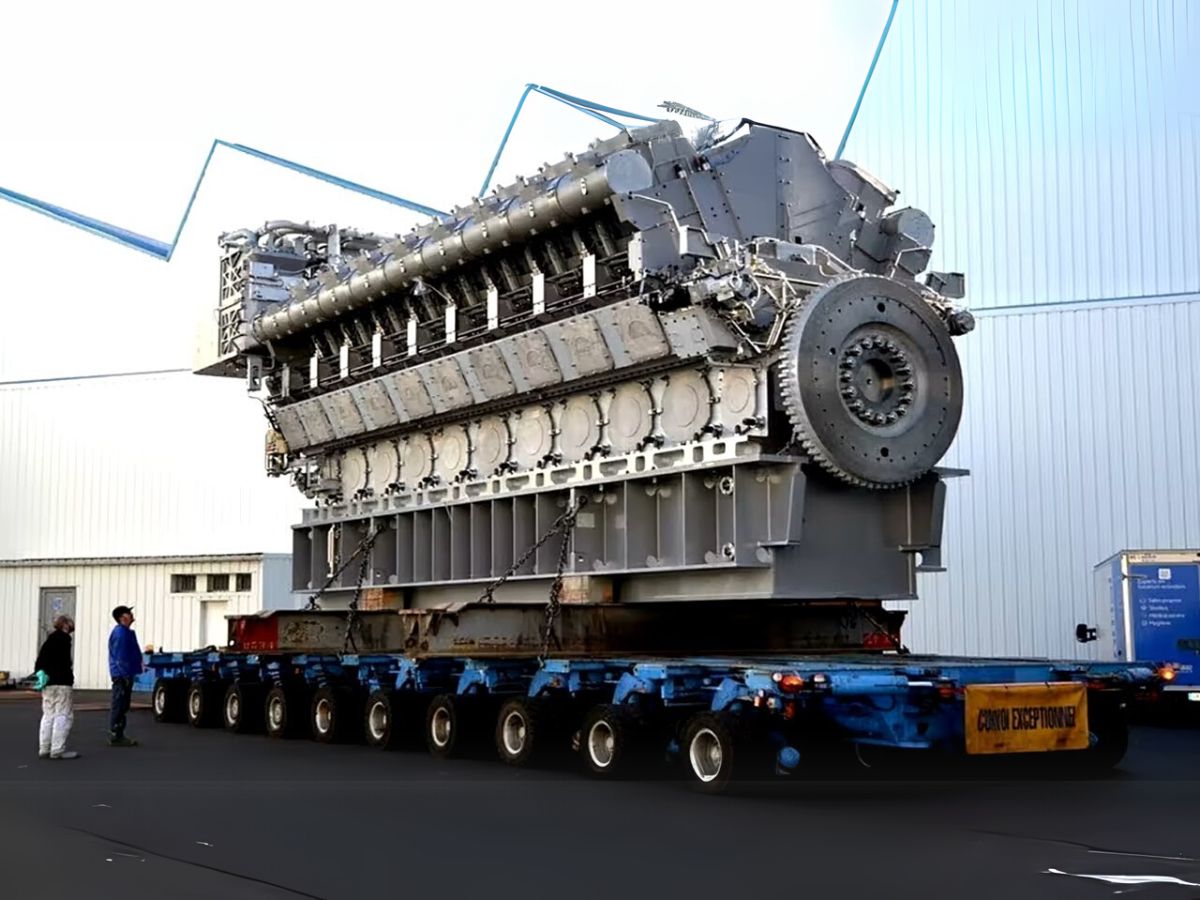


The Wärtsilä-Sulzer RTA96C Engine Has Torque 40 Thousand Times Greater Than That of a Regular Car and Weighs More Than a Boeing 747
The most powerful engine in the world: Developing 109,000 HP, it consumes 14 tons of fuel per hour and moves giant ships with incredible efficiency. This is the largest engine of all time, and despite its staggering consumption, its efficiency is superior to that of a conventional internal combustion engine. Its size and power are just as amazing as the rest of the numbers I will provide later.
Wärtsilä-Sulzer RTA96C: The Heart of the Colossus
The Finnish company Wärtsilä gave birth to this mammoth designed to move supertankers and very large crude carriers across seas and oceans. It entered service in 2006 on the Emma Maersk cargo ship. Thanks to the 109,000 HP it develops, it can displace its 397 meters in length filled with thousands of shipping containers at nearly 50 km/h. The Emma Maersk has a gross weight of approximately 170,974 tons, which further highlights the power needed to move it.
Now let’s get to the heart of the matter. How big is this engine really? How can it be efficient consuming 14,000 kilograms of fuel per hour? And the torque? We will answer all of this, but I can already tell you that the torque it generates defies all logic. Just look at the images in the gallery to see.
-
After decades of failed attempts, Brazil is once again looking to space with an orbital rocket measuring 12 meters, weighing 12 tons, costing R$ 189 million, and scheduled for launch in 2026, in a new race to finally achieve autonomous access to orbit.

-
The Earth will plunge into a few minutes of darkness in broad daylight in August 2026, when a total solar eclipse transforms the sky into one of the most impressive astronomical phenomena in recent years.

-
How the terraforming of Mars can transform the planet: artificial aerosols can increase the temperature by up to 35°C in 15 years, creating conditions for liquid water.

-
Scientists drilled nearly 8,000 meters into the ocean floor above the fault that caused the 2011 tsunami in Japan and discovered that a layer of clay 130 million years old was responsible for making the wave much worse than any model had predicted.

Designed to move very large crude carriers, the RTA96C delivers 109,000 HP while consuming 14,000 kilograms of fuel per hour to fulfill its mission.
Main Specifications:
- Maximum Power: 109,000 HP (about 80,000 kW) at 102 rpm
- Torque: 7,603,850 Nm
- Total Weight: 2,300 tons
- Length: 27 meters
- Height: 13.5 meters (equivalent to a 5-story building)
- Total Displacement: 25,480 liters (1,820 liters per cylinder)
- Maximum Consumption: about 14,000 kg/h of heavy fuel oil (HFO)
Just the crankshaft of this engine weighs 300 tons. Each of the 14 pistons has more than 1 meter in diameter, and the connecting rods are comparable in size to trees. The operation at low RPM — about 102 rpm — translates into reliability and high mechanical efficiency, allowing it to push vessels with tens of thousands of tons of cargo at speeds of up to 48 km/h (26 knots).
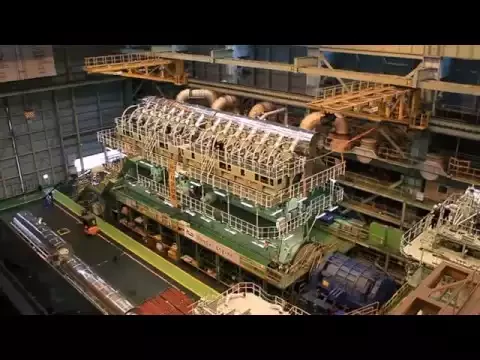

Dimensions of the Largest Engine in the World
While a conventional internal combustion engine can weigh between 120 kg and 300 kg, the RTA96C tips the scales at 2,300 tons. Madness, much like its size. About 27 m in length and 13.5 m in height, the same as a 5-story building. Let’s continue with more astronomical numbers. The displacement is a modest 25,480 liters. Considering it is a 14-cylinder engine, we have 1,820 liters per cylinder.
Now that you see how big it is, you can imagine that its manufacturing is not done overnight. It takes several months to a year, and the cost can exceed 20 million. Of course, after that, maintenance is required, which is done every three years and, no, it is not cheap either. As big as a 5-story building, with a displacement of 25,480 liters and a weight of 2,300 tons.
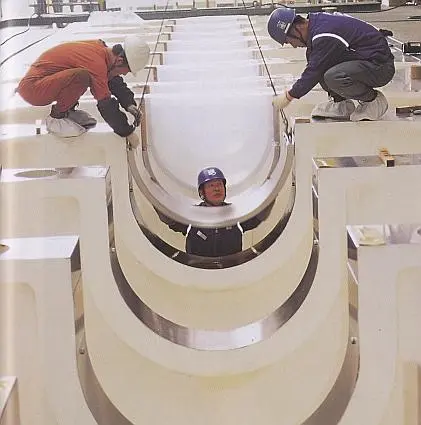
The Wärtsilä-Sulzer RTA96C
It is a 14-cylinder inline turbocharged diesel engine with a two-stroke common rail injection system. It uses heavy fuel oil that is injected mixed with oil (note there are thousands more liters). The maximum power of 109,000 HP is developed at “only” 102 rpm. I don’t know if that seems little or much considering its dimensions. Keep in mind that just the crankshaft weighs 300 tons. The torque is also given at 102 rpm and, hold on, it’s 7,603,850 Nm. Yes, we are talking in millions. 7.6 million Newton-meters of torque at 102 revolutions per minute.
Consumption of the Largest Engine in History: Explaining the Efficiency of an Engine
The consumption of this beast is 3.8 liters of fuel per second at maximum load. That’s almost the 14 tons per hour mentioned earlier. However, at a more efficient RPM, this consumption can be reduced to something less than half. Not bad, although those figures are still staggering. It is known that some ships of this type pollute as much as all the cars on the planet. We must be aware of the cargo they carry, which can be as incredibly enormous as all the numbers we saw in the specifications of this machine.
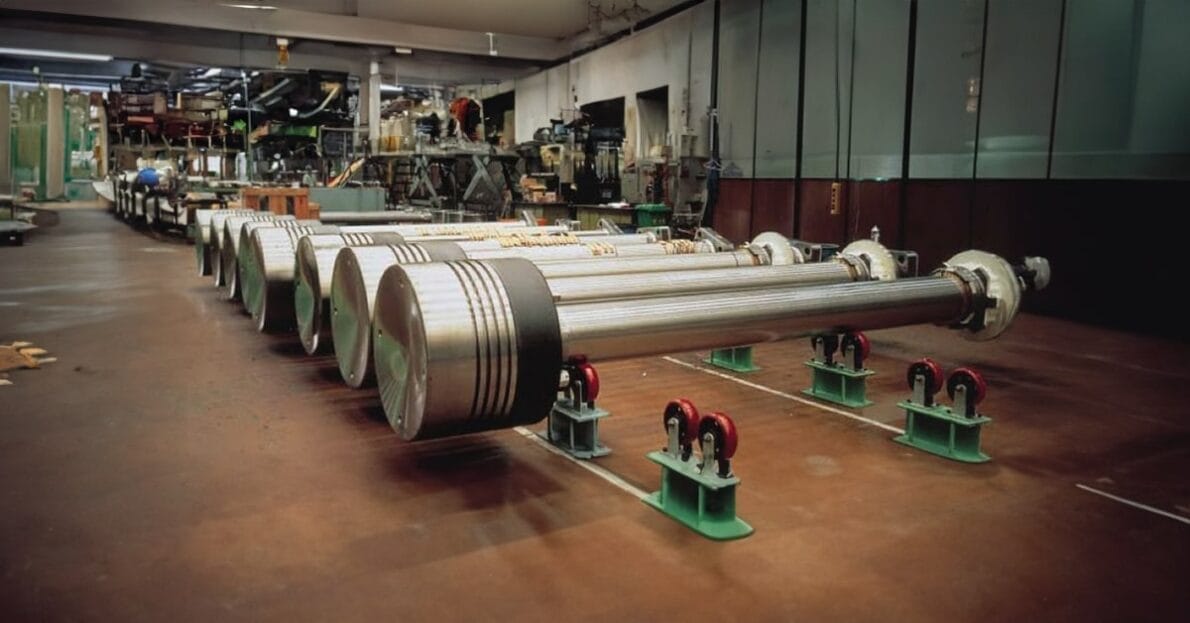
Despite this, this engine enjoys a thermal efficiency slightly above 50%. Something that many cars (especially those from the time it was created) don’t even come close to with their combustion engines. This percentage means that 50% of the energy from the burned fuel is transformed into motion. What do you think of these engineering beasts? Is there a cleaner way to move such colossal ships? A thermal efficiency of 50% implies that 50% of the energy from the burned fuel is transformed into motion.
Environmental Impact: A Global Concern
Despite its energy efficiency, the Wärtsilä-Sulzer RTA96C engine predominantly uses heavy fuel oil (HFO) — a highly polluting petroleum derivative. Emissions of sulfur oxides (SOx), nitrogen oxides (NOx), and fine particles significantly contribute to marine and atmospheric pollution.
Studies indicate that the 15 largest cargo ships in the world, all with engines of similar size, pollute more than the entire global fleet of automobiles in terms of sulfur. Source: Transport & Environment (EU)
To mitigate this impact, the IMO (International Maritime Organization) has implemented stricter regulations since 2020, reducing the allowable sulfur content in marine fuel to 0.5%. In response, many shipowners have begun to adopt gas purification systems (scrubbers), fuel with lower sulfur content, and more recently, dual-fuel engines.
Logistical Application: How It Supports Global Trade
Engines like the RTA96C are installed in next-generation container ships, responsible for transporting thousands of TEUs (20-foot container units) between continents. In the case of the Emma Maersk, for example, it has an estimated capacity of over 14,000 TEUs, equivalent to the cargo volume of more than 10,000 trucks.
Moreover, its reliability allows long interoceanic crossings without the need for constant maintenance. Adjustments are typically made every three years, with scheduled stops in dry docks, where the engine is partially disassembled for inspections.

With its 397 meters in length and 56 meters in beam, it can carry approximately 14,770 twenty-foot containers.
Operating and Maintenance Costs: Power Comes at a Price
Operating an engine like the Wärtsilä-Sulzer RTA96C involves costs proportional to its scale. Although extremely efficient for its size, the costs related to fuel, preventive maintenance, and scheduled stops represent a significant fraction of the logistical costs of a modern cargo ship.
Fuel Consumption
At maximum load, the engine consumes about 14 tons of heavy fuel oil (HFO) per hour. Considering an average global price of US$ 600 per metric ton of HFO (reference values in 2025), this results in an expenditure of US$ 8,400 per hour of continuous operation.
On a 30-day crossing between Asia and Europe, operating approximately 20 hours a day, the fuel cost would exceed US$ 5 million. This expense may vary depending on cruising speed and the adoption of low-sulfur fuels required by international standards.
Maintenance and Periodic Review Costs
The RTA96C engine requires complete inspections every 25,000 to 30,000 hours of operation, which averages out to a deep maintenance every three years. During these occasions, the ship is taken to a shipyard for dry-docking, partial disassembly, and review of critical components — including pistons, connecting rods, valves, and the crankshaft.
This process can cost between US$ 1.5 million and US$ 3 million, depending on the scope of services, availability of spare parts, and geographical location. The crankshaft, for example, which weighs 300 tons, requires specialized tools and cranes just for its removal and inspection.
Specialized Technical Team
The operation and maintenance of such large engines also require a highly trained technical crew. Marine engineers, propulsion system operators, and machine technicians are part of a team that continuously works to ensure the reliability of the system. The costs associated with onboard technical personnel and outsourced services in shipyards should also be considered as a relevant part of the fixed operating costs.
Total Life Cycle Cost
Considering fuel, maintenance, crew, and potential parts replacements, it is estimated that the cost of the complete life cycle of the Wärtsilä-Sulzer RTA96C engine exceeds US$ 100 million over 25 years of operation. This amount includes not only the operating expenses but also the initial manufacturing cost, which can reach US$ 20 to 25 million per unit.









Tento imaginar como são os torquímetros e a bancada de testes desse motor, mas não consigo, rsrsrs…
Ja trabalhei com esse tipo de motores na Ishibras nos anos 80!!
Para uma travessia Brasil x Asia, qual e a capacidade do tq de armazenamento e a capacidade do tq de consumo?.
Se contar 4 ou 5 banguelas lá pro lado do riacho do navio ,deve economizar uns 27 litros de diesel