





 Portuguese
  English
  Spanish
  4 min of reading
  2 comments


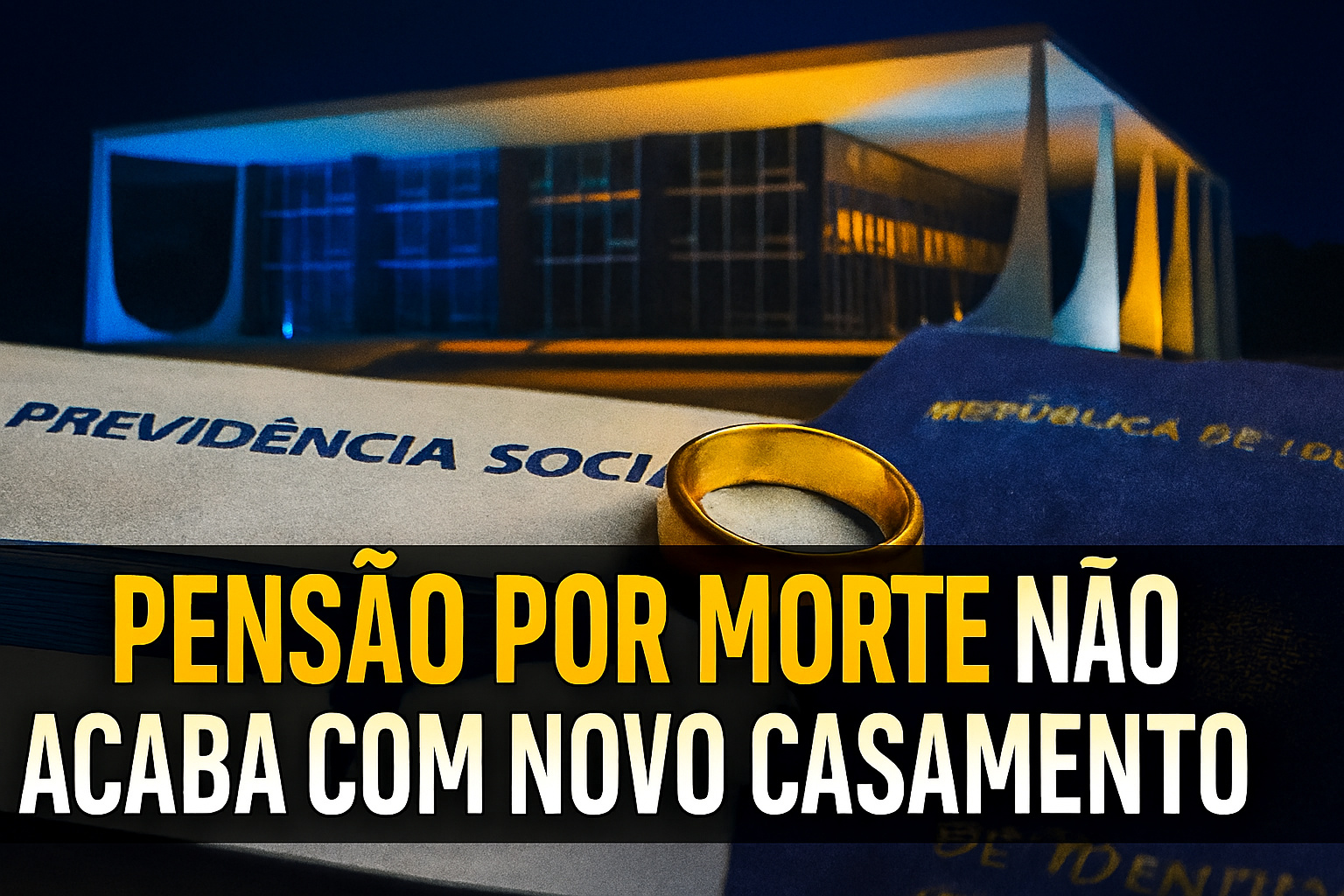


Spouse Does Not Lose Death Pension Upon Remarrying: Courts Confirm That Benefit Can Only Be Cut in Cases of Proven Fraud
For decades, thousands of Brazilian widows and widowers believed that a new marriage could mean the immediate end of the death pension received from the INSS or from specific pension schemes. The fear was not unfounded: in old legislations, this hypothesis was indeed provided as a reason for cancellation.
However, current legislation and the interpretation of higher courts have brought relief. Today, it is consolidated understanding that a new marriage does not automatically extinguish the benefit. Loss only occurs in cases of proven fraud, when the marriage is celebrated merely as a way to maintain or increase the pension.
What the Law Says About Death Pension
The Law No. 8.213/1991, which governs Social Security benefits, establishes that the death pension is due to the spouse or partner of the deceased insured party, as long as there is proof of economic dependence.
-
The noise law will no longer be in effect at 10 PM starting in June with a new rule valid during the 2026 World Cup.

-
The Chamber opens a debate on driver’s licenses at 16 years old as part of a reform that includes around 270 proposals to change the Brazilian Traffic Code and may redesign rules for licensing, enforcement, and circulation in the country.

-
The new Civil Code could revolutionize marriages in Brazil with “express divorce” and changes that could exclude spouses from inheritance.
-
Banco do Brasil sues famous influencer for million-dollar debt and intensifies debate on delinquency, risks of seizure, and direct impact on Gkay’s credibility.


The regulation does not provide for the cancellation of the pension due to new marriage. In other words, the widow or widower can rebuild their emotional life without fearing the automatic loss of the benefit.
The exception occurs when there is fraud: if it is proven that the union was made in a simulated manner, solely to secure or maintain the benefit, the INSS can suspend the payment.
The History of Change
Until the 1990s, there were more restrictive interpretations which, in some pension regimes, led to the cancellation of the pension in the case of a new marriage. The justification was that the economic dependence ceased to exist.
Over time, social reality and court decisions changed this logic. The Federal Constitution of 1988 itself recognized the right to human dignity and the formation of new families as fundamental guarantees.
Thus, the death pension ceased to be a benefit conditioned on the “civil status” of the widow or widower, becoming centered on the criterion of economic dependence existing at the time of the insured’s death.
Court Decisions That Consolidated the Understanding
- The Superior Court of Justice (STJ) has already ruled that a new marriage does not extinguish the death pension, except in cases of proven fraud (AgInt no REsp 1.614.874/RS).
- In 2023, the Federal Regional Court of the 4th Region (TRF-4) ruled against an action from the INSS that aimed to cut the pension of a widow who remarried, confirming that the law does not provide for such a hypothesis.
- State courts, in cases involving public servants and specific pension schemes, have also followed the same line, reinforcing that loss of the benefit can only occur in exceptional cases of bad faith.
How It Works in Practice
In practice, this means that:
- Widows and widowers can remarry without the risk of automatically losing the pension.
- The INSS cannot suspend the benefit solely due to the new marriage.
- Fraud needs to be proven, not presumed. Simulated marriages to secure the pension can lead to loss of the benefit.
Example: a 55-year-old widow, a pensioner for 10 years, can remarry and will continue to receive the benefit normally, as long as there are no indications of fraud.
The Impact on Millions of Brazilians
According to data from the INSS itself, in 2024 there were more than 7 million beneficiaries of death pensions in Brazil. Of these, a significant portion consists of spouses and partners.
The legal security of knowing that a new marriage does not automatically cut the benefit brings peace of mind to thousands of families. In addition to protecting income, it guarantees the constitutional right to rebuild emotional life without fear of financial punishment.
What to Do in Case of Attempted Pension Cut
If the INSS or pension regime attempts to suspend the pension due to a new marriage, the insured can:
- File an administrative appeal directly with the INSS.
- Register a complaint with the agency’s ombudsman.
- File a lawsuit, where the case law is established in favor of the beneficiaries.
In numerous cases, the courts not only reinstate the pension but also order the agency to pay retroactive amounts and, in cases of abuse, compensation for moral damages.
Controversial Issues Still Under Debate
Despite the consolidated understanding, some specific situations still generate disputes:
- Simulated unions: fictitious or convenience marriages may lead to cuts.
- Accumulation of benefits: when the new spouse also passes away and the widower tries to accumulate two death pensions, the law establishes limitation rules.
- Specific pension schemes: in some states and municipalities, local rules still generate controversy, but courts have overturned illegal restrictions.
New Marriage Does Not Cancel Death Pension: Right Guaranteed by Justice
The courts’ decision is clear: love cannot be penalized. Widows and widowers can rebuild their lives without fear of losing the benefit they have secured by right.
The death pension can only be cut if there is proven fraud, never simply for choosing to remarry. This change not only ensures lifetime income for millions of families but also reinforces the principle of human dignity that guides the Brazilian legal system.
In summary, the message from the Justice is direct: death pension is not a bargaining chip. It is the dependent’s right and must be respected.










Só no Brasil mesmo!!!
Muito justo
Eu TB pensava que perdia a pensão