





 Portuguese
  English
  Spanish
  3 min of reading
  0 comments


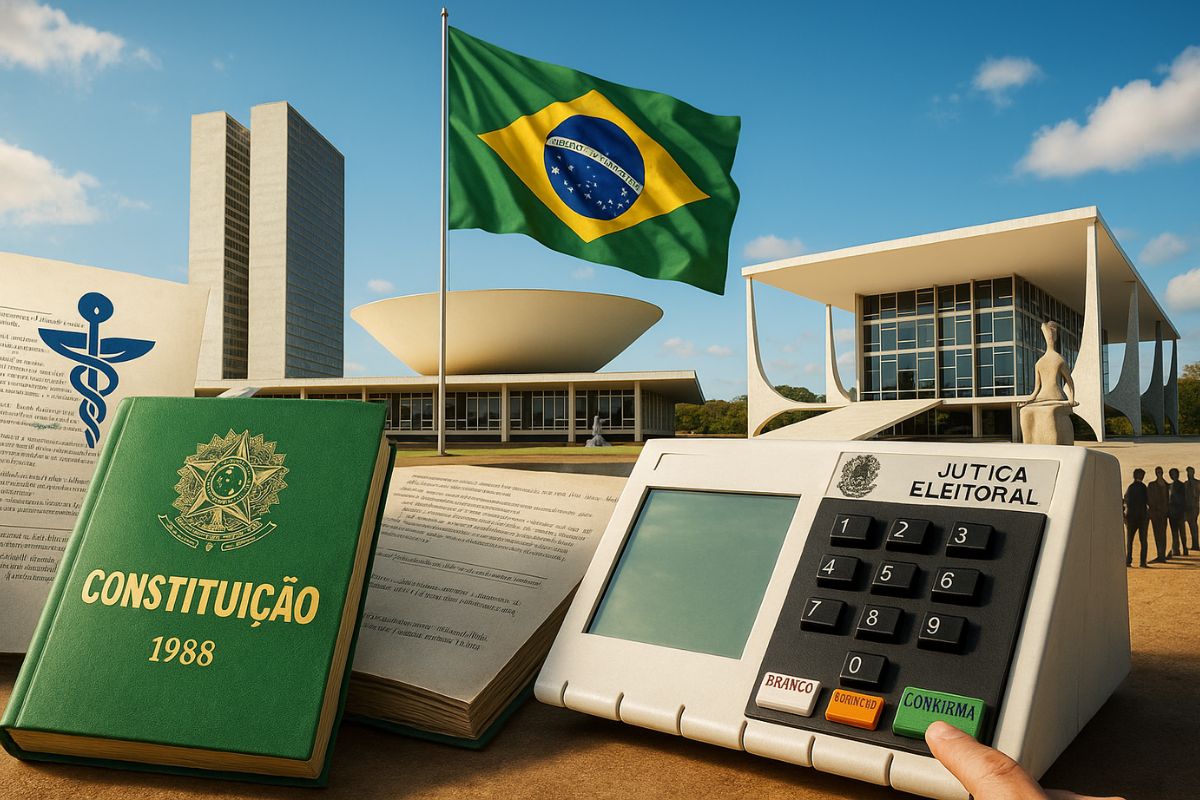
1988 Constitution Without Legalese: Rights and Duties Explained, Three Powers, Unalterable Clauses, SUS, and Constitutional Amendments to Understand How Voting Transforms Brazil
The 1988 Constitution was born to organize public life and protect freedoms, uniting rights, duties, and an institutional framework that prevents the concentration of power. It was announced by Ulysses Guimarães and became the foundation of the Brazilian democratic system, detailing how the three powers, unalterable clauses, SUS, and constitutional amendments work, and why voting is the tool that drives everything.
In this guided reading, the 1988 Constitution appears without legalese. You will understand in clear language what is guaranteed to the citizen, what belongs to the State, and how rules change with legitimacy, always with attention to the practical role of the voter in demanding, proposing, and transforming. The proposal is simple: to translate principles, show paths, and reinforce that balanced three powers, firm unalterable clauses, universal SUS, and responsible constitutional amendments only exist fully when voting is involved.
Why the 1988 Constitution Matters
The 1988 Constitution organized the Republic on foundations such as citizenship, human dignity, and political pluralism.
-
Banco do Brasil sues famous influencer for million-dollar debt and intensifies debate on delinquency, risks of seizure, and direct impact on Gkay’s credibility.

-
The Senate approves a bill that criminalizes misogyny, hatred, or aversion towards women, and includes the crime in the Racism Law with a penalty of up to 5 years.

-
Chamber Approves Bill That Allows Pepper Spray for Women Over 16 and Imposes Strict Rules for Purchase, Possession, and Use as Self-Defense

-
Chamber Approves Law to Combat Leucaena, Fast-Growing Plant That Dominates Land and Threatens Native Species in Various Regions of the Country


It defines who decides, how they decide, and how far they can go, establishing limits and responsibilities.
It is not an abstract text: it is a manual for the country’s functioning, distributing competences and sustaining mutual control among the three powers.
The core of rights affirms equality before the law, freedom, security, and property.
Social rights such as education, health, work, and housing are also pillars, explaining the creation of SUS as a universal and free system.
In contrast, duties such as respect for laws and civic participation ensure that the 1988 Constitution comes to life and reaches everyday situations.
How the Three Powers Work
The three powers are independent and harmonious. The Legislative makes laws and oversees, the Executive governs and implements policies, and the Judiciary judges based on existing laws.
When you demand a change in rules, the demand should target those who legislate, reinforcing the logic of the 1988 Constitution.
This balance among the three powers prevents abuses and maintains the democratic game.
The unalterable clauses protect the heart of the constitutional pact.
Federal state form, direct, secret, universal, and periodic voting, separation of the three powers, and individual rights and guarantees cannot be abolished even by constitutional amendments.
It is the anchor of the 1988 Constitution, shielding the democratic regime against setbacks.
SUS and the Social Order
The SUS materializes the promise of social rights. Universality, comprehensiveness, and equity guide public health policy, confirming that the 1988 Constitution sees freedom and dignity alongside minimum material conditions.
By recognizing SUS as state policy, the Charter links budget, management, and social control to results for all.
Constitutional Amendments and Updating the Rules
The Charter is stable but not unchangeable.
Constitutional amendments allow adjustments through qualified quorum and two rounds in each House of Congress.
This more rigorous procedure protects coherence and predictability, keeping the choices of the 1988 Constitution alive without violating unalterable clauses.
Responsible constitutional amendments respond to social changes without breaking principles.
Voting selects who legislates, governs, and judges through institutional indication.
It is the lever that connects you to the three powers. When rights are violated, there are paths such as the Public Ministry, Public Defender, ombudsmen, and constitutional actions.
The 1988 Constitution is not just theory: it provides tools for action, while constitutional amendments and SUS policies show how electoral choices become real services.
The 1988 Constitution is a living project.
Balanced three powers, firm unalterable clauses, universal SUS, and responsible constitutional amendments depend on continuous participation.
Voting transforms priorities into policies, converts promises into budgets, and ensures that rights exist beyond the text.
In your municipality, what should be the first budget priority guaranteed by the 1988 Constitution to improve your life next year?










Seja o primeiro a reagir!