





 Portuguese
  English
  Spanish
  5 min of reading
  12 comments


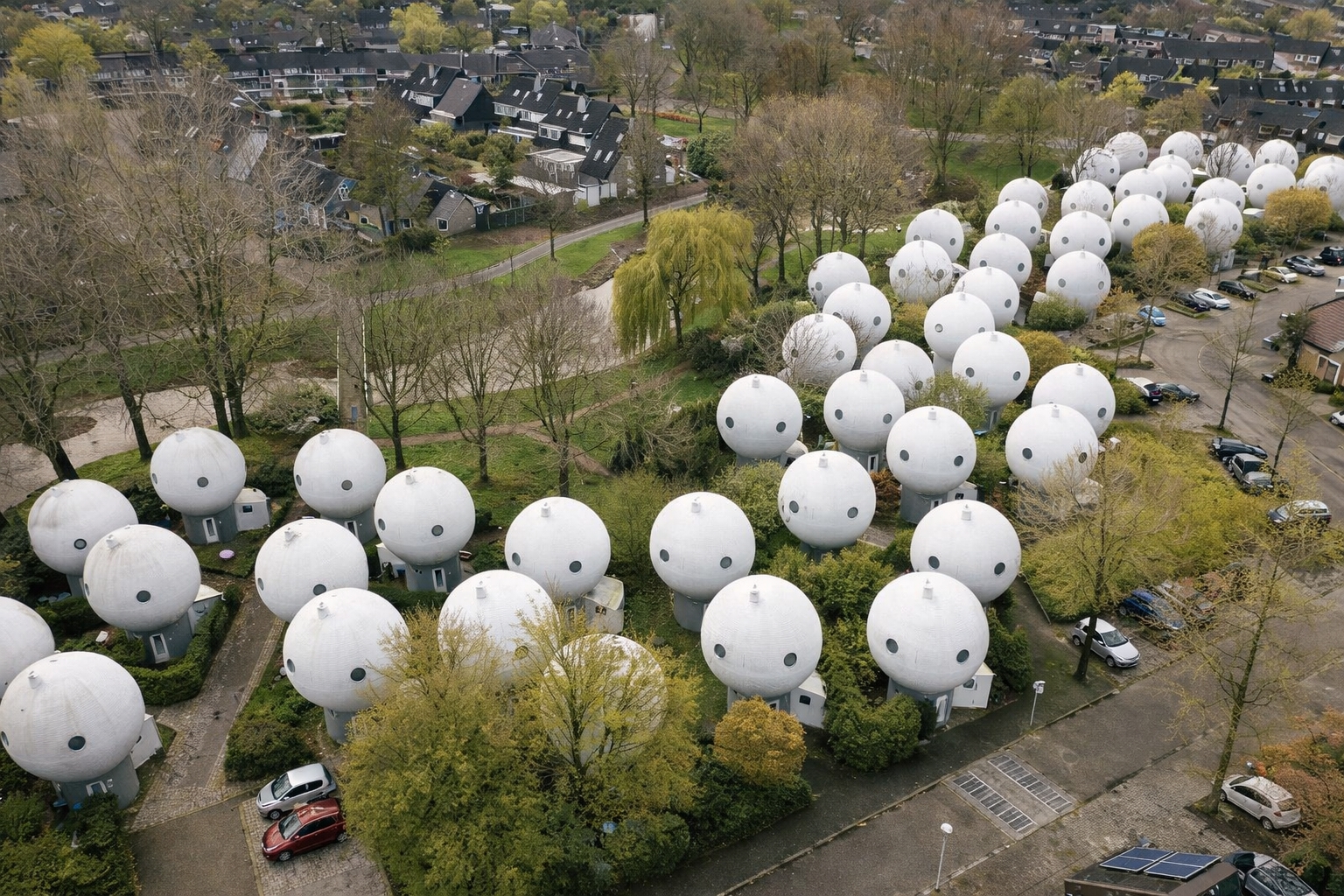


Construction of 50 Spherical Houses Measuring 5.5 Meters in Diameter and 11 Windows to Test Low-Cost Housing Provokes Debate About Non-Traditional Architecture and Attracts Attention from Tourists, Architects, and Journalists Worldwide.
In the late 1960s, the Dutch government opened the floodgates for experimental housing projects. This wave gave birth to ideas that still attract attention today, such as the Cube Houses, the Kasbah complex, and in the midst of brick houses and winding canals, a neighborhood that seems to have fallen from another planet: the Bolwoningen.
Bolwoningen literally means ball-shaped or bulbous houses. And that’s exactly what they are: spheres that resemble giant golf balls, assembled as a real residential complex, with people actually living there.
The outcome is curious for a simple reason. The project did not become a standard, it did not spread as expected, but it also did not die. It continued to be in use, with satisfied residents, and an aesthetic that became even more unusual over time.
-
Friends have been building a small “town” for 30 years to grow old together, with compact houses, a common area, nature surrounding it, and a collective life project designed for friendship, coexistence, and simplicity.

-
This small town in Germany created its own currency 24 years ago, today it circulates millions per year, is accepted in over 300 stores, and the German government allowed all of this to happen under one condition.

-
Curitiba is shrinking and is expected to lose 97,000 residents by 2050, while inland cities in Paraná such as Sarandi, Araucária, and Toledo are experiencing accelerated growth that is changing the entire state’s map.

-
Tourists were poisoned on Everest in a million-dollar fraud scheme involving helicopters that diverted over $19 million and shocked international authorities.


How the Netherlands Funded Experimental Housing and Why Bolwoningen was Born in 1968
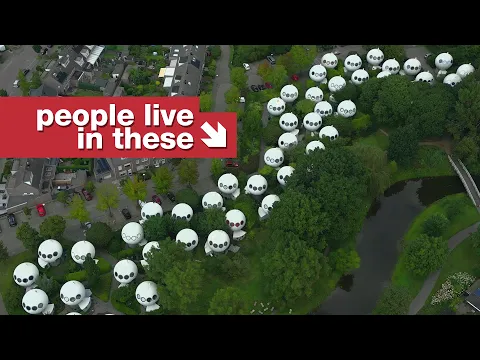

In 1968, the Netherlands allocated funds for the experimental construction of low-cost housing. Bolwoningen was one of the proposals from this movement, designed by Dries Kreijkamp, a Dutch architect, industrial designer, and sculptor.
The time was fertile for this type of experience. Other well-known examples, like the Cube Houses in Helmond and the Kasbah complex in Hengelo, were completed in the 1970s. Bolwoningen emerged in the same period, but construction was delayed and only started much later.
The most striking detail is that the problems did not end when they decided to start the work. Construction began in 1980, the project was ultimately canceled in 1984, and during this period, several changes had to be made to meet rules and regulations.
From Prototype in the Backyard to Cylindrical Base, the Changes the Project Underwent Until 1980
Before arriving in Den Bosch, Kreijkamp tested the idea in his own backyard in Vlijmen. The initial prototype did not even have a cylindrical base. Two spherical models and one semi-spherical model were placed directly on the ground.
The plan was to replicate the concept in Den Bosch, but building codes pushed the project in another direction. The first change was to incorporate the cylindrical base, which became an essential part of the solution.
The second change was even greater: material. The original proposal sought something light and easy to install, so Kreijkamp considered polyester to ensure low weight. However, polyester was replaced with two layers of reinforced concrete with fiberglass reinforcement, as well as rock wool insulation.
Even with compromises and changes, he viewed the Den Bosch phase as just the beginning, hoping that the idea would multiply later.
Numbers That Ground the Spherical Houses: 50 Units, 5.5 Meters, 11 Windows, and 55 M²
Bolwoningen, as constructed, consists of 50 spherical houses in use and has become a tourist attraction. The shape was advocated by Kreijkamp himself as a logical and efficient choice.
He explained in interviews that the sphere would be an organic and natural form, as life would be surrounded by “roundness.” He also argued that the sphere combines a large volume with a smaller surface area, requiring less material, saving space, being ecological, and needing minimal maintenance.
Each house has a diameter of about 5.5 meters and 11 round windows. The proposal is for units that do not require a permanent foundation and can be constructed with low energy consumption. Each one weighs 1250 kg and could be easily assembled or transported.
In practice, they can be viewed as micro houses, suitable for a maximum of two people. The envisioned approach was precisely adaptability: installing in different places to popularize the concept.
Entry Through the Base, Life in the Sphere, and an Interior That Replaces Walls with Open Platforms

The layout diverges from the obvious. The cylindrical base functions as an entrance and houses the stairs, storage rooms, and service areas. Access to the main part occurs on the upper floor, inside the spherical unit, where the living spaces are located.
The interior includes a bedroom, living room, kitchen, and bathroom, organized so that the most used areas receive the best possible lighting. The bed is accessed by a spiral staircase that winds around the interior of the sphere, passing through the lavatory and reaching the living room and kitchen.
Lighting plays a part in the effect. A central fixture in the ceiling and six circular windows measuring 1.20 meters in diameter allow plenty of light to enter. Instead of traditional rooms and separate levels, the sphere is divided into open platforms and interconnected functional spaces. This reduces the feeling of crampedness, even with an interior of 55 square meters of usable area.
The hook here is the practical side. The experience is unique, but decoration becomes a challenge. As the walls curve from floor to ceiling, common furniture rarely fits well. Still, photos shared by residents show that it is possible to adapt and decorate, even with this unfriendly geometry.
Visits from Around the World, Risk of Demolition in the 1990s, and Restoration After Cracks and Infiltrations
From the beginning of the discussions until the end of construction, the experimental settlement drew attention. After completion, journalists, architects, and tourists from various places came to see the spheres up close. This encouraged Kreijkamp to consider mass production, but the second chance never came.
In the following years, he created hundreds of designs and budgets to develop new sites, but he could not secure a new order. Over time, complaints arose about infiltrations and cracks, as well as the sinking of one of the houses. In the mid-1990s, the housing company even considered demolition.
The houses were restored after a complete renovation and the addition of storage space in small structures connected to the poles. Nonetheless, the municipality refused and did not request new projects.
Kreijkamp continued attempting to refine the idea until his death. He even designed floating globe-shaped houses made of polyester powered by wind and solar energy and equipped with outboard motors. He also found a factory in Dubai that could produce the polyester spheres. In the end, none of these plans came to fruition.
Bolwoningen continued to exist as a remnant of a time when the Dutch government supported experimental projects, remaining a prototype, just like the Cube Houses. And that is precisely why it continues to be visited.
Would you live in one of these spherical houses, or do you think the fun is just in visiting and leaving?










Interessante, precisa ver o custo
Aqui em Valinhos existe uma comunidade com estas casas.
Tem foto
Era uma casa muito engraçada…
Na rua Bobos, número zero!
Lembrei da canção do Vinícius.