





 Portuguese
  English
  Spanish
  4 min of reading
  1 comment


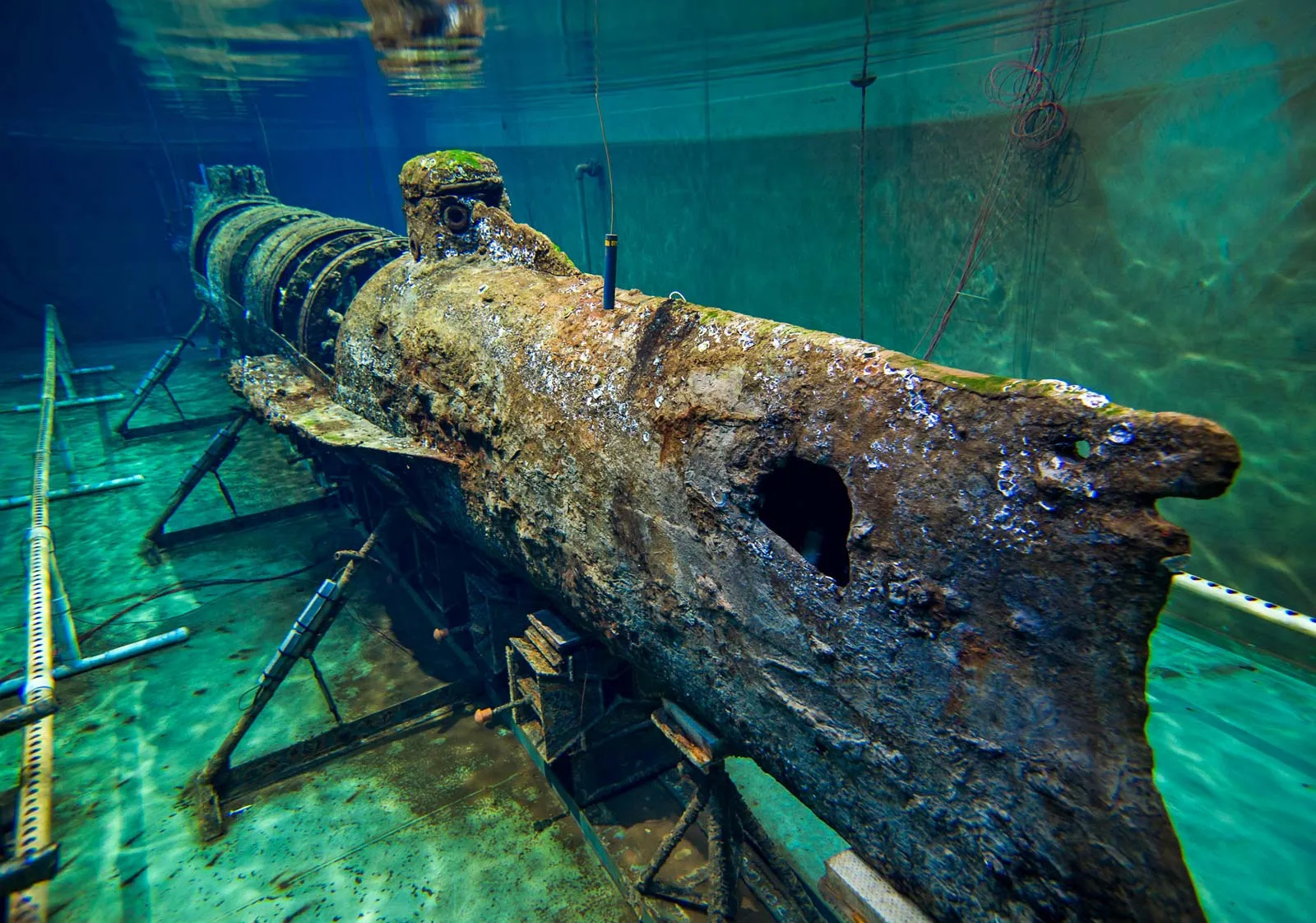


In 1864, the Submarine H.L. Hunley Sank the USS Housatonic and Entered History as the First Successful Combat Submarine, But Never Returned to Base.
On February 17, 1864, in the port of Charleston, South Carolina, during the American Civil War, a metal cylinder just over 12 meters long glided beneath the dark waters of the Atlantic. Hand-cranked by an internal crank and crewed by eight Confederate men, the submarine H.L. Hunley would carry out the first successful underwater mission in military history and would not return.
The episode was confirmed by official records of the United States Navy and documented by the U.S. Naval History and Heritage Command. That night, the Hunley attacked the Union warship USS Housatonic, marking the first time a submarine sank an enemy vessel in real combat.
Primitive Engineering That Changed Naval Warfare – First Submarine in History to Sink an Enemy Ship
The H.L. Hunley was built in Mobile, Alabama, under the supervision of engineer Horace Lawson Hunley, from whom it inherited its name. Unlike modern submarines, it did not have an independent engine. Its propulsion system relied solely on human power: seven crew members turned a crank connected to a shaft that moved the propeller.
-
Friends have been building a small “town” for 30 years to grow old together, with compact houses, a common area, nature surrounding it, and a collective life project designed for friendship, coexistence, and simplicity.

-
This small town in Germany created its own currency 24 years ago, today it circulates millions per year, is accepted in over 300 stores, and the German government allowed all of this to happen under one condition.

-
Curitiba is shrinking and is expected to lose 97,000 residents by 2050, while inland cities in Paraná such as Sarandi, Araucária, and Toledo are experiencing accelerated growth that is changing the entire state’s map.

-
Tourists were poisoned on Everest in a million-dollar fraud scheme involving helicopters that diverted over $19 million and shocked international authorities.


The eighth man — the commander — controlled depth and direction through levers and rudders.
Approximate Technical Specifications:
- Length: 12 meters
- Diameter: about 1.2 meters
- Propulsion: hand-cranked
- Crew: 8 men
- Armament: Fixed explosive charge on the forward spar (spar torpedo)


The weapon used was not a modern torpedo, but an explosive charge attached to the tip of a rod approximately 5 meters long, which had to be rammed into the hull of the enemy ship before detonation.
The Attack of the Submarine H.L. Hunley on the USS Housatonic
On the night of February 17, 1864, the Hunley approached the USS Housatonic, a 1,240-ton Union ship blocking the port of Charleston. According to historical accounts and military documents, the vessel was struck below the waterline and sank within minutes.
The Housatonic became the first ship in history to be sunk by a submarine in combat. But the success was followed by silence.
The Immediate Disappearance of the H.L. Hunley
After the explosion, the Hunley never returned to base. Witnesses on land reported seeing a blue light — possibly a signal of mission accomplished, but the submarine simply vanished. For more than a century, its exact location remained a mystery.
Recovery After 136 Years on the Seabed
In 1995, the team led by writer and explorer Clive Cussler located the wreck of the submarine about 8 meters below the surface, not far from the attack site.

In 2000, the H.L. Hunley was officially recovered from the seabed through an operation coordinated between marine archaeologists and the state of South Carolina.
Forensic analysis revealed that all eight crew members remained in their original positions inside the vessel.
What Killed the Crew?
For years, it was speculated that the submarine might have been hit by enemy fire or that it had suffered structural failure.
Subsequent scientific research suggested another hypothesis: the shockwave from the explosion itself may have traversed the metal hull and caused immediate fatal pulmonary trauma to the crew.
Studies conducted by researchers at Duke University indicate that the nearby detonation may have produced enough pressure to kill the crew instantly, even without significant visible external damage.
Before Success, Two Disasters
Few people know that the Hunley had already sunk twice before the final mission.
- In August 1863, the submarine sank during testing, killing five crew members.
- In October of the same year, it sank again, this time resulting in the deaths of eight men, including its creator, Horace Hunley.
Even so, it was recovered and put back into operation.
Why is the Submarine H.L. Hunley Considered Revolutionary?
Despite its rudimentary design, the Hunley introduced three concepts that would shape the future of naval warfare:
- Underwater Stealth Attack
- Use of Explosives Fixed Below the Waterline
- Strategic Shift in Naval Defense Against Invisible Threats
Until then, ships were designed to face visible enemies on the surface. The Hunley introduced the fear of attack from below.
Decades later, this concept would evolve into diesel-powered submarines, and later nuclear ones, capable of remaining submerged for months.
Although the Confederacy lost the war, the attack by the Hunley had a significant psychological impact. The Union Navy began to reinforce port surveillance and anti-submarine nets. The very idea of submarine warfare began to gain traction in global military thought.
Comparison with Modern Submarines
Today, nuclear submarines can:
- Stay submerged for months
- Travel at speeds over 40 knots
- Launch intercontinental ballistic missiles
- Operate at hundreds of meters of depth
The Hunley, in contrast, had a limited autonomy of a few hours and relied entirely on the physical strength of the crew. Even so, it was the first step.
Historical Legacy
Today, the H.L. Hunley is preserved in Charleston, South Carolina, under continuous conservation care. The site has become a center for naval archaeological research.
The vessel is officially recognized as the first successful combat submarine in history.
Hand-cranked, operated by just eight men, and built during the Civil War, the H.L. Hunley transformed naval history by proving that ships could be destroyed beneath the surface.
Its attack on the USS Housatonic marked the birth of modern submarine warfare.
But its fate also left a clear warning: military innovation often comes at a high price, and in the case of the Hunley, that price was fully paid by its own crew.










Corrigir erros, o huley não foi construido em madeira e nem era movido a vapor. Foi construido em metal de caldeiras de trem e era movido por força humana. O navio que ele afundou, este sim fora construido em madeira e tinha propulsão a vapor.