





 Portuguese
  English
  Spanish
  8 min of reading
  0 comments


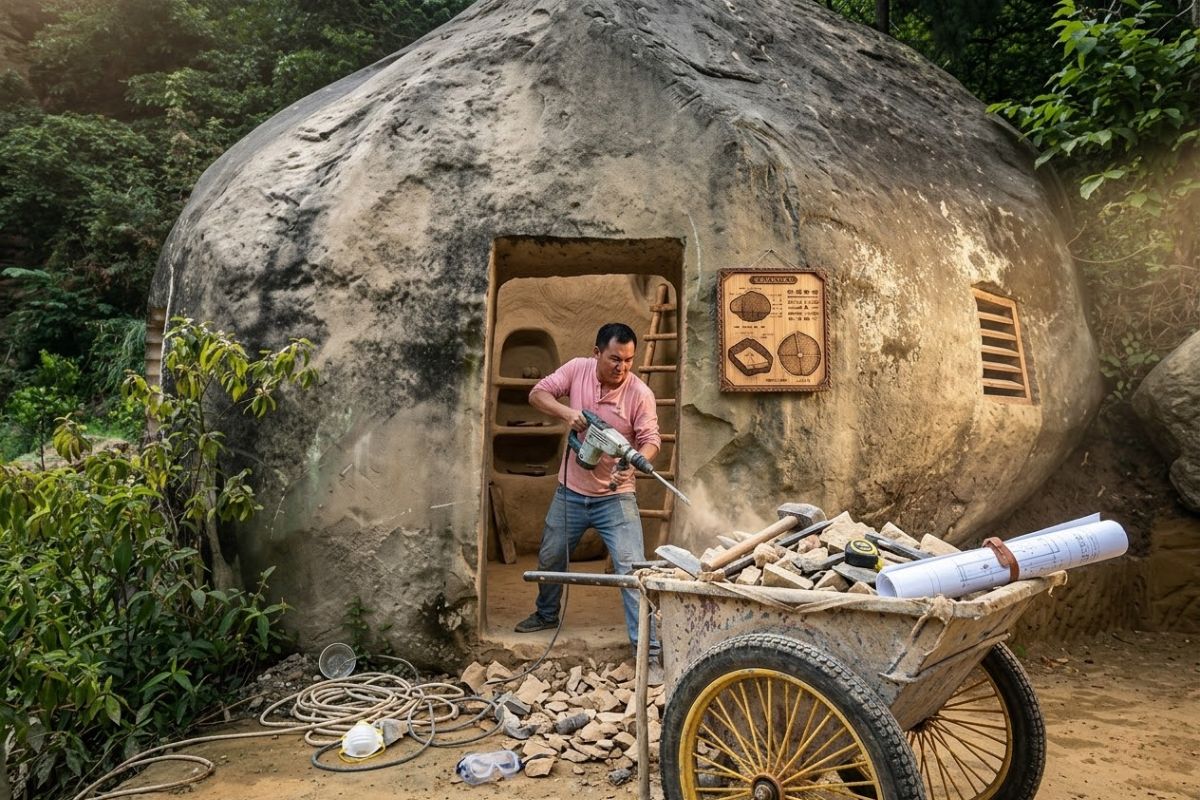
The House Created Inside A Solid Rock Shows How Structural Planning, Manual Excavation, Power Tools, And Daily Discipline Allowed A Single Builder To Create Doors, Windows, Niches, And Livable Areas Without Resorting To Heavy Machinery, Preserving Natural Ventilation, Thermal Comfort, And Organic Integration With The Surrounding Landscape.
The house carved directly into the rock summarizes a rare type of work where physical strength, reading the material, and technical patience walk hand in hand from start to finish. Over 15 months, one builder worked alone to open, expand, and organize the interior of a solid rock until it was transformed into a functional, discreet home integrated with its environment.
What stands out most about this house is not just the visual result, but the method that supported the transformation. Before the first deep drilling, there was marking, symmetry calculation, defining openings, and care with airflow and light circulation—factors that prevented the excavation from advancing haphazardly.
The Initial Layout That Defined The Safety Of The House
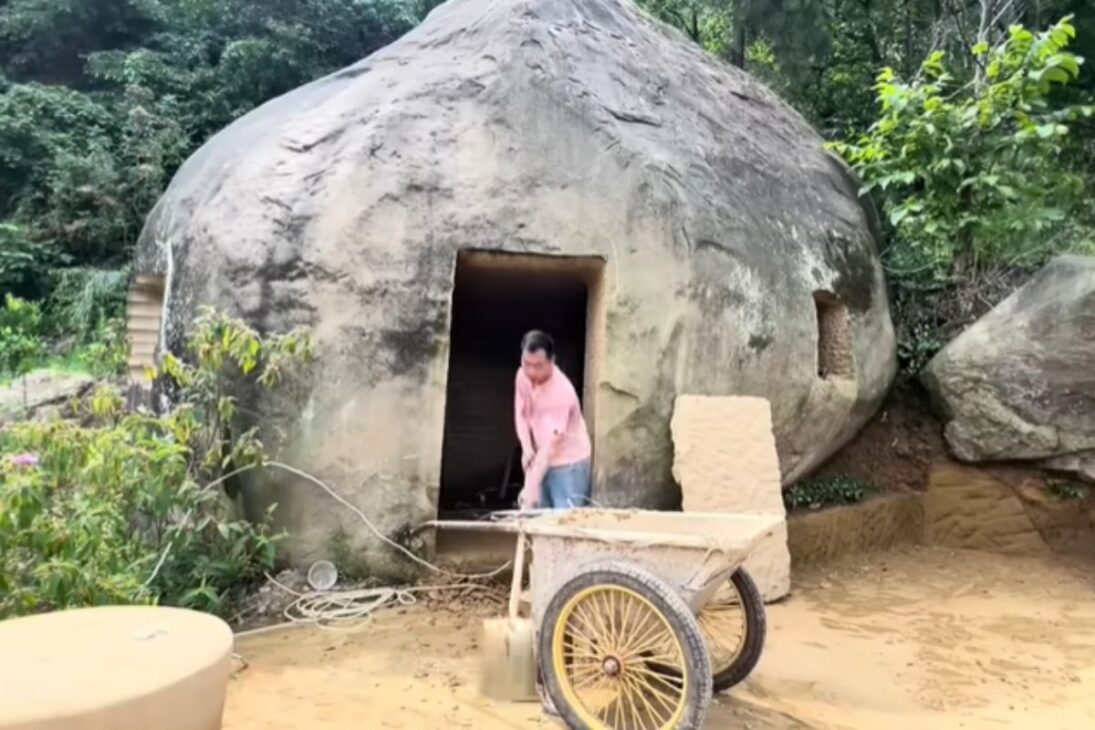
Every house built inside a rocky volume relies on a stage that may seem simple to those who only see the final result, but is decisive: the marking of the floor plan directly on the mineral surface. It was this initial drawing, made with levels, rulers, and precise visual reference, that defined where doors and windows would be opened without compromising the stability of the whole. Structural planning came before brute force, and that completely changed the logic of the work.
-
Son of a seamstress from the rural area of Ceará who did not speak English wins a scholarship of over 2 million reais at Williams College, one of the top 10 universities in the United States, covering everything including dormitory, meals, and annual trips to Brazil.

-
Bill Gates revealed that the true secret behind every great achievement is not a brilliant leap but rather small improvements repeated over the years, and the data from his own career and the fight against climate change prove that he is right.
-
With 22 thousand tons of steel, a height nearly three times greater than the Eiffel Tower, and a cost of R$ 1.6 billion, China is building the highest bridge on the planet over a colossal canyon, reducing a crossing time of over 2 hours to just over 2 minutes.

-
With more than 635,000 doctors, Brazil sees competition increasing in large cities, and recent graduates are competing for shifts at an accelerated pace while the countryside still faces shortages.






This care allowed the house to not appear as an improvised hole, but as a space designed to be livable. By pre-marking each opening, the builder was able to anticipate the entry of sunlight, the flow of natural ventilation, and the internal distribution of the future residence. In this type of excavation, missing a few centimeters can mean reaching fragile points of the rock, creating unnecessary tensions in the ceiling, or compromising walls that would need to continue supporting the weight of the block.
It was also at this stage that the work ceased to be just a physical challenge and began to function as a constant exercise in reading the material. The stone does not accept easy corrections. Unlike conventional construction, where pieces can be replaced or sections redone with more freedom, the house hollowed out in the rock requires much more definitive decisions. Each line drawn before excavation reduced future risks, saving effort and avoiding difficult-to-correct damage.
Power Tools And Controlled Excavation Inside The Rock
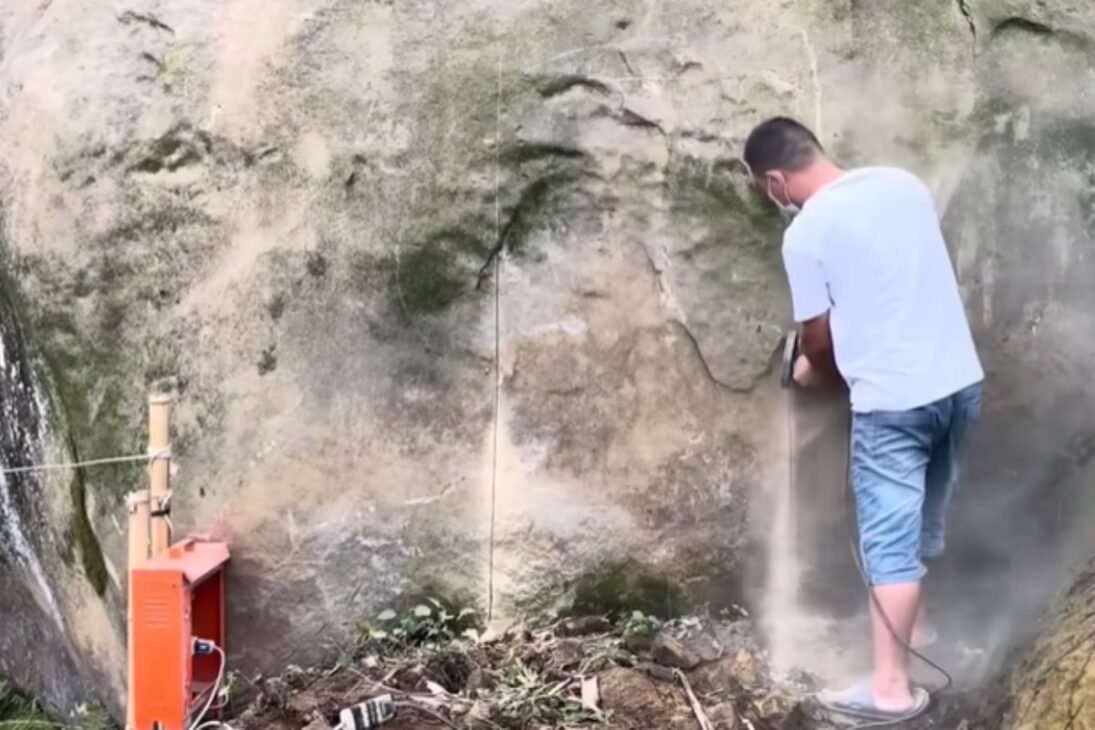
Without resorting to heavy machinery, the builder relied on high-impact electric drills to start dismantling the rock. The choice was not just a matter of scale, but of control. Cylindrical and repeated drillings facilitated the removal of smaller blocks, making the advancement of the house more manageable and less aggressive to the immediate surroundings. Instead of breaking everything at once, the method allowed the stone to be overcome in stages.
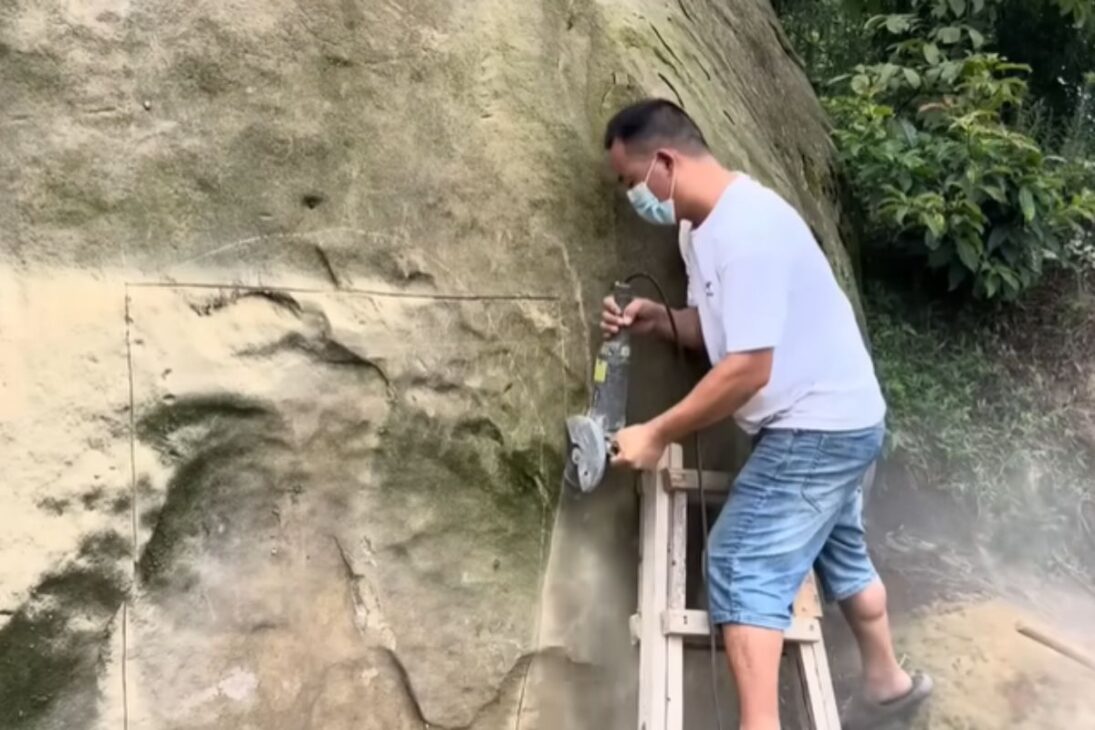
This system brought an important advantage: the house was being opened gradually, with constant adaptation to the material’s behavior. When the rock responds unevenly, the rhythm of the work needs to follow that variation. The use of power tools helped precisely in this, as they offered enough precision to remove dense parts without overly enlarging the cavities right away. The work advanced through control, not impulse.
In the internal modeling stage, pneumatic hammers played a decisive role. They allowed leveling floors, regularizing surfaces, and creating details directly in the walls of the house, such as niches and shelves integrated into the structure. This type of finish shows that the goal was not just to create a shelter, but to transform the interior of the rock into a usable space in daily life, with functional logic and maximum utilization of the excavated volume.
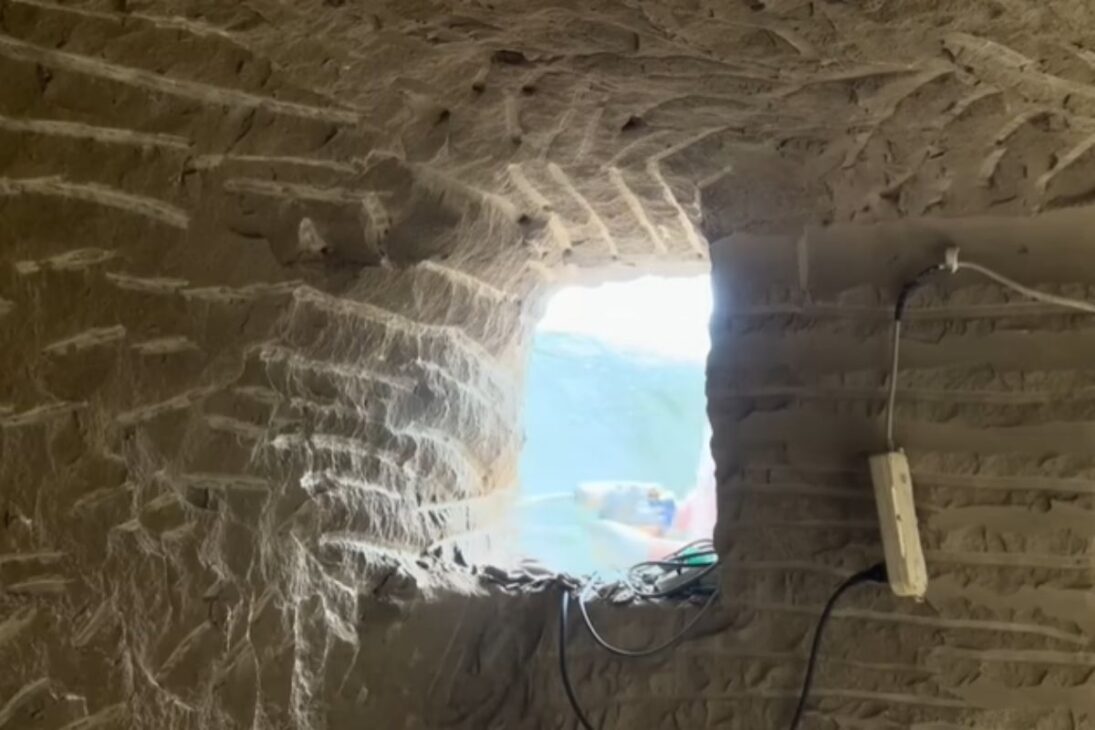
At the same time, the choice of smaller manual and electric tools reveals a concern for the impact of the process. Heavy machinery would speed up material removal but would change the scale of the intervention and the type of damage to the terrain. In this context, the house emerged with a slower rhythm, yet with greater control over each stage of the excavation, which helped preserve the integration between the home and the landscape.
How 15 Months Of Work Were Organized To Avoid Improvisation
A house opened inside a rock does not stand solely on physical resistance. It requires routine, sequencing, and the ability to break a long project into small technical goals. This is what the phases table represented over the 15 months: a way to transform a monumental task into cycles of more objective work, with clearly defined beginnings, middles, and ends.
Initially, the priority was marking and leveling. Next came the initial drilling, the opening of the internal opening, lateral excavation, and finally, surface regularization with sanders and water. This progression was not aesthetic, but operational. Each phase prepared the next and prevented the house from accumulating logistics problems, excessive dust, or disordered debris removal. The discipline of the schedule was as important as the quality of the tools.
Another central point was the daily removal of removed material. With each advancement, debris needed to be taken out with wheelbarrows to keep the internal space accessible and safe. This detail helps understand how much invisible work existed behind the final result. Excavating was just one part of the task. The other consisted of cleaning, reorganizing, reassessing, and preparing the environment for the next stage.
This stage logic also explains why the house managed to maintain coherence between form and function. When excavation is done by zones, the builder can better observe proportions, depth, ventilation, and internal circulation. The result is a home where the elements do not seem random. Doors, windows, living areas, and useful surfaces emerge as consequences of a continuous process of technical adjustments.
The Physical Limits Of A Solo Work Inside The Rock
Working alone for so long on a house of this type imposes a fatigue that goes far beyond the romantic image of the determined builder. The constant vibration of the tools pressures hands, arms, and joints, while the repetitive effort of removing fragments requires breaks to avoid injuries. The work only advanced because there was persistence, but also because the body had to be managed as part of the project itself.
Exhaustion appears as one of the most concrete data of this journey. The weight of debris, the repetition of movements, and the hardness of the rock turned the construction of the house into a routine of severe physical load. Additionally, the breakage of drills caused by friction shows that it wasn’t just the human body that worked at the limit. The equipment also suffered intense wear, requiring replacement and adaptation along the way.
Environmental conditions aggravated this scenario. The heat in enclosed areas made breathing difficult, while mineral dust made it essential to use high-filtration masks. In an excavating space, natural ventilation is still forming, which means part of the work happens just before the environment becomes comfortable. The cool and quiet house of the final result was born from a harsh, noisy, and physically aggressive process.
There were also episodes of instability, with minor collapses that required immediate reinforcements through props. This reinforces an essential point: the work was not only heavy but technically sensitive. Each advancement had to be accompanied by constant observation of the rock’s responses. Alone, the builder was not only dealing with the difficulty of making space but also with the responsibility of keeping that space safe.
Why The Stone House Works So Well As Low-Impact Housing
Once completed, the house reveals an advantage that helps explain the fascination with this type of architecture: the rock itself acts as a thermal regulator. The interior tends to remain cooler in warm periods and more protected in cold conditions, reducing dependence on artificial climate control. The stone functions as both structure and natural barrier, which enhances the efficiency of the home.
This characteristic makes the house directly engage with off-grid living proposals and low environmental impact. By becoming part of the landscape, the construction reduces exposure to strong winds, harnesses the thermal mass of the land, and maintains a less aggressive relationship with the surroundings. Instead of imposing new volumetry on the environment, it reorganizes an already existing volume to make it livable.
Durability also comes into this equation. While a conventional construction depends on multiple overlapping materials and broader periodic maintenance, the house excavated in rock concentrates its resistance in the very mineral body where it was opened. This does not eliminate the need for care, but demonstrates why this model is seen as a robust alternative when the goal is to unite shelter, stability, and permanence.
Another aspect that helps understand the interest in this work is the visual record of the process, made available on video platforms and associated with the channel World Tech. The documentation reveals the transition from raw stone to a usable interior, showing how the house gained ventilation, carved internal areas, and sufficient finishing to function as a residence. Seeing this complete transition helps gauge the real magnitude of the feat.
The House As Proof That Method And Persistence Can Reconfigure The Impossible
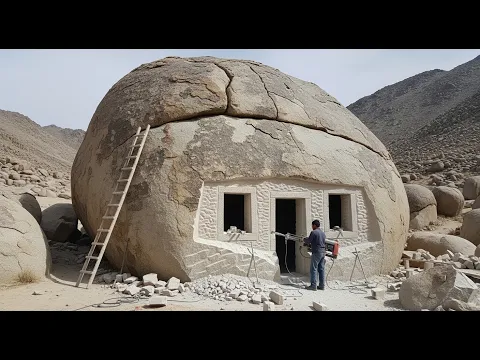

In the end, the strength of this house lies not only in the fact that it was excavated by a single person but in the balance between precision and insistence. The project shows that an extreme work only becomes viable when planning, technical sequencing, and constant reading of the space work together. Without this, 15 months of effort could result only in wear and risk.
The house carved in the rock leaves a hard-to-ignore impression since it transforms an apparently inert mass into functional shelter, with natural ventilation, thermal comfort, and spatial solutions integrated into the very relief. More than just a curiosity of artisan engineering, it exposes how far constructive discipline can reach when someone decides to move forward alone, step by step, without giving up calculation and control.
Does this type of housing impress more because of the intelligence of the process or the physical resistance involved in the execution?







Seja o primeiro a reagir!