





 Portuguese
  English
  Spanish
  3 min of reading
  1 comment


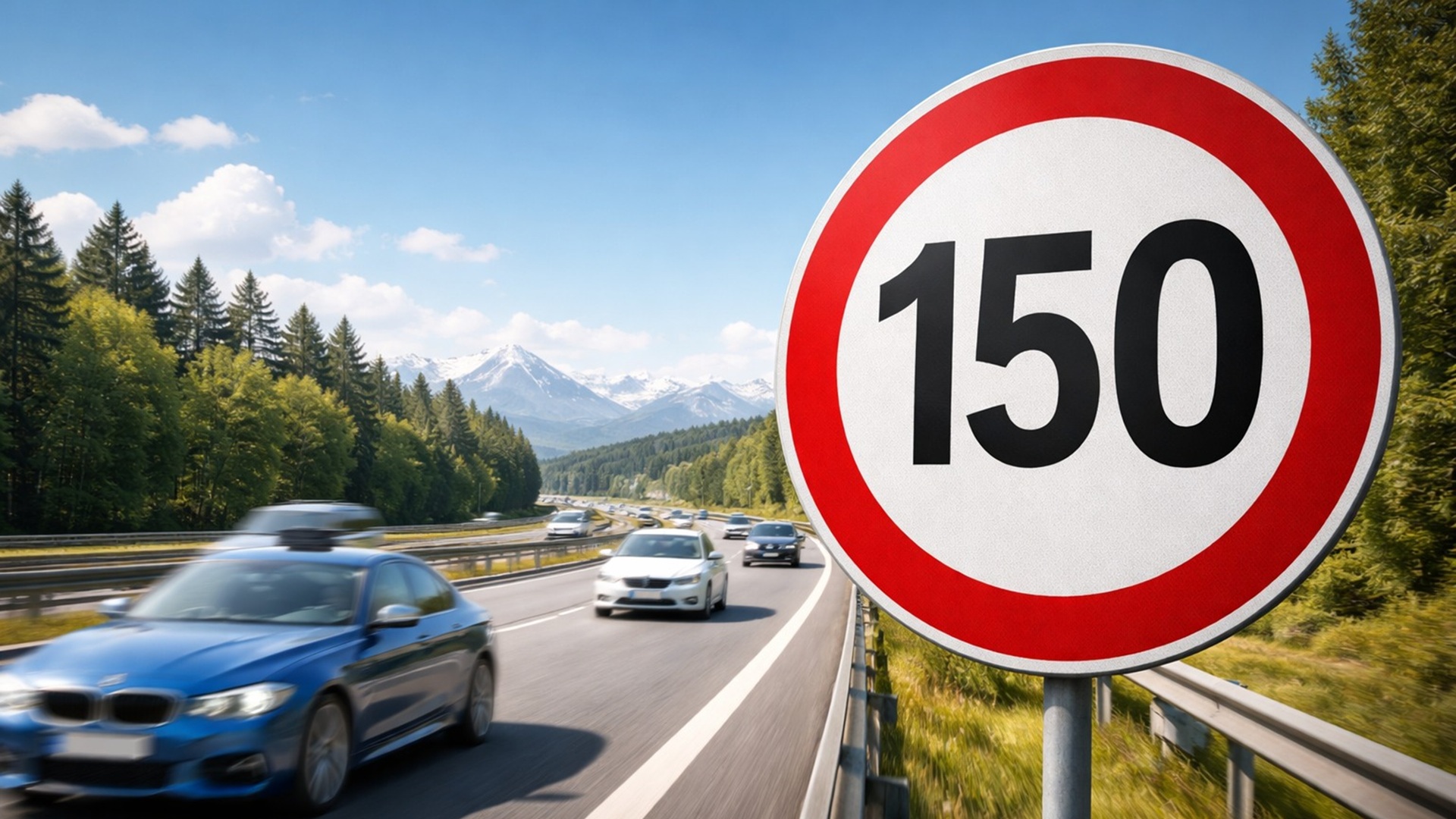


Czech Republic Launches Unprecedented Test in the European Union by Raising Speed Limit to 150 km/h on 50 Kilometers of the D3, Between Tábor and České Budějovice, Under Dynamic Control and Strictly Favorable Weather and Traffic Conditions
The Czech Republic has become the first country in the European Union to test raising the speed limit to 150 km/h on a 50-kilometer stretch of the D3 highway, between Tábor and České Budějovice, starting in late September 2025.
Pilot Project Expands Speed Limit in Specific Stretch
Amid the climate and road safety debate in Europe, the decision stands out for going against the environmental strategies promoted in Brussels. The country opted to put to the test a higher speed limit than the European standard under controlled conditions.
The project allows drivers to travel at speeds up to 150 km/h exclusively on a 50-kilometer segment of the D3 highway. The measure is valid only when weather and traffic conditions are considered strictly favorable.
-
Motorola launched the Signature with a gold seal from DxOMark, tying with the iPhone 17 Pro in camera performance, Snapdragon 8 Gen 5 that surpassed 3 million in benchmarks, and a zoom that impresses even at night.

-
Satellites reveal beneath the Sahara a giant river buried for thousands of kilometers: study shows that the largest hot desert on the planet was once traversed by a river system comparable to the largest on Earth.

-
Scientists have captured something never seen in space: newly born stars are creating gigantic rings of light a thousand times larger than the distance between the Earth and the Sun, and this changes everything we knew about stellar birth.

-
Geologists find traces of a continent that disappeared 155 million years ago after separating from Australia and reveal that it did not sink, but broke into fragments scattered across Southeast Asia.

The initiative is structured with dynamic limits. Electronic panels authorize the new ceiling only when the weather is suitable, traffic flow is normal, and there are no construction or incidents on the road.
If any of these factors change, the speed limit automatically reverts to 130 km/h, the standard level on many European highways. In other countries, such as Spain, the maximum does not exceed 120 km/h and can drop to 100 km/h in various stretches.
Technical Conditions and Real-Time Control
According to the Czech Ministry of Transport, the use of variable signage and real-time control systems will allow for the safe management of the higher speed. The proposal is based on constant monitoring technology of road conditions.
The authorities argue that active management of the infrastructure and continuous monitoring will ensure that the expanded speed limit operates without compromising driver safety.
The government also maintains that technological advances present in modern vehicles contribute to reducing risks, reinforcing the feasibility of the test on the selected stretch.
Environmental Debate and Criticism of the Increase in Speed Limit
The measure has triggered intense debate among experts, authorities from other countries, and European institutions. Critics point out that raising the speed limit tends to increase fuel consumption and, consequently, emissions per kilometer traveled.
Various European nations have been adopting the opposite strategy, lowering limits to improve air quality and enhance road safety. Countries like the Netherlands and Switzerland have considered reductions even below 120 km/h.
For opponents, the Czech decision contradicts the spirit of European policies aimed at reducing emissions, sustainability, and decreasing noise and air pollution.
Environmental organizations and experts have expressed opposition to the initiative, arguing that the increase in speed limit represents a setback in the environmental goals being discussed on the continent.
Road Safety and Associated Risks
Besides the environmental impact, road safety is at the center of the criticism. Data traditionally associate higher speeds with a greater likelihood of being involved in accidents.
Reaction times become shorter in the face of unforeseen events when vehicles travel at higher speeds. Collisions at higher speeds also entail more severe consequences for occupants.
Czech authorities claim that warning systems and adaptive signaling will mitigate these risks. Nevertheless, this argument does not universally convince experts and European institutions.
The debate occurs within a broader context of clean mobility in Europe. In many countries, lower limits have been adopted to reduce consumption and emissions, in line with continental environmental goals.
Despite the criticism, the Czech Republic argues that freedom of movement, trust in onboard technology, and active road management justify the controlled experiment.
The pilot project remains restricted to the 50-kilometer stretch of the D3 and conditioned to specific parameters. The measure represents a test that challenges prevailing trends in the European bloc, keeping the speed limit as the central axis of discussion.







Parabéns à REP. Theca. Provando que bom senso contra a falácia climática e de controle total da população não os engana. Fora que a maioria esmagadora dos acidentes acontecem em velocidades muito mais baixas, por imbecilidade e imprudência dos motoristas. O resto é discurso.