





 Portuguese
  English
  Spanish
 6 min of reading
  3 comments


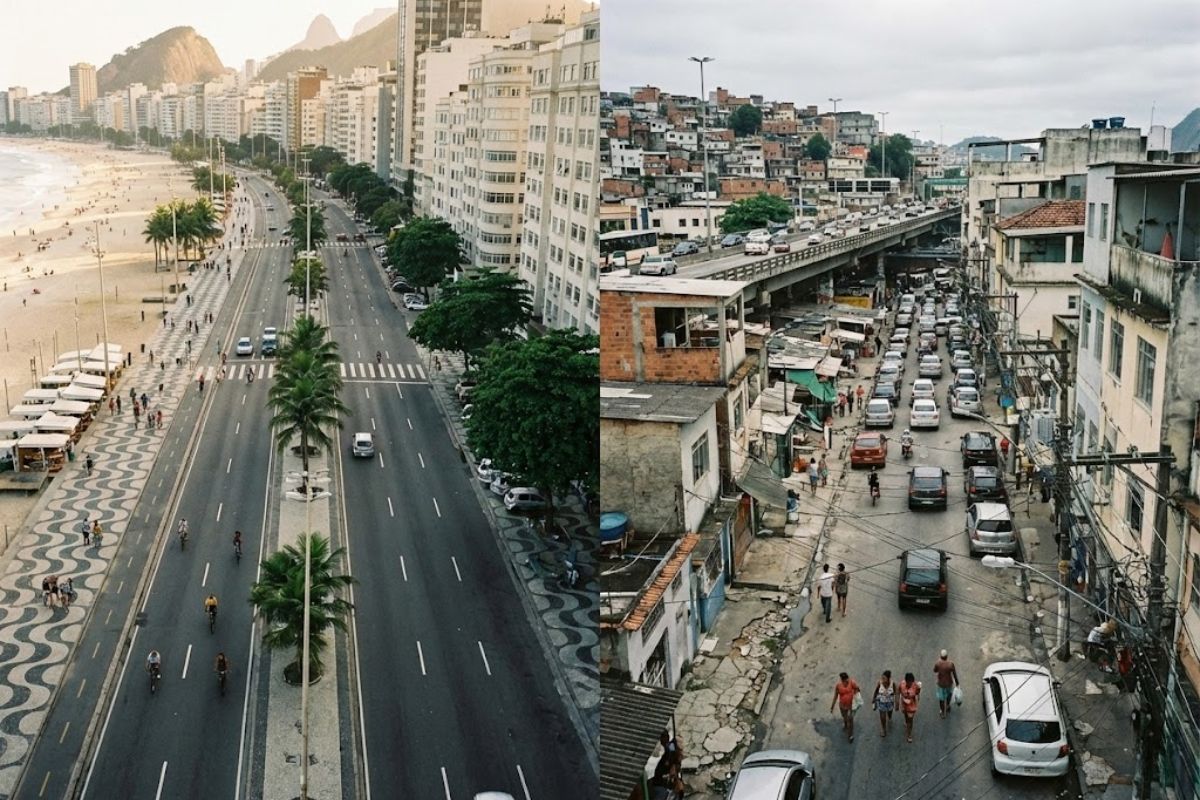


In Copacabana, The Urbanism of Copacabana Combines Short Blocks, Intense Commerce, and Continuous Street Life, But New Neighborhoods in Rio de Janeiro Are Spreading in Gated Communities, Overpasses, and Shopping Malls, Deepening Inequality and Transforming the Southern Zone of Rio into an Isolated Showcase of the City for a Few Privileged Residents
Since the 1950s, Copacabana has consolidated an urban design that mixes housing, services, public transport, and intense pedestrian traffic throughout the year. Throughout the 1960s, 1970s, and 1980s, the neighborhood consolidated a high density, but with diverse land use, keeping public space active from morning until dawn. Copacabana continued to receive roadway and infrastructure investments in the following decades, reinforcing its position as a permanent reference in the Brazilian urban debate.
Meanwhile, starting in the 1990s and especially in the 2000s and 2010s, the expansion to the west and north accelerated the creation of new neighborhoods in Rio de Janeiro with wide avenues, walled condominiums, and extreme dependence on cars. In 2020, 2022, and 2024, the contrast was already visible in commuting data, street design, and the occupancy of public spaces, turning Copacabana into a shocking exception within the city itself. The result is a functioning, walkable, and vibrant southern zone of Rio surrounded by fragmented areas, with low street life and urbanism that is more expensive to maintain.
Urbanism of Copacabana as Planned Exception

The urbanism of Copacabana relies on three basic pillars: a dense roadway network, relatively short blocks, and a consistent mix of urban functions on almost all streets.
-
The aircraft carrier HMS Prince of Wales is heading to the Arctic with F-35 fighters, helicopters, and warships in an operation that repositions the United Kingdom at the forefront of NATO in 2026.

-
He found the largest gold shipwreck in the United States with tons of the precious metal at a depth of 2,400 meters in the Atlantic and recovered a treasure that no one thought possible to reach, but 500 gold coins disappeared without explanation.

-
The United States has a serious problem with its F-35s: China is already producing fighters at a pace that exceeds American capacity and could manufacture up to 300 aircraft per year before the end of the decade, shifting the global military balance.
-
A retired IT professional built a 22-meter boat in his backyard in Oklahoma with a school bus engine, light pole masts, and handmade watertight doors to become the redneck version of Jacques Cousteau.


Residential buildings, offices, small shops, hotels, banks, bakeries, and neighborhood services overlap in a few blocks, reducing the need for long commutes.
This arrangement creates an environment in which pedestrians are a central part of the urban system.
When experts talk about the urbanism of Copacabana, they refer to a place where almost everything is a few minutes’ walk away.
The constant presence of residents, workers, and tourists on the sidewalks enhances the sense of safety, even during times of greater tension in the city.
The street life in Copacabana does not depend on major events, but on the daily routine of the population. It is the opposite of business centers that become empty at night and on weekends.
Another crucial element is the diversity of real estate typologies.
Small apartments, studios, larger units, and hotels share the same urban space.
This allows different social groups to share the neighborhood, even though real estate pressure is high.
The urbanism of Copacabana, despite its known problems, offers a concrete basis for thinking about compact, connected, and economically viable cities.
Neighborhoods in Rio de Janeiro and the Spread-Out Expansion Model

In the last forty years, many new neighborhoods in Rio de Janeiro have been built upon a model of horizontal expansion, with wide roads, roundabouts, large parking lots, and residential complexes far from commercial fronts.
In this design, people need to walk long distances to access basic services. The logic is the opposite of that of Copacabana.
Instead of replicating the urbanism of Copacabana, with active blocks and facades facing the street, the dominant pattern has been one of extensive subdivisions, high walls, and guardhouses.
The result is a set of neighborhoods in Rio de Janeiro where pedestrians lose priority, public transport becomes more expensive, and urban service management requires larger and less efficient networks.
This pressures the public budget, increases travel times, and reduces daily interaction among residents.
The lack of continuous sidewalks, safe crossings, and commercial fronts facing the public space fragments the city.
In many cases, commerce is concentrated in large isolated centers, which depend on cars or specific bus lines.
While Copacabana concentrates urban functions within a few kilometers, recent expansion scatters activities in areas that do not connect with one another.
Street Life, Proximity, and Daily Safety


The street life in Copacabana is a structural component of the neighborhood’s functioning.
Bakeries full in the morning, newspaper stands still present, bars open at night, and various services in malls and corners create an environment with almost permanent movement.
This street life creates informal networks of surveillance, coexistence, and support among shopkeepers, doormen, residents, and workers.
When street life is replaced by garages, walls, and parking lots, public space loses eyes, stories, and connections.
In many of the more recent neighborhoods in Rio de Janeiro, the sidewalk ceases to be a place of permanence and becomes just a passage corridor.
The street, instead of being a platform for coexistence, becomes a residual space between condominiums and expressways.
The urbanism of Copacabana shows that daily security does not rely solely on formal policing or cameras, but on how the neighborhood is occupied.
By reinforcing street life in Copacabana, urban design reduces empty areas, discourages irregular uses, and increases the circulation of people at varied times.
This vitality is hard to reproduce in territories fragmented by restricted accesses and long distances between services.
Southern Zone of Rio as an Isolated Showcase of the Real City
The southern zone of Rio, of which Copacabana is a central part, concentrates a disproportionate share of quality urban infrastructure.
Throughout the 1990s, 2000s, and 2010s, investments were made in transport, sanitation, tourism, and urban operations that reinforced this showcase role.
The problem is that this pattern has not been extended with the same intensity to the rest of the city.
The southern zone of Rio has become a reference for mobility, walkability, and functional density, while large areas of the northern and western zones have remained with weak transport networks and low availability of nearby services.
The difference in urban design translates into concrete differences in travel time, cost of living, and job opportunities.
Copacabana thrives as an exception, while much of the territory faces fragmented and expensive urbanism.
This asymmetry turns the urbanism of Copacabana into a kind of isolated laboratory.
Instead of serving as a replicable base for new projects, it is treated as a particular case, linked only to tourism and the history of the neighborhood.
The consequence is a city in which the southern zone of Rio operates as an island, surrounded by territories where the car remains almost the only realistic option.
What Copacabana Reveals for the Urban Future of Brazil
Copacabana indicates that it is possible to combine high density, diverse services, functional public transport, and intense street life in the same territory.
The urbanism of Copacabana proves that the compact, mixed, and walkable model is not an imported theory, but a practice consolidated for decades on Brazilian soil.
The challenge is to transform this knowledge into consistent public policy.
If new neighborhoods in Rio de Janeiro continue to be designed based on isolated condominiums, shopping malls, and large roadways, the social and financial costs of the city tend to grow.
More time lost in commutes, more pressure on the road system, more difficulty in providing quality public services, and more territorial inequality.
The experience of the southern zone of Rio, especially of Copacabana, could guide projects in other Brazilian capitals that are still expanding their urban borders.
Copacabana is not a perfect neighborhood, but it is a laboratory that clearly shows that compactness, a mix of uses, and street life are strategic assets for any metropolis.
The central point is to decide whether the city will learn from this case or keep it as a comfortable exception for a few.
Do you think that the urbanism of Copacabana should be adopted as a reference for new neighborhoods in Rio de Janeiro, or has the city already established a spread-out model that is hard to reverse?







Existem outros bairros planejados e Bangu é um exemplo, a questão é que apesar de ser planejado foi um bairro que expandiu desordenadamente com a conivência e descaso do poder público
Madureira com praia não é referência
Deveria ser proibido qq VLT e outros mimos em bairros consolidados, apenas manutenção, enquanto tiver ruas sem saneamento em bairros perifericos, tipo, Guaratiba, Santa Cruz, Campo Grande, sem uma linha de van ou ônibus que ultrapasse o túnel da grota funda, para deixar no Recreio, Barra ou metrô, excetuando os BRTs que para chegar nele a população tem que pegar outros ônibus distantes, segregação total ou cansativos Brts ou ônibus com tarifas de 27,00 reais.