





 Portuguese
  English
  Spanish
  4 min of reading
  0 comments


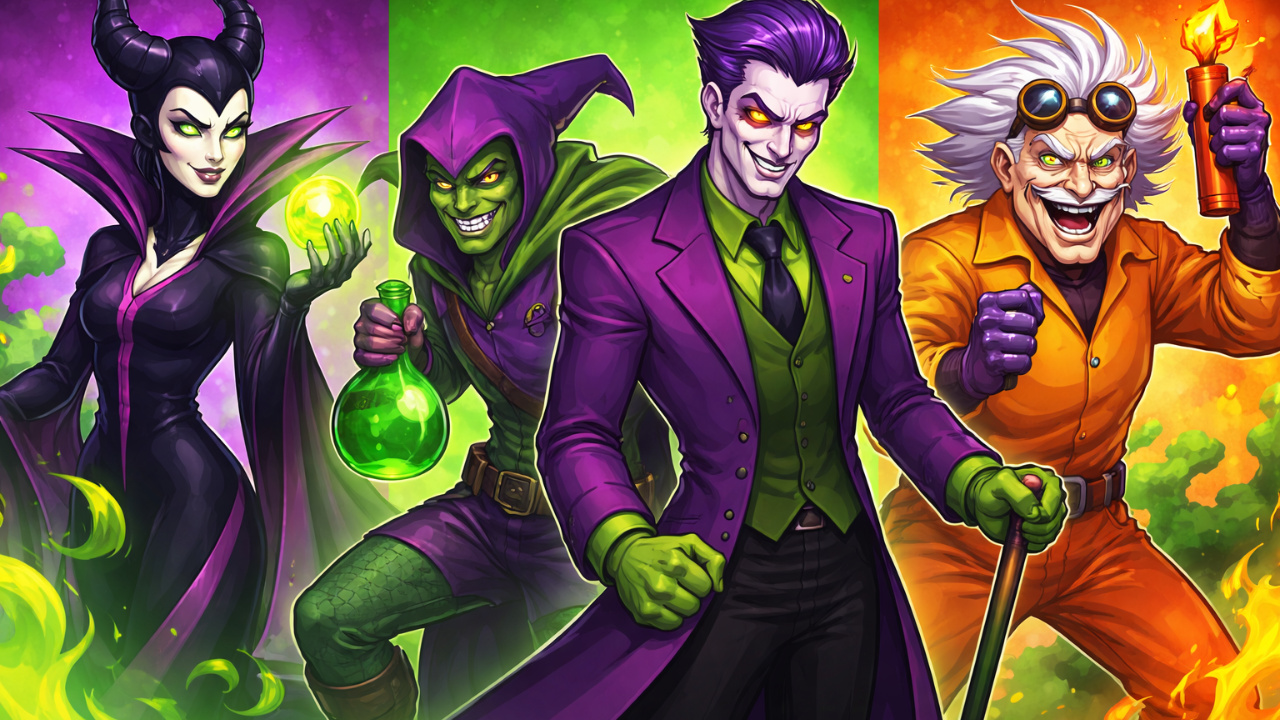
Discover The Reason Behind The Colors Of Villains And How Cinema Uses Color Psychology To Differentiate Heroes And Antagonists.
The presence of villains’ colors in shades of purple, green, and orange in movies, comics, and animations is not a coincidence.
The phenomenon involves famous villains like Maleficent, The Joker, Green Goblin, Gru, and Ursula, and appears repeatedly in global pop culture.
This visual choice emerged from color theory, practical decisions in the comic book industry, and also from color psychology, which helps the audience quickly recognize who is a hero and who is an antagonist.
-
From sertanejo star to international investor: Ana Castela invests millions in a mansion in the USA, creates a themed accommodation in Orlando, and shows that the “boiadeira” also wants to grow away from the stage.

-
The 10 most stunning motorhomes in the world: a $3 million trailer with a rooftop nightclub and garage for a Ferrari, “palaces on wheels” with Italian marble, private cinema, and five-star hotel luxury for billionaires.

-
Trump wanted to spend $400 million on the White House, but the courts prohibited the million-dollar construction.

-
How the Egyptians erected giant structures like pyramids, temples, and obelisks without modern technology, cranes, or engines still amazes the world and reveals the power of engineering based on ramps, levers, ropes, and colossal organization.


The pattern mainly appears in Western entertainment productions, especially in Hollywood and American comics.
Over the decades, artists and designers have adopted this resource to facilitate the identification of character colors even before any dialogue or narrative explanation.
Thus, what seems like merely an aesthetic choice has transformed into a true visual code that shapes how the audience interprets stories of heroes and villains.
How Color Theory Explains Villains’ Colors
To understand the pattern of villains’ colors, it is necessary to look at a classic concept in visual arts: color theory.
This system organizes colors into basic categories.
In the traditional model, there are three primary colors: red, blue, and yellow. They are considered the foundation for all other shades.
Interestingly, these same colors frequently appear in the most well-known heroes of pop culture.
Superman uses blue, red, and yellow. Spider-Man combines red and blue. Meanwhile, Iron Man mixes red and yellow.
When these primary colors are combined, the so-called secondary colors emerge: purple, green, and orange. And it is this trio that appears repeatedly in villains’ colors.
This contrast creates an immediate visual distinction between protagonists and antagonists. While heroes display primary colors considered more “pure,” villains use colors derived from these mixtures.
Character Colors Help The Audience Identify Heroes And Villains
In comics and animations, visual design needs to communicate information quickly. Therefore, character colors have become an extremely efficient narrative tool.
When a character appears on screen, the audience begins to interpret their role in the story just by the visual.
The colors of villains, such as purple, green, and orange, often generate contrast with the heroes. This contrast facilitates the identification of each character’s roles.
Moreover, artists use these palettes to reinforce personality traits. Extravagant, dangerous, or unpredictable villains often receive more intense and contrasting colors.
This visual resource works almost subconsciously but directly influences audience perception.
The Historical Origin Of Villains’ Colors In Comics
Besides aesthetics, there is an important historical factor behind the popularization of villains’ colors.
In the early years of the comic book industry, especially between the 1930s and 1950s, the printing process was limited and relatively expensive.
Therefore, publishers needed to choose color combinations that worked well in the printers of the time.
The heroes, who appeared in practically every issue, maintained consistent color schemes to facilitate audience recognition.
In contrast, villains often appeared only in a specific story. Thus, artists could experiment with more striking and contrasting palettes.
Over time, this visual pattern became established and began to be replicated in animations, movies, and series.
Color Psychology Explains The Symbolism Of Villains’ Colors
Another important element behind villains’ colors is called color psychology, a field that studies how colors influence emotions and perceptions.
Each shade carries cultural and symbolic meanings that help build character identity.
Here are some examples:
Purple: Power, Extravagance, And Superiority
Historically, purple is associated with royalty, authority, and wealth.
When a villain wears this color, as is the case with The Joker, it can convey arrogance, extravagance, or a sense of superiority.
That is why purple frequently appears in famous villains who possess theatrical or manipulative personalities.
Green: Envy, Toxicity, And Transformation
Green often represents envy or ambition.
Additionally, in many stories, it is also associated with toxic, radioactive, or mutated elements.
This symbolism helps explain why characters like Green Goblin use this color in their visual.
Orange: Intensity, Energy, And Chaos
Orange, in turn, is a vibrant color linked to energy and fire.
Depending on the context, it can represent impulsivity, danger, or intense emotions.
Thus, characters with explosive or chaotic personalities often appear associated with this shade.
Why Heroes Use Different Colors
While villains’ colors tend to convey threat or instability, heroes usually appear in shades that evoke confidence.
Blue is associated with stability and loyalty. Yellow evokes light and optimism. Red often represents courage and action.
This contrast reinforces the visual narrative of the stories.
Thus, even without realizing it, the audience learns to recognize patterns between heroes and villains simply by observing colors.
A Detail That Shapes Cinema And Comics
The use of villains’ colors in purple, green, and orange has become a tradition that spans decades of entertainment.
This pattern arose from the combination of color theory, technical limitations in the industry, and elements of color psychology.
Today, it continues to influence character design in movies, comics, and animations.
And although many viewers may never have consciously noticed this detail, it helps to tell stories silently, reinforcing who the hero is and who the villain is even before the first line of dialogue.








-

-

2 pessoas reagiram a isso.