





 Portuguese
  English
  Spanish
  7 min of reading
  20 comments


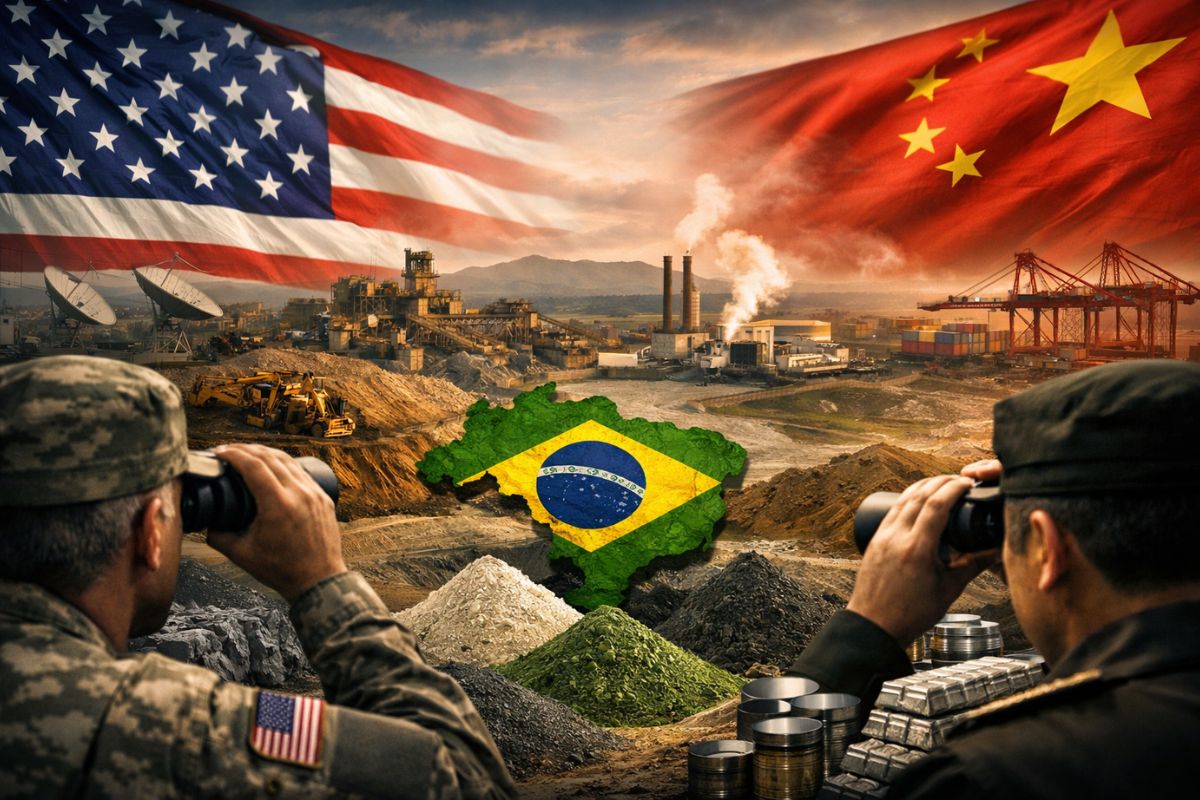


Brazil Holds Second Largest Rare Earth Reserve, Has Only One Mine in Operation and Australian Projects Advancing, While the United States and China Dispute Access to Deposits and Experts Call for Urgent Strategy to Decide Between Selling Raw Ore or Investing Heavily in Competitive Domestic Refining and Long-Term Technology.
In January 2024, Mineração Serra Verde began commercial operations in Minaçu (GO), marking Brazil’s debut in large-scale production of rare earth oxides, a crucial input for permanent magnets used in electric cars and wind turbines. By mid-2025, the United States’ declared interest in Brazilian reserves elevated the topic to a strategic agenda in Brasília and the mining sector.
Since then, the global race for the 17 chemical elements that make up rare earths has gained momentum in the country: Brazil, home to the second largest reserve in the world, has become contested by the United States, China, and other powers trying to reduce dependence on Chinese refining, responsible for about 70% of global production and 85% of world processing capacity.
Brazil Has Only One Operating Mine and a Queue of Projects Under Review
Despite the potential, the current production landscape is still modest. According to data from the Brazilian Mining Institute (Ibram), the country currently has 12 rare earth mines authorized and 186 under review by authorities.
-
Brazilian city bets on the business environment to generate jobs and attract investments in the energy sector — secretary reveals strategy at Macaé Energy 2026.

-
50 viaducts, 4 tunnels, 28 bridges, and 40 kilometers of bike paths: BR-262 in Espírito Santo will receive 8.6 billion reais for the largest engineering project in the state’s history, inspired by the Immigrant Highway in São Paulo.

-
Brazil produces too much clean energy and doesn’t know what to do with it: over 20% of solar and wind capacity was wasted in 2025 while investors flee and 509 renewable generation projects were abandoned in the last year.
-
Piauí will produce a new fuel that replaces diesel without needing to change anything in the truck’s engine and reduces pollutant gas emissions by half: truck drivers from all over the Northeast are already celebrating the news that will arrive later this decade.


Additionally, there are 1,790 authorized mineral research projects that could reveal new deposits and 348 research requests under review, signaling a substantial pipeline, but still without translation into effective production.
In practice, only Serra Verde Mineração, in Minaçu (GO), is commercially operating with rare earths in Brazil, in a ramp-up phase, aiming to reach 5,000 tons annually of oxides intended mainly for the high-efficiency magnet industry.
The rest of the national portfolio is still among phases of research, licensing, and financial structuring.
Australian Projects in Minas Gerais Accelerate the Dispute
While national production is crawling, two projects with Australian capital in Minas Gerais are advancing and helping to put Brazil on the radar of the global race.
In Poços de Caldas (MG), the Caldeira Project, by Meteoric, inaugurated this month a pilot plant aimed at testing the industrial process, generating operational data, and producing samples.
With the capacity to process 25 kilograms of ionic clay per hour, the plant concentrates all steps to transform the ore into mixed rare earth carbonate: leaching, impurity removal, precipitation, and filtration.
The investment amounts to AUD 1.5 million (about R$ 5.5 million), with a target of producing 455 kilograms of carbonate per year, a modest volume, but strategic for validating the model.
In the same region, Viridis Mining & Minerals is working on the Colossus Project and has already qualified to receive resources from BNDES and Finep, in a line that offers up to R$ 5 billion.
The company also obtained letter of interest for up to US$ 100 million from a Canadian export credit agency to support the execution phase, showing how international capital sees Brazilian rare earths as a long-term asset.
Export Raw Ore or Create a Billion-Dollar Refining Chain
The advancement of these projects reignites a well-known dilemma in Brazilian mineral policy: to repeat the historic role of raw material exporter or to invest heavily in processing the ore internally and sell products with higher added value.
For some experts, the country is once again at this crossroads, now with rare earths at the center.
Another group argues that the choice needs to be less ideological and more pragmatic. The technology for refining rare earths is currently dominated by China, which raises costs and prolongs any plan to build a complete processing chain in Brazil.
Since the typical cycle of a large mining project takes 10 to 15 years and faces complex environmental licensing, some argue that the initial priority should be to enable competitive extraction while deciding how far the country wants to advance in refining.
Geopolitical Pressure from the United States and China on Brazilian Reserves
Recent probing by Americans about the “treasure” buried in Brazilian territory has a clear backdrop: ensure stable access to rare earths to support technological advancements, energy transition, and military and defense applications.
Before looking to Brazil, the United States sought understandings with China itself, which dominates the production and processing chain.
Today, China accounts for 70% of global production and 85% of rare earth refining capacity, giving it enormous influence over high-tech industries, clean energy, electric cars, and defense systems.
In this context, the European Union, Japan, and Australia are also looking to diversify suppliers. It is in this geopolitical game that Brazil, owner of large underutilized deposits, enters.
Second Largest Reserve in the World, Little Supply in the Market
Brazil holds the second largest rare earth reserve on the planet, with significant deposits in Minas Gerais, Goiás, and the Amazon, among other regions.
Nonetheless, national production is considered nascent, limited by lack of domestic refining technology, logistical bottlenecks, and regulatory uncertainties that deter some investors.
The processing of rare earths requires a sophisticated chain, ranging from physical beneficiation to chemical purification in multiple stages, often with intensive use of acids, until reaching the rare earth oxides sold in the international market.
Today, China dominates all links in this chain, from mining to the manufacture of high-value-added components, such as permanent magnets and special alloys.
Technology, Urgency, and the Clock of Energy Transition
For Patrícia Muricy, mining industry leader at Deloitte, it is not enough for Brazil to invest capital; it needs to master refining technology.
She highlights that movements made now will only materialize at scale in about 15 years, just when the energy transition should be even further advanced.
Without firm decisions in the present, the country risks arriving late to this market.
Patrícia also points to a fundamental problem: “we do not even have fully identified reserves yet”, which requires significant investment in geological exploration, a costly and uncertain activity.
Without this knowledge, it becomes more challenging to design a consistent industrial policy for rare earths, whether for concentrated exports or for installing more complex chemical plants.
“No One Will Give Technology for Free to the Country”
The enthusiasm for the idea of developing a complete rare earth chain in Brazil faces additional obstacles.
Mateus Figueiredo, a partner at KPMG, recalls that, although the technology for transforming rare earths into electro-electronic inputs is not new, Brazil has never been a significant producer and still does not dominate critical processes.
His assessment is straightforward: “No one will give technology for free to the country.”
Therefore, Figueiredo argues that, while a long-term strategy is debated, Brazil should prioritize the start of extraction, taking advantage of existing structures to generate cash and reduce risks, without abandoning the ambition to move up the value chain as the technological base matures.
Ibram Calls for Balance and Remembers Lesson from Iron Ore
The Brazilian Mining Institute (Ibram), which represents large mining companies, adopts a middle-ground position. According to Julio Nery, director of Sustainability and Regulatory Affairs, the ideal is to advance in the value chain of rare earths without missing immediate export opportunities.
He emphasizes that it is necessary to study case by case where it is possible to add value without compromising project profitability.
Nery cites iron ore as an example: if Brazil tried to process all produced volume, it could lose about 30% of the trade balance surplus, given the impact on costs and competitiveness.
In the case of rare earths, the challenge is even greater because low Chinese costs act as a barrier to entry, compounded by a lack of investment in infrastructure and a tight fiscal landscape that limits the state’s ability to finance large industrial projects.
Forecasted Investments in Rare Earths Until 2029
Even with uncertainties, rare earths are beginning to appear in the investment plans of the mineral sector.
According to Ibram, the segment accounts for 3.2% of the investments planned for mining in Brazil between 2025 and 2029, equivalent to US$ 2.2 billion allocated to projects at different stages, from exploration to the implementation of industrial plants.
These resources, combined with private initiatives and geopolitical competition, indicate that Brazil is unlikely to be left out of the global rare earth map.
In your opinion, should Brazil focus on quickly exporting rare earth ore or take the risk of investing heavily in a complete refining and technology chain within the country?







tem que ir exportando, mas buscar agregar valor aqui dentro.Temos universiades e tecnico para alavancar isso
é só investir na pesquisa, pode-se pedir uma ajuda tecnologica a china em troca de um pouco do mineral
O potencial das reservas de terras raras, lítio e nióbio, conforme recentes volumes de requerimentos de pesquisa na ANM, principalmente nos Estados de MG e Bahia, começa a despertar o que representa em termos econômicos e desenvolvimento regional, pois ainda não enxergamos como a extração ou refino irão impactar as regiões exploradas.
O Brasil tem que investir em Tecnologia Tem que desenvolver pessoas e qualifica-las para isto Tem que investir na formação de quadros com excelência. Selecione os potenciais superiores e invistam neles, paguem para fazer curso e estágio em lugares com Tecnologia avançada, É preciso começar buscando know how onde já existe .Vão aprender lá. É preciso ambição e querer! Já não dá para aceitar que falta dinheiro.