





 Portuguese
  English
  Spanish
  5 min of reading
  1 comment


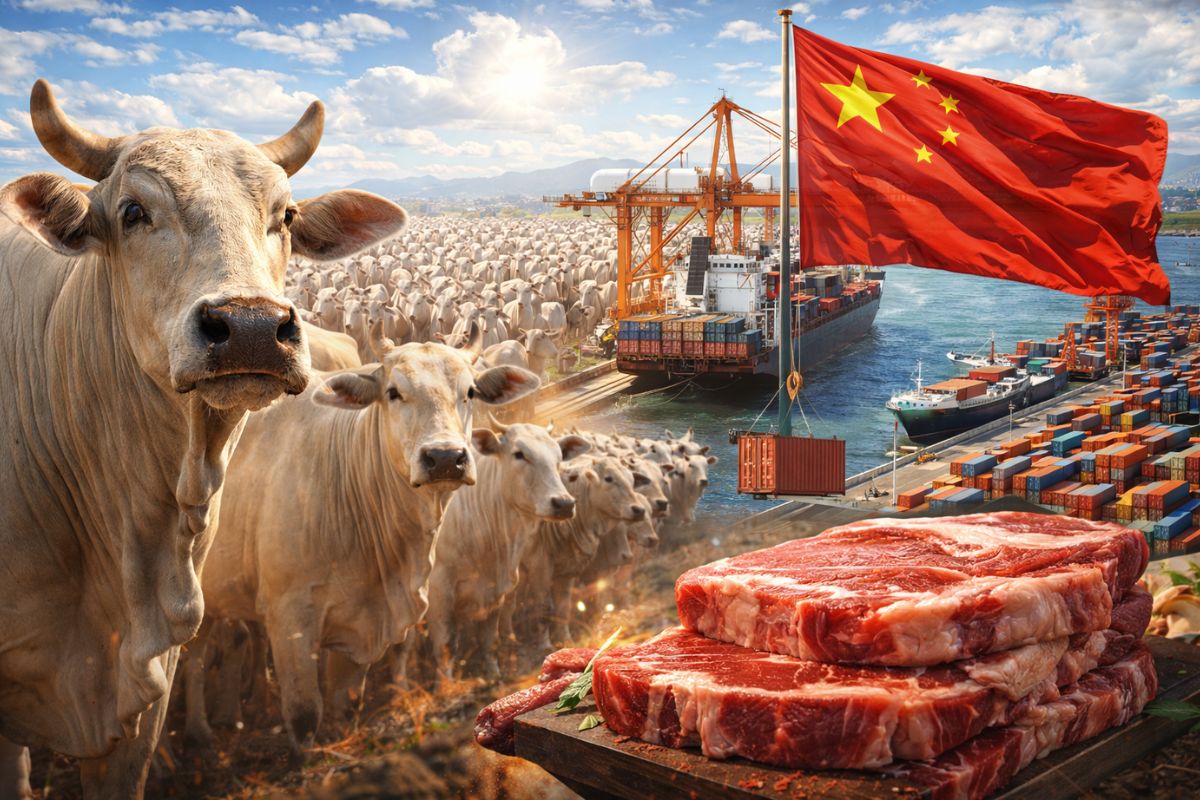


China’s New Quota Ignites a Rush for Brazilian Beef Shipments, Pushing Live Cattle Above R$ 350 Per Arroba and Exposing How China’s Demand Dominates Brazilian Beef Exports.
As meat processors and importers rush to ship as much Brazilian beef as possible before the quota limit is hit, Brazilian beef gains value in the short term, but is trapped by a rule that could inflate prices overnight if the 1.1 million-ton quota is exceeded. What seems like a “gift” from China could turn into a problem down the line if the country slows its purchases and forces Brazil to reposition its beef in the international market.
Quota of 1.1 Million Tons and Anticipated Rush for Brazilian Beef
The starting point is the new 1.1 million-ton quota set by the Chinese government for imported beef, including Brazilian beef.
Last year, according to FGV Agro researcher Felipe Serigate, Brazil exported 1.747 million tons of beef to China.
-
The sugar-energy sector advances with agricultural technology, but agricultural productivity still raises concerns.

-
The eggshell that almost everyone throws away is made up of about 95% calcium carbonate and can help enrich the soil when crushed, slowly releasing nutrients and being reused in home gardens and vegetable patches.

-
This farm in the United States does not use sunlight, does not use soil, and produces 500 times more food per square meter than traditional agriculture: the secret lies in 42,000 LEDs, hydroponics, and a system that recycles even the heat from the lamps.

-
The water that almost everyone throws away after cooking potatoes carries nutrients released during the preparation and can be reused to help in the development of plants when used correctly at the base of gardens and pots, at no additional cost and without changing the routine.


In simple terms, if Brazilian beef maintains the same shipment pace in 2026 as last year, this quota would be reached by August.
After that, any additional container would enter a higher tax regime, reducing or even eliminating the competitiveness of Brazilian beef against other proteins in the Chinese market.
That’s why exporters and importers are rushing to ship as much Brazilian beef as possible before the quota threshold changes.
No one wants to be the last in line and pay the higher tariff. The immediate effect is a wave of business anticipation that artificially heats up flows in the short term.
When the Tariff Rises, Brazilian Beef Loses Advantage in China
The Chinese quota is not a specific attack on Brazil. All countries exporting beef to China received a limit, in an explicit attempt to protect local animal protein producers.
Even so, the impact on Brazilian beef is direct, as Brazil is currently one of the main suppliers to that market.
Serigate recalls that on the day the quota was established, the arroba in Brazil cost between 54 and 56 dollars, while in China it exceeded 140 dollars. With this difference, Brazilian beef is very competitive for the Chinese consumer.
The quota, followed by a higher tax once the limit is reached, is precisely the mechanism used by Beijing to curb this advantage.
In other words, if the quota is reached without negotiation, Brazilian beef tends to become much less interesting for Chinese importers, making room for replacement by other proteins or local sources.
Hence the researcher’s insistence: Brazil needs to negotiate, either through the government, industry entities, or major exporters.
Exports Surge, Live Cattle Breaks R$ 350 and Pulls All Livestock

The result of the rush is visible in the latest numbers. In January, beef exports to China and Hong Kong were 28% above those of January last year, clearly reflecting the attempt to accelerate shipments before the quota limit is reached.
With this increased demand, Brazilian beef prices reacted quickly. Live cattle surpassed the R$ 350 threshold, and the movement was not limited to animals ready for slaughter.
Calves also appreciated, now being traded for over R$ 3,200 each, which shows that the market is repricing the entire beef production chain.
Even those who do not sell directly to China feel the effects. The markets are interconnected: if Brazilian beef eligible for the Chinese standard becomes more expensive, it pulls the rest of the herd upwards, because cattle do not “die of old age” waiting for a buyer.
The animal that does not enter a processing plant authorized for export ends up being redirected to another market, including the domestic one.
The Risk of a “Turning Point” When the Quota Is Reached
If today the Chinese quota is functioning as fuel for Brazilian beef prices, the picture could change rapidly when the limit is actually reached.
Serigate points out that: upon reaching the quota, China remains a major potential buyer, but with entry priced higher due to new taxation.
In such conditions, it is natural to expect a price adjustment in the opposite direction, especially if no new developments arise in negotiations between Brazil and China.
In simple terms, the same trigger that today triggers price increases could, down the line, cause sharp corrections, if part of Brazilian beef loses ground in the Chinese market or needs to seek alternative destinations in other countries and in the domestic market.
China Standard Cattle, Livestock Cycle, and Its Effect on All Brazilian Beef
In the short term, those with cattle that meet the requirements demanded by the Chinese market are at the forefront of this rush.
Authorized slaughterhouses and livestock producers with animals of the so-called “China standard” are anticipating slaughter and closing contracts to take advantage of the heated demand moment.
However, as the researcher reminds us, the effect is not limited to this niche. If there is no demand for this higher-valued cattle, its route recalibrates and it enters other sales channels, which spreads price pressure across all beef production.
Thus, the upward movement is widespread, although more intense where Brazilian beef meets the specific export requirements for China.
At the same time, Brazilian beef production had already been lagging in the reversal of the livestock cycle, the famous period of female retention, where the producer keeps more breeding stock to increase the herd in the future.
A price shock like the current one can accelerate decisions, hasten slaughter on one side, reinforce retention on the other, and deeply affect the supply structure in a few years.
Negotiating Safeguards and Diversifying Markets for Brazilian Beef
In light of this scenario, Brazilian beef cannot afford to rely almost exclusively on Beijing’s will.
The 1.1 million-ton quota serves as a reminder that the primary exit door for our beef could be narrowed at any moment by a unilateral decision.
That’s why Serigate emphasizes the importance of negotiating safeguards and flexibilities with China, such as the possibility for Brazil to absorb quotas from other countries that do not fully utilize their limits.
The idea is simple: if another exporter does not use its quota, Brazil could take that space, ensuring that Brazilian beef continues to reach the Chinese market at competitive prices.
At the same time, there is an increasing need to diversify markets, reducing the geographical concentration of exports and strengthening other destinations for Brazilian beef, so that a shock in demand or a regulatory change in Beijing does not cause such strong jolts in the field, in processing plants, and in the domestic consumer’s pocket.
In the end, the Chinese quota exposed both the strength and fragility of Brazilian beef: we are competitive, we have scale and attractive costs, but we remain very dependent on a single destination.
What do you think, should Brazil seize this moment of high prices to diversify its beef destinations more, or does it make sense to continue betting heavily on China’s demand while it is buying?









O que determina o preço do **** é a demanda interna.80 % da produção fica no Brasil