





 Portuguese
  English
  Spanish
  5 min of reading
  0 comments


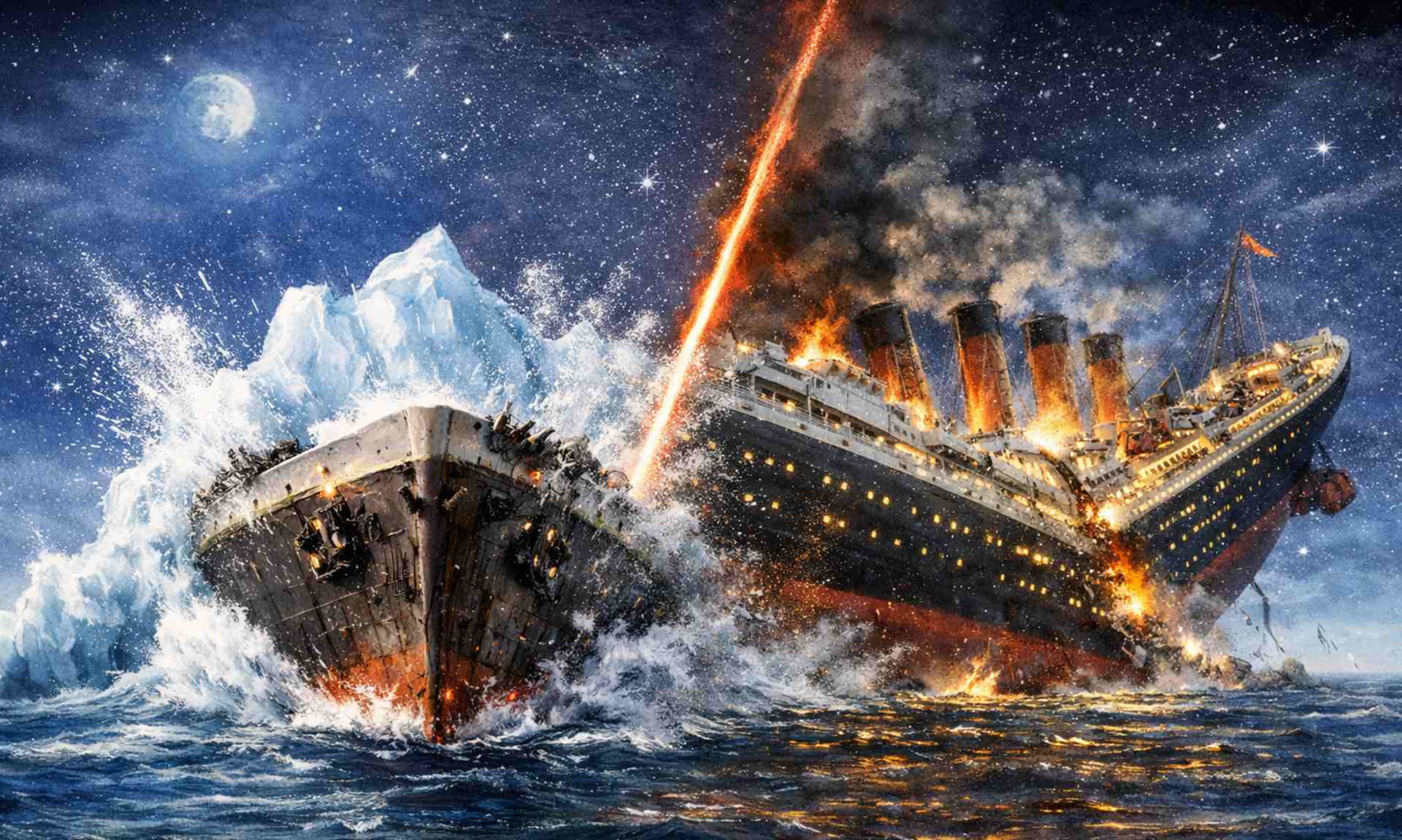
The hypothesis that the Titanic could have stayed afloat if it had hit the iceberg head-on, instead of scraping the side and flooding five compartments, reignites an old debate about the maneuver that preceded the most famous shipwreck of the 20th century
The Titanic sank after colliding with an iceberg in 1912, becoming one of the most well-known shipwrecks in history, but a hypothesis discussed since then suggests that the outcome could have been different had the impact occurred head-on, rather than on the starboard side.
The evasive maneuver was initiated only after lookout Frederick Fleet spotted the iceberg ahead, when there was already insufficient time to avoid the collision.
The impact ultimately punctured the starboard side of the ship and allowed water to enter five of the 16 compartments of the hull, one more than the vessel could withstand without sinking.
-
Rare document reveals surprising age of Brazilian and investigation could change official records.

-
Health issues urgent alert for flu and calls for the vaccination of the elderly, children, and pregnant women this Saturday with Day D and drive-thru in Curitiba.

-
What is it like to live inside a $13 billion aircraft carrier where 5,000 military personnel eat 17,000 meals a day and spend months sleeping in cramped bunks?

-
Man plays the same numbers in the lottery for 22 years, hits everything at once, and wins a prize of $3.5 million.


The idea that the Titanic was “unsinkable” was precisely linked to the internal division of the hull into 16 compartments considered watertight.
The understanding was that the ship could continue operating even with up to four of them flooded, but the impact with the iceberg exceeded that limit.
Although this breach of five compartments is often cited as the main cause of the sinking, a review conducted on the centenary of the disaster in 2012 indicated that identifying a single cause is more complex. According to this assessment, in addition to the water ingress, there were also issues such as deformation of the bottom of the ship and failure of joints subjected to the stress of the collision.
Titanic and the collision that hit the side of the hull
Before the impact, there were reports of other vessels trying to alert the Titanic about ice ahead in the sea. Still, these warnings were said to have been ignored, as the ice was not seen as a significant threat to large ships.
When the iceberg was finally spotted directly ahead, the attempt to maneuver around it failed to prevent the collision. The result was damage to the starboard side and deformation of the hull, which opened the way for water to invade the internal compartments.
With five compartments compromised, the ship began to take on water progressively. The bow sank, the stern rose, and later, the vessel broke in two, with the front section submerging first and the rear momentarily remaining upright vertically due to trapped air before also disappearing into the sea.
This chain of failures helps explain why the discussion about a head-on impact continues to attract interest. The hypothesis does not stem solely from post-disaster imagination, but from comparisons with other ships and assessments made by people connected to the ship’s design.
Cases of other ships feed the hypothesis
One of the cited examples is the SS Arizona, a 450-foot-long ship that, in 1879, hit an iceberg head-on and still managed to continue operating for another 50 years. Another mentioned case is the SS Grampian, which also survived a head-on collision in 1919, although it suffered severe damage and recorded the deaths of two crew members.
These episodes are used as references to discuss whether the Titanic could have remained afloat had the damage been concentrated at the front, rather than spreading along the side. According to the channel Oceanliner Designs, the complex internal steel honeycomb structure at the ship’s bow could, in theory, have provided enough elasticity to absorb the shock without causing an immediate rupture.
The type of deformation that occurs when a ship hits a stationary object head-on is called telescoping. According to the report presented, this phenomenon has occurred in several vessels throughout history without necessarily leading them to sink.
The thesis that the Titanic could have been saved in a head-on collision was also defended by Edward Wilding, then assistant to Thomas Andrews in the ship’s design department. In the inquiry conducted by the British commissioner responsible for the case, Wilding stated that he was convinced the vessel would have been preserved had it advanced onto the iceberg with its bow.
Edward Wilding’s testimony about the Titanic
During the interrogation, Wilding responded that he believed the ship would have been saved, although the impact could kill all the workers who were housed in the boiler room area. He also stated that he believed the passengers would have survived and reinforced his position by recalling the case of the Arizona, mentioned in the hearing as an example of a large ocean liner that hit an iceberg head-on and managed to reach port.
According to the testimony, the Titanic would suffer severe crumpling at the front, with crushing between 24 and 30 meters from the bow. Still, in Wilding’s assessment, the ship could remain afloat even with human losses among the workers located in the impacted section.
The hypothesis, however, does not eliminate the risks of a high-speed head-on collision. An abrupt stop against the face of a large iceberg would also bring its own fatal consequences, which prevents treating this scenario as a simple or guaranteed solution.
Moreover, the 2012 review itself pointed out that the ship’s behavior in the face of such an impact would remain surrounded by uncertainties, due to the complexity of the design and how different parts of the structure might react to the shock. The picture becomes even less defined with the inclusion of the so-called fire theory in the debate about what could have happened.
Therefore, the question of whether the Titanic would sink or not after a head-on collision remains unanswered definitively. What the gathered records indicate is that there is a line of technical and historical reasoning according to which the vessel could have stayed afloat, albeit under extreme damage and with a high human cost in the areas closest to the impact.








Seja o primeiro a reagir!