





 Portuguese
  English
  Spanish
  3 min of reading
  0 comments


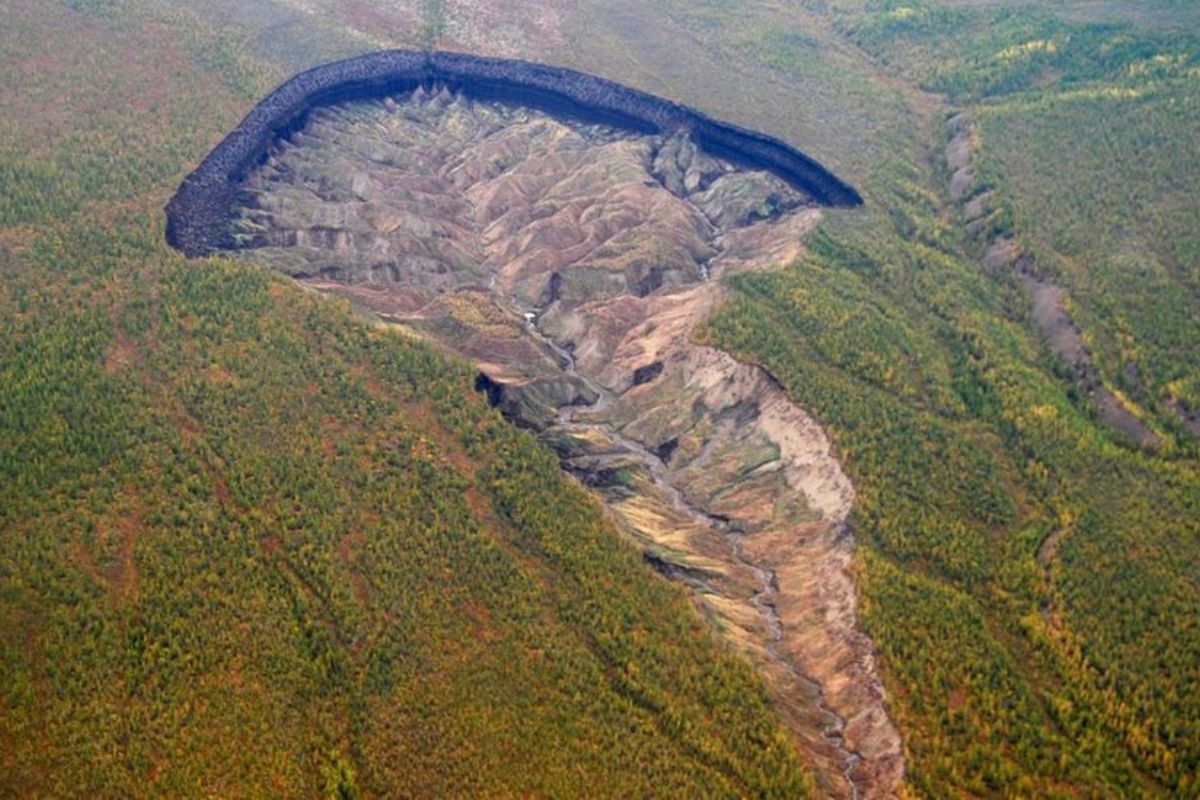
Brazil Houses Several Impact Craters, But Current Science Indicates That No Known Giant Crater In Brazil Is Linked To The Extinction Of Dinosaurs, A Mystery That Remains Centered In Chicxulub, Mexico.
The idea of a giant crater in Brazil as a fundamental piece in the extinction of dinosaurs, which occurred about 66 million years ago, sparks great curiosity. The national territory indeed bears scars from violent cosmic collisions that took place over its vast geological history.
However, while the Chicxulub crater in Mexico is widely accepted as the main cause of the event that wiped out non-avian dinosaurs, the analysis of scientific evidence regarding Brazilian formations, such as the Vargeão Dome, points to different times and contexts, distancing a direct link with that mass extinction.
Brazil And Its Cosmic Impact Marks
The Earth constantly erases the marks of asteroid impacts due to erosion and plate tectonics, unlike the Moon. Nevertheless, Brazil has a significant record of these collisions. Among the main confirmed impact structures are the Araguainha Dome (MT/GO), the largest in South America, Serra da Cangalha (TO), Vista Alegre (PR), the Riachão Ring (MA), and the Vargeão Dome (SC). Each requires complex geological studies for its confirmation and dating.
-
Spain surprises the world by erecting 62 artificial dunes, mixing sand with natural remains of posidonia, and causing the structure to lose only 1.4% of its volume in 1 year.

-
With 16 Bulava missiles, improvements in acoustic stealth, and a design focused on silent patrols, Russia’s nuclear submarine was born to ensure Moscow’s invisible retaliation and has become one of the pillars of its maritime strength.

-
‘Populous’ city in Rio among the worst in Brazil in national ranking and exposes silent development crisis.

-
Couple buys house in the South Zone of São Paulo, opens a hidden door in the garage, and finds a secret wine cellar with dozens of old wines forgotten since the 1970s.

Vargeão Dome: A Notable Crater In Santa Catarina

The Vargeão Dome, located in western Santa Catarina, is an astrobleme (an ancient, eroded crater) about 12 km in diameter. Formed over volcanic rocks of the Serra Geral Formation, it features a pronounced relief and complex internal structure.
Its origin from a meteorite impact is confirmed by shock cones (cone-shaped fractures visible to the naked eye), planar deformation features (PDFs) in quartz grains (microscopic evidence of extreme shock), and impact breccias. Research estimates the age of the impact at approximately 110 million years, in the Cretaceous period.
Extinction Of The Dinosaurs: The Role Of The Chicxulub Crater
The mass extinction event of the Cretaceous-Paleogene (K-Pg), 66 million years ago, eliminated about 75% of the planet’s species, including non-avian dinosaurs. The scientific consensus attributes this catastrophe to the impact of a large asteroid that formed the Chicxulub crater in the Yucatán Peninsula, Mexico.
This crater, with a diameter of 180 to 200 km, has its age precisely dated at 66.043 million years, coinciding with the layer of iridium (a rare element on Earth, common in meteorites) found globally at the K-Pg boundary. The effects of the impact, such as megatsunamis, global fires, and a prolonged “impact winter,” caused the collapse of food chains.
No Giant Crater In Brazil Linked To The End Of Dinosaurs, Studies Say

By comparing the estimated ages of Brazilian craters with the K-Pg event (~66 Ma), a direct link becomes unlikely.
- Vargeão Dome: ~110 Ma or <134 Ma, significantly older.
- Araguainha: ~254.7 Ma, related to the Permian-Triassic extinction.
- Serra da Cangalha: ~220 Ma (Triassic).
- Vista Alegre: ~115 Ma or <65 Ma (if <65 Ma, it would be post-K-Pg).
- Riachão Ring: <200 Ma, with no precise dating close to 66 Ma.
Based on current evidence, there is no scientific support to claim that any known giant crater in Brazil is the “key” to the extinction of dinosaurs.
The Scientific Importance Of Brazilian Craters
Although not connected to the K-Pg extinction, Brazilian craters hold great scientific value. The Vargeão Dome and Vista Alegre, formed in basalt, are rare terrestrial analogs for studies of cratering on other planets. Araguainha is crucial for understanding the largest mass extinction on Earth, the Permian-Triassic extinction, with theories suggesting that the impact may have released methane, exacerbating climate changes.
Geological research continues, and future discoveries may reveal new structures or refine dating. Regardless, the already known craters in Brazil tell a fascinating story of cosmic collisions and their consequences for the planet.








Seja o primeiro a reagir!