





 Portuguese
  English
  Spanish
  4 min of reading
  0 comments


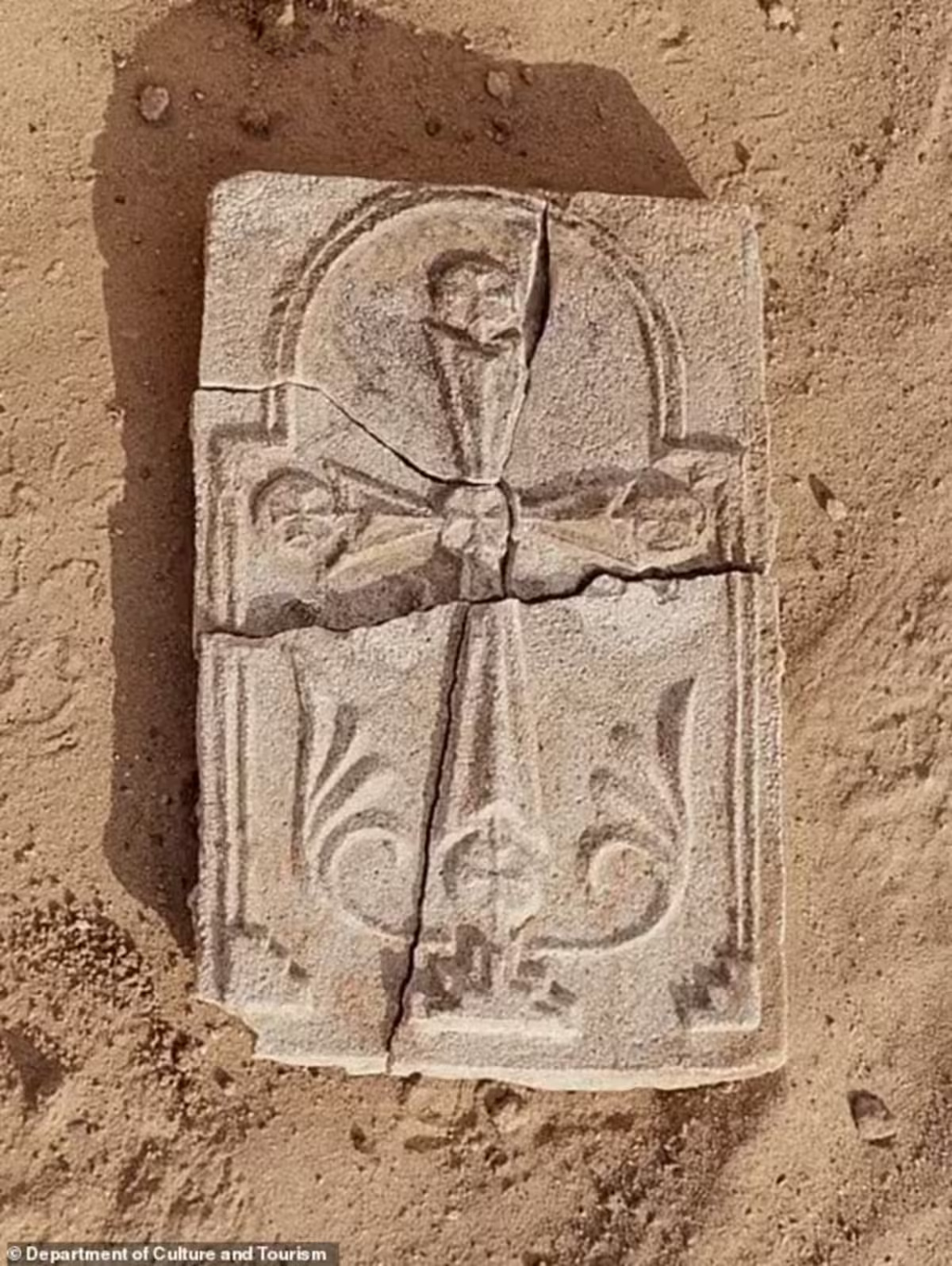
1,400-Year-Old Cross Discovery in Sir Bani Yas Reveals Thriving Christian Community in the Persian Gulf, Challenging Notions of Faith’s Reach
A 1,400-year-old plaque depicting a cross was found on Sir Bani Yas Island in Abu Dhabi. The discovery reshapes the understanding of how far Christianity spread to the east.
The artifact features a stepped pyramid symbolizing Golgotha, where Christians believe Jesus was crucified. From the base, leaves emerge that reinforce the symbolism of life.
It was identified among the ruins of a church and a monastery, indicating the existence of a thriving Christian community in the region during the 7th and 8th centuries.
-
Motorola launched the Signature with a gold seal from DxOMark, tying with the iPhone 17 Pro in camera performance, Snapdragon 8 Gen 5 that surpassed 3 million in benchmarks, and a zoom that impresses even at night.

-
Satellites reveal beneath the Sahara a giant river buried for thousands of kilometers: study shows that the largest hot desert on the planet was once traversed by a river system comparable to the largest on Earth.

-
Scientists have captured something never seen in space: newly born stars are creating gigantic rings of light a thousand times larger than the distance between the Earth and the Sun, and this changes everything we knew about stellar birth.

-
Geologists find traces of a continent that disappeared 155 million years ago after separating from Australia and reveal that it did not sink, but broke into fragments scattered across Southeast Asia.

This finding is surprising. At that time, Christianity was more commonly associated with the Levant, Mesopotamia, and some parts of Europe.
Finding signs of prosperity on an island in the southeastern Persian Gulf carries profound historical significance.
Context of Religious Transformations
The period was marked by intense changes. Islam was emerging and spreading rapidly across the Arabian Peninsula, ancient pagan traditions resisted, and many believed that Christianity was on the decline in the region.
However, the presence of an organized community in Sir Bani Yas challenges this assumption. The discovery shows that the faithful not only survived but adapted and thrived amid the transformations.
Maria Gajewska, chief archaeologist of the site, emphasized the strength of this adaptation. “Each element of the cross incorporates regional motifs,” she explained.
For her, this detail indicates that Christianity not only existed but flourished, absorbing local elements and creating its own roots.
Local Voices and Cultural Significance
The discovery was also celebrated by the cultural authorities of the United Arab Emirates. Mohamed Khalifa Al Mubarak, chairman of the Department of Culture and Tourism, described the finding as “a powerful testimony to the deep and enduring values of coexistence and cultural openness.”
He stressed that the evidence reinforces the idea of a long tradition of peaceful religious diversity in the region, long before the formation of modern states.
Artifact Details and New Discoveries
The cross measures approximately 27 centimeters in length, 17 in width, and 2 in thickness. Archaeologists believe it may have served as an object of veneration, possibly mounted on a wall in front of which the faithful knelt in prayer.
The finding adds to others from this excavation season, such as ceramics, glass pieces, and a small greenish bottle. This bottle, according to experts, may have been used to store oil or rose water.
Hager Al Menhali, an Emirati archaeologist, recounted to The National how she found the piece. She said the plaster was upside down, and a detail caught her attention.
On the back, there was a distinct fingerprint, possibly left by the person who molded the stucco plaque.
Structures and Way of Life
The excavations also revealed well-constructed buildings. The walls made of limestone and coral, combined with cisterns for storing water, indicate a relatively comfortable lifestyle.
This reality suggests that the inhabitants did not live in extreme isolation but in an organized community.
Evidence points to senior monks residing in buildings with courtyards, attending the church for ceremonies or using the spaces for spiritual retreats.
Connections to the Church of the East
The Sir Bani Yas community was linked to the Church of the East. This Christian branch had a reach extending from the Middle East to China.
The discovery expands the understanding of how faith spread, connecting the Persian Gulf to the routes that took Christianity to India and other regions of Asia.
Other Sites and Ongoing Investigations
The first evidence of a church and monastery in Sir Bani Yas was identified in the early 1990s.
More recently, in 2022, another similar monastery was found in Umm Al Quwain. Similar structures have also been recorded in Kuwait, Iran, and Saudi Arabia.
Despite advances in research, it is still unclear why the island settlement declined. One hypothesis is that the very fragmentation of the Church of the East, marked by internal schisms, may have contributed to its weakening.
Even so, excavations indicate that Christians and Muslims coexisted peacefully, maintaining commercial and social relations. So far, there are no signs of conflicts or natural disasters that explain the abandonment.
What surprises archaeologists the most is the condition of the ruins. The buildings are clean, with few signs of collapse.
This suggests that the inhabitants may have left in a planned manner, perhaps intending to return, and not due to a forced escape.
Looking to the Future
Further research, including radiocarbon analysis, is expected to provide new answers. The plan is to expand excavations in the courtyard houses and, in the future, integrate the archaeological site into a visitor trail.
Al Mubarak emphasized that these findings strengthen the society’s connection to its past and inspire generations to appreciate the spirit of unity and mutual respect.
The cross from Sir Bani Yas, therefore, is not just an ancient object. It symbolizes a history of resilience, adaptation, and coexistence that sheds light on a little-known chapter of Christianity in the Persian Gulf.
With information from Daily Mail.







Seja o primeiro a reagir!