





 Portuguese
  English
  Spanish
  5 min of reading
  1 comment


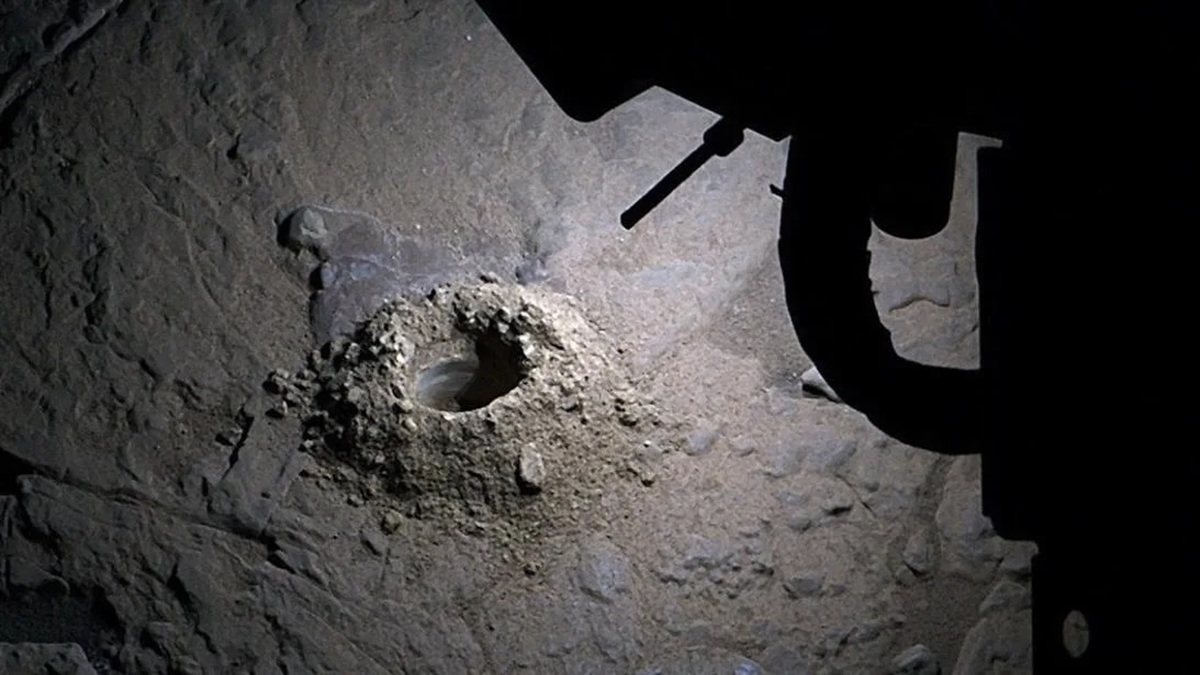


After 13 Years of Operations on Mars, NASA’s Curiosity Began a Rare Chemical Experiment Using the Last Dose of a Special Solvent to Analyze Rocks Formed in a Water Environment, a Stage Considered Critical for Expanding Understanding of Organic Compounds on the Planet.
NASA’s Curiosity rover began a rare experiment on Mars on February 2 by using the last dose of a special chemical reagent to analyze a rock sample with possible organic compounds, after a period of conjunction and 13 years of operations on the planet.
NASA’s Curiosity and the Rare Chemical Experiment on Mars
NASA’s Curiosity began executing an unusual type of scientific experiment after Mars came out of conjunction, a period when communication with spacecraft is interrupted because the planet is behind the Sun from Earth’s perspective. The procedure had only been carried out once before during the mission.
The experiment uses a solvent called tetramethylammonium hydroxide, known as TMAH in methanol. The liquid is mixed with powdered rock to facilitate the detection of certain carbon-based molecules associated with chemical processes related to known life on Earth.
-
Motorola launched the Signature with a gold seal from DxOMark, tying with the iPhone 17 Pro in camera performance, Snapdragon 8 Gen 5 that surpassed 3 million in benchmarks, and a zoom that impresses even at night.

-
Satellites reveal beneath the Sahara a giant river buried for thousands of kilometers: study shows that the largest hot desert on the planet was once traversed by a river system comparable to the largest on Earth.

-
Scientists have captured something never seen in space: newly born stars are creating gigantic rings of light a thousand times larger than the distance between the Earth and the Sun, and this changes everything we knew about stellar birth.

-
Geologists find traces of a continent that disappeared 155 million years ago after separating from Australia and reveal that it did not sink, but broke into fragments scattered across Southeast Asia.

The onboard laboratory of NASA’s Curiosity took only two small containers of this solvent throughout the mission. One had been used about six years ago, making the current analysis the last opportunity to employ the specific chemical compound.
Planning and Risk Reduction in Test Execution
Before the final execution, the scientific team conducted detailed rehearsals to minimize operational risks. The tests included simulating the transfer of the sample to the rover’s chemical laboratory, as recorded in mission reports.
“We want to be very sure that everything goes well,” said Alex Innanen, atmospheric scientist at York University, in an official record. According to him, the team conducted a complete rehearsal of the sample delivery procedure.
The technique offers the possibility of identifying chemical signatures that standard methods may not detect. Identifying these molecules helps researchers assess whether Mars ever had conditions compatible with the presence of life and how chemical processes similar to those on Earth could emerge on other worlds.
Previous Results and Recent Scientific Context
Organic compounds have previously been identified on Mars, although the scientific significance of these detections is still under analysis. In September, NASA announced that a sample collected by the Perseverance rover contained fossilized material that could have been produced by ancient microorganisms.
According to Nicky Fox, associate administrator of the agency, this finding represents the closest yet to identifying ancient life on Mars. However, officials emphasized that non-biological explanations cannot yet be ruled out.
Images obtained by the Mars Reconnaissance Orbiter revealed formations known as boxwork on the planet. These structures, visible from orbit, are being directly investigated by NASA’s Curiosity on the Martian surface.
Sampling Location and Geological Characteristics of the Sample
The sample analyzed was collected near a hole drilled in November, called Nevado Sajama. The region contains fine-grained sedimentary rocks, believed to have formed long ago in conditions involving water.
This type of environment is considered favorable for preserving fossilized organic material. The past presence of water makes the site relevant for scientific searches, as aqueous environments are associated with chemical processes essential to known life.
To avoid errors, the team previously trained each step of the transfer of material to the rover’s chemical laboratory. The formal initiation of the experiment took place on a Monday, February 2, according to Ashwin Vasavada, scientist for NASA’s Curiosity project.
Previous Experiments with TMAH and Method Reformulation
The last use of TMAH occurred in 2020 when NASA’s Curiosity drilled a clay-rich rock called Mary Anning. Analyzing the results took about seven months and revealed a greater variety of organic molecules than methods based solely on heating.
These results provided a more detailed view of the complex chemistry of Gale Crater. Scientists continue to evaluate whether some of these molecules could originate from components of the rover itself, which requires caution in interpreting the data.
After the initial test, researchers at the Goddard Space Flight Center decided to redesign the experiment. The goal was to adjust the solvent’s interaction with Martian sediment and bring the procedure closer to analyses performed in terrestrial laboratories.
The new method divides the experiment into three stages, allowing the solvent to interact with the sediment at different temperatures. The development took several years and faced delays due to the COVID-19 pandemic.
Timing Choice and Clay Relevance
With the redesign completed, the team waited for a suitable opportunity to execute the experiment. The discovery of clay minerals in the boxwork region led scientists to consider the site appropriate for the final use of TMAH.
Clay minerals can help preserve organic material over time. According to Vasavada, the combination of this discovery with favorable signs from the initial drilling in Nevado Sajama convinced the mission that the location was suitable for the final test.
Since its launch in 2011, NASA’s Curiosity has traveled over 352,000,022 miles, with 352 million during the space journey and another 22.5 on the Martian surface, traversing deserts and diverse geological formations.
Boxwork Region and Remaining Solvents
In the past year, the rover has explored an extensive boxwork region characterized by networks of low ridges that resemble spider webs when viewed from space. Scientists suggest that these structures may have formed with the last flows of groundwater before the area dried up completely.
Of the 74 internal compartments of NASA’s Curiosity, nine contained solvents intended for wet chemistry experiments when the rover landed in 2012. Although TMAH has been fully utilized, there are still compartments with another solvent known by the acronym MTBSTFA.
Two of the three phases of the current experiment have already been completed, according to Vasavada. He stated that the team is looking forward to the results but emphasized that the analysis is complex and will take several months for scientists to gain confidence in what has been found, even with a slight delay in interpreting the data.








A really good blog and me back again.