





 Portuguese
  English
  Spanish
  3 min of reading
  0 comments


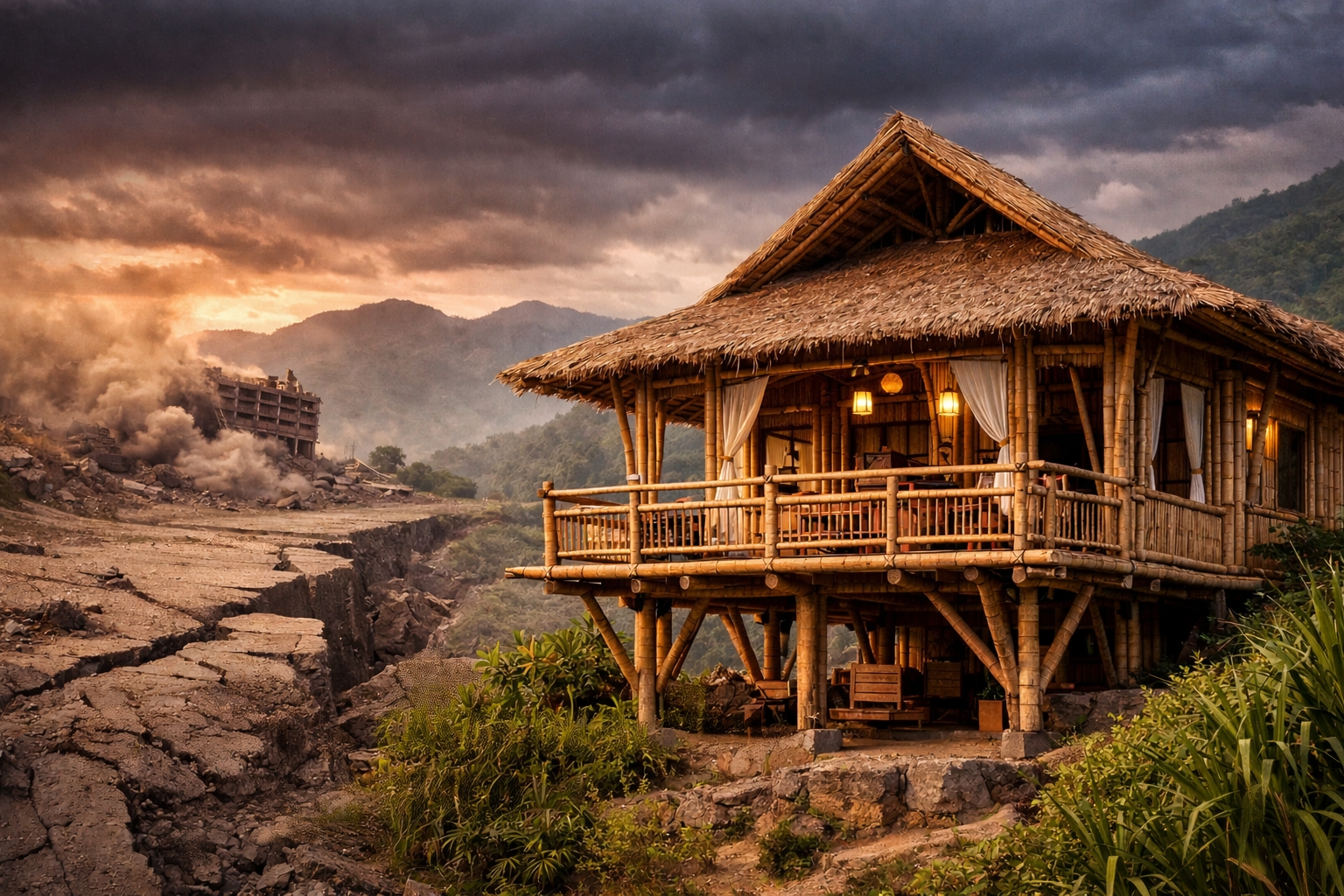
Bamboo Houses Are Inexpensive, Withstand Extreme Earthquakes, and Have Already Saved Entire Communities in Areas Affected by Natural Disasters
Bamboo houses are being used today in countries like Ecuador, the Philippines, and Pakistan as a cheap, quick, and resilient solution to protect populations against earthquakes, typhoons, and floods, after studies and tests have shown that this natural material can withstand tremors of up to magnitude 7.8, costing less than R$ 100,000 and remaining standing where concrete and brick have failed.
What Happened When a 7.8 Earthquake Destroyed Entire Cities but Spared Bamboo Houses
In April 2016, a magnitude 7.8 earthquake struck the coast of Ecuador and devastated cities like Manta. Concrete buildings collapsed, streets opened up, and entire neighborhoods disappeared. Amid the destruction, bamboo structures remained intact.
Fish markets, fire stations, tourist centers, and hundreds of bamboo-built houses stood firm. All had been constructed before the earthquake. This observation caught the attention of engineers and researchers worldwide.
-
This small town in Germany created its own currency 24 years ago, today it circulates millions per year, is accepted in over 300 stores, and the German government allowed all of this to happen under one condition.

-
Curitiba is shrinking and is expected to lose 97,000 residents by 2050, while inland cities in Paraná such as Sarandi, Araucária, and Toledo are experiencing accelerated growth that is changing the entire state’s map.

-
Tourists were poisoned on Everest in a million-dollar fraud scheme involving helicopters that diverted over $19 million and shocked international authorities.

-
Hidden beneath the dense forest of the Sierra Nevada, Betoma emerges in a neighbor of Brazil as the greatest archaeological discovery of the century, revealing a colossal ancestral city covering over 18 km², with 8,334 stone structures and the potential to rewrite the history of South American civilizations.


The main explanation lies in the behavior of the material. Unlike concrete, which is rigid and breaks, bamboo bends, absorbs energy, and dissipates the impact of the moving ground.
Why Bamboo Performs Better Than Concrete and Steel in Earthquakes
The secret of bamboo houses lies in the combination of lightness and flexibility. The stems, which are the hollow stalks of the plant, have low mass. This reduces the seismic forces acting on the structure during an earthquake.
Moreover, academic research, such as a study from the 2024 World Conference on Earthquake Engineering, shows that bamboo possesses high ductility. It bends without breaking. This characteristic allows the structure to move with the tremor without collapsing.
How Bamboo Houses Can Cost Less Than R$ 100,000 and Still Be Safe
According to data from the International Bamboo and Rattan Organization, a two-bedroom house made with bamboo and wood can cost less than US$ 20,000, equivalent to about R$ 100,000, depending on the country and the technique used. The main source of the article is the International Bamboo and Rattan Organization and the BBC.
The reduced cost occurs because the material is abundant, grows quickly, and can be processed locally. In many projects, the community itself participates in the construction, reducing labor costs.
Structures typically follow traditional techniques, such as bahareque, which uses interwoven bamboo panels covered with clay, lime, or lightweight cement. This combination creates strong, lightweight, and durable walls.
Bamboo Houses Have Withstood Typhoons, Floods, and Extreme Laboratory Tests
In the Philippines, over 800 bamboo houses have been built since 2014 by the Base Bahay Foundation, an organization affiliated with Ateneo de Manila University. These homes have withstood annual typhoons with intense winds and heavy rains, according to published data.
In Pakistan, researchers from the NED University of Engineering and Technology subjected models of bamboo houses to shake table tests simulating earthquakes stronger than the one in Kobe, Japan. The structures resisted up to 250% of the original tremor’s force, according to the report.
Sustainability, Low Carbon, and Access to Safe Housing
In addition to their resilience, bamboo houses offer environmental advantages. Bamboo grows quickly and serves as an important carbon sink. According to the Food and Agriculture Organization of the United Nations, the material absorbs more carbon than it releases during its life cycle, reducing the environmental impact of construction.
This makes bamboo a viable alternative in impoverished regions vulnerable to natural disasters and with limited access to safe housing. Countries like Colombia, Peru, India, and Bangladesh have already established official standards for bamboo construction.
The challenge now is to overcome prejudice. In many regions, bamboo is still seen as a fragile material or associated with poverty. The data, however, show the opposite.









-

2 pessoas reagiram a isso.