





 Portuguese
  English
  Spanish
  4 min of reading
  0 comments


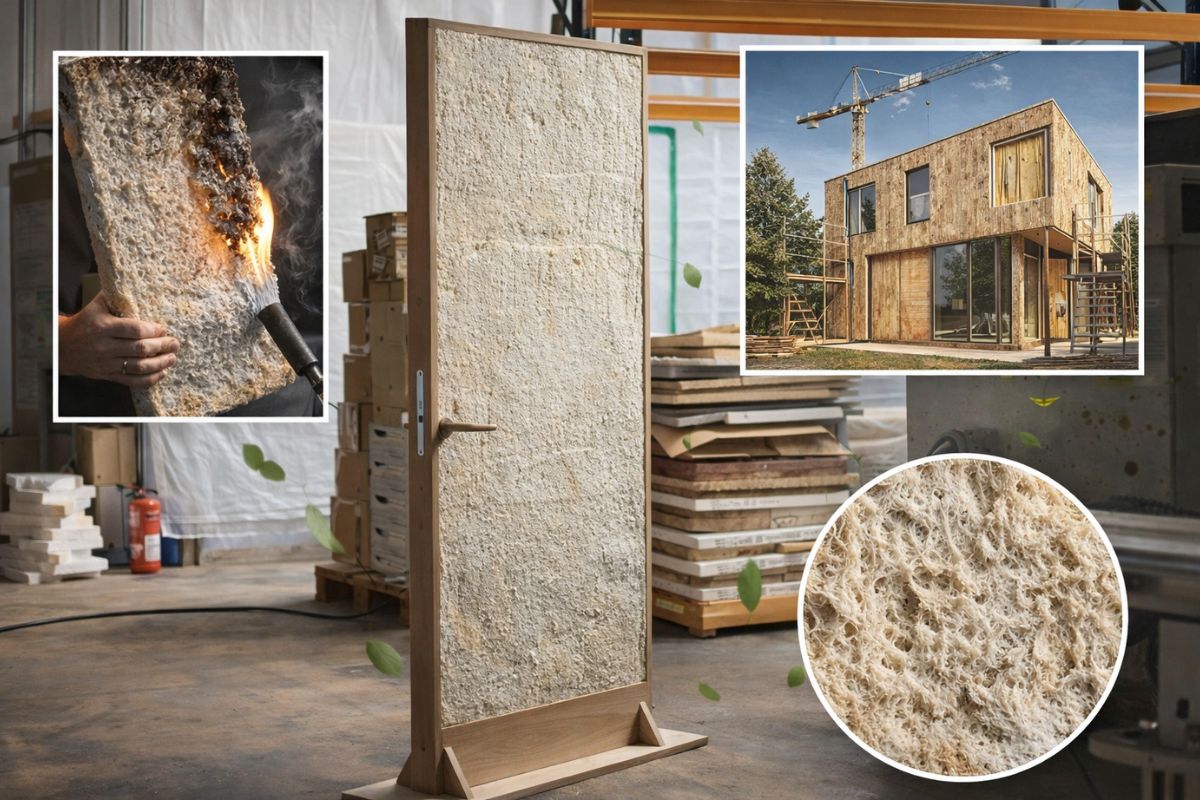
The door made from fungal mycelium was developed by Rebound in partnership with the Det Levende Hus office and has a core cultivated in two weeks with natural qualities of sound absorption, fire resistance, and a structure covered with recycled wood ready for installation in homes.
A Danish company has created what it claims to be the world’s first mass-produced internal door with a core grown from fungal mycelium. Rebound, in partnership with the architectural office Det Levende Hus, developed a door whose central core grows in just two weeks using the rapid growth of fungi to produce a rigid, lightweight panel with natural sound absorption qualities. This core is covered by a structure of recycled wood that gives integrity to the whole and allows for conventional installation in any home.
What makes this door revolutionary is not just the material, but what it represents for the construction industry. While a tree takes years to grow and be harvested, consuming large amounts of water and energy, the fungal cultivation process for the door takes about two weeks and was designed from the outset for industrial scalability. The first practical application will be in Kaerhytten, a low-impact housing project in Ramloese, Denmark, with completion expected in 2026.
How a door can be grown from fungi in two weeks

According to information from the portal yankodesign, the process begins with mycelium, the filament structure that forms the main part of fungi and spreads rapidly through organic substrates.
-
More than 1,500 Chinese workers transformed an entire railway station in just one night and reduced a 7-hour journey to 90 minutes with a high-speed line of 200 km/h.

-
An Asian country has just divided its high-speed train megaproject into 17 independent works to accelerate the construction of the railway that will run through the entire country from north to south.

-
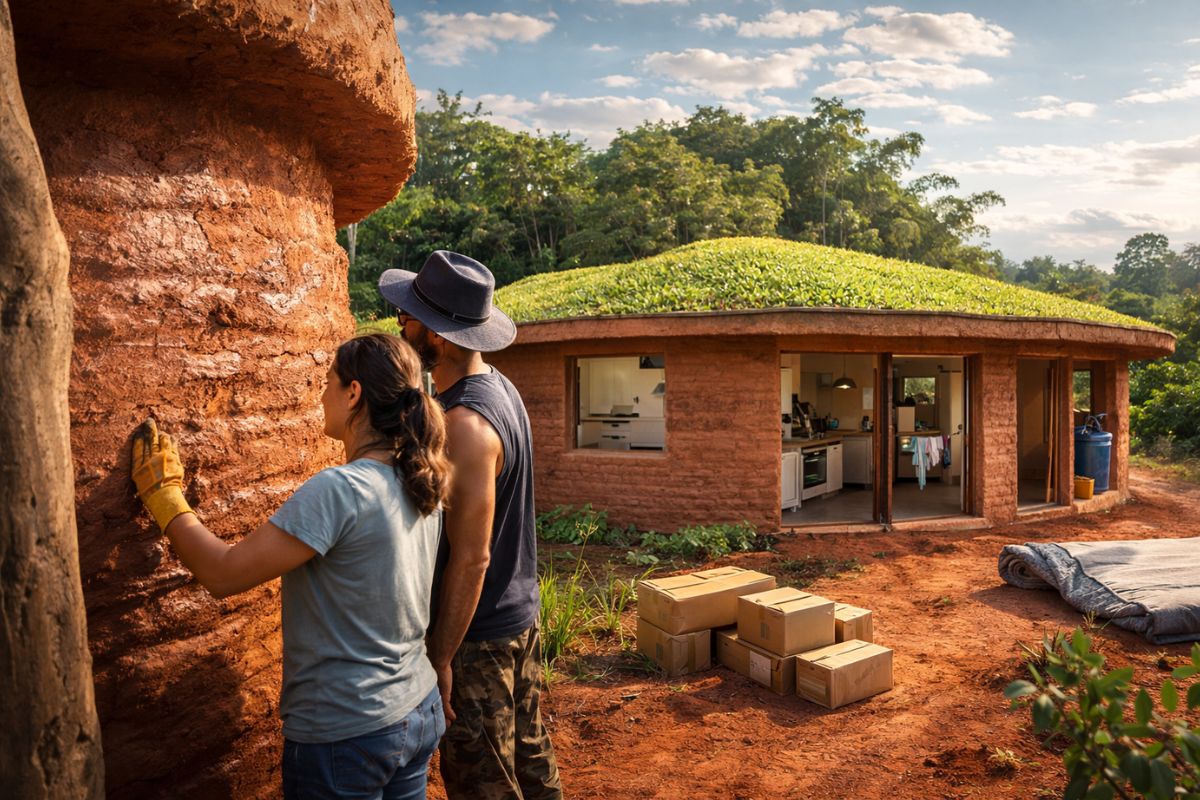
Couple builds earth house using hyperadobe technique and green roof without tarpaulin: the project uses gelmembrane, adobe partitions, and plaster with cactus slime, and the kitchen is already ready with a move planned in two months.
-
Switzerland has hidden more than 1,400 tunnels beneath the Alps to take trucks out of the mountains, and the result has already prevented hundreds of thousands of tons of CO2 without passengers noticing the difference.

Rebound’s engineers use this natural growth to fill a mold in the shape of the door’s core.
In about two weeks, the mycelium forms a rigid and lightweight panel that occupies the center of the door, replacing conventional materials like particleboard or foam that typically make up the core of internal doors.
The result is a material with surprising properties. The fungal core naturally absorbs sound, improving acoustic insulation without the need for additional materials.
The door also receives a bio-based coating during the growth process that hardens the surface and improves fire resistance—two characteristics that typically require chemical treatments in conventional doors. All of this happens in 14 days, with an environmental impact that manufacturers describe as almost zero.
Why this door could replace traditional wood in construction
Wood is one of the oldest and most reliable materials in construction, but it has a growing environmental cost. Forests are cut down, the growth cycle takes decades, transporting the raw material generates emissions, and industrial processing consumes energy.
The Rebound fungal door addresses each of these points: the material grows in weeks instead of years, does not require tree cutting, the process is local and scalable, and the carbon footprint is drastically lower.
Jon Strunge, co-founder of Rebound, summarized the ambition: “We wanted to demonstrate how high-performance regenerative materials based on mycelium open up opportunities for innovative and scalable building components.”
The door does not require post-finishing because the color and texture of the surface can be altered during the fungal growth process.
The first prototype has a smooth and silky surface, but the material can change in hue and also accepts clay coating for a warmer, earthier aesthetic—all determined during cultivation, not in the factory.
What the fire resistance of this door means in practice
One of the natural concerns when hearing “fungal door” is safety. Fungi are organic—shouldn’t they be flammable? The answer is surprising.
The bio-based coating incorporated during the growth of the mycelium hardens the door and significantly improves its fire resistance, a property that conventional internal doors only achieve with chemical flame-retardant treatments.
For the construction industry, this changes the equation. A door that is both lightweight, acoustically efficient, and fire-resistant, made from renewable material in two weeks, competes directly with any industrialized door.
The difference is that the fungal door does not generate the chemical waste associated with traditional treatments and can be composted at the end of its life cycle, closing a loop that conventional doors simply cannot offer.
Where the first fungal door will be installed and what comes next
The first real application will be in the Kaerhytten housing project in Ramloese, Denmark, designed by architect Jens Martin Suzuki-Højrup.
The low environmental impact set serves as a showcase to demonstrate that the fungal door works under real usage conditions with residents opening and closing daily, temperature and humidity variations, and natural wear over time.
The plans do not stop at doors. Rebound and Det Levende Hus intend to expand their mycelium-based panels to include acoustic insulation boards for walls and ceilings, broadening the reach of the technology beyond a single building component.
If the door works as a proof of concept, an entire line of building materials grown from fungi could follow, transforming what is currently a prototype into an industry standard.
Would you live in a house with doors made from fungi? Do you think this type of material could actually replace wood?







Seja o primeiro a reagir!