





 Portuguese
  English
  Spanish
  3 min of reading
  0 comments


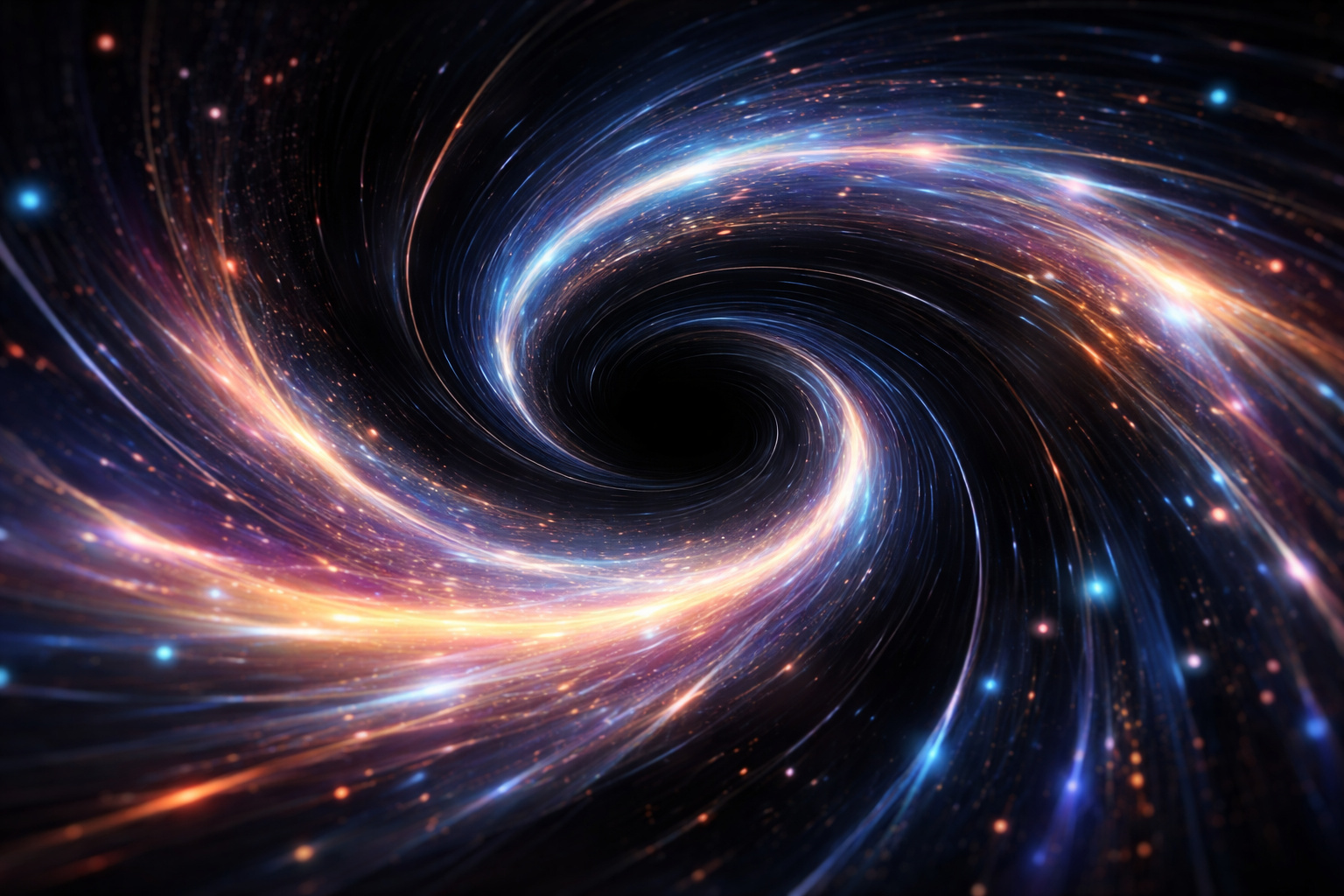
Recent studies show how dark vortices move faster than light without violating the laws of physics
A recent scientific discovery has brought new elements to the understanding of light and darkness in the universe, attracting the attention of the international scientific community.
Researchers have demonstrated that structures of darkness can move faster than light, without contradicting the principles established by relativity.
The theories formulated by Albert Einstein in the early 20th century define that the speed of light in a vacuum is the maximum limit for objects with mass.
This limitation also applies to signals that carry energy or information, which maintains the consistency of known physical laws.
However, phenomena that have no mass and do not carry energy can exhibit different behaviors.
This point opens the door to the existence of so-called superluminal effects, which have been studied over the past few decades by international scientific teams.
-
A Brazilian scientist created a pen that touches human tissue and identifies cancer cells in seconds using a drop of water and artificial intelligence, and Lívia Eberlin’s invention has already been used in over 400 surgeries in the United States and Brazil.

-
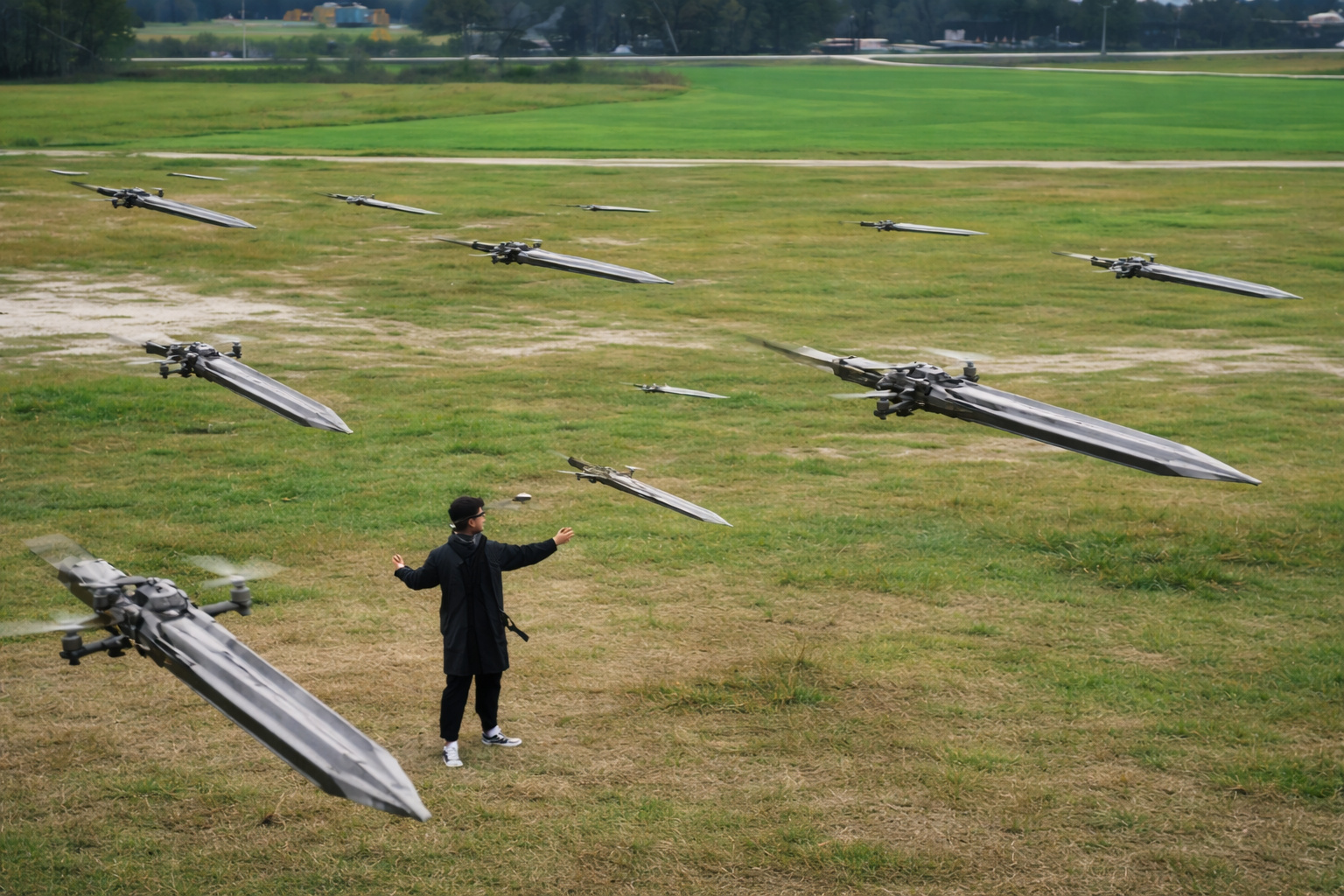
An inventor in China creates flying drones shaped like swords that respond to hand gestures in real time, with technology based on motion sensors transforming interaction into a scene worthy of a movie and redefining the control of machines in the air.
-
100 times less energy consumption: the innovation that could solve the huge energy crisis of AI.

-
Scientists reveal a new method using solar light that transforms plastic into vinegar and could change the game against pollution, converting waste into a sustainable solution with future global impact.

Points of darkness within light reveal new dynamics
Light, behaving like a wave, presents regions where its intensity becomes null.
These points are known as null points and represent areas of complete darkness within the luminous field.
This characteristic led researchers to investigate the possibility of manipulating these regions as organized physical structures.
Recent experiments confirmed that it is possible to create patterns of darkness within light, expanding the understanding of wave nature.
An international team, including Professor Ido Kaminer, experimentally validated a theory debated for years.
The scientists managed to create dark helices, described as vortices of non-light within light waves.
Dark vortices reveal behavior above the speed of light
Vortices are common phenomena in nature and can be observed in systems such as fluids and water currents.
These structures have the ability to move independently of the flow around them.
In optical systems, light vortices are already explored in technological applications, including communication and particle manipulation.
Recent research demonstrated that it is also possible to create vortices formed by regions of darkness.
The experiments showed that these vortices can move faster than the very light wave in which they form.
This behavior does not violate relativity, as these structures have no mass and do not carry energy or information.
Scientific applications expand the reach of the discovery
The experimental demonstration of this phenomenon presents relevant implications for different areas of knowledge.
According to Ido Kaminer, the discovery reveals universal laws that apply to various types of waves, including sound and fluid flows.
The team used a method based on electronic interferometry to observe phenomena at the nanoscale with greater precision.
This technique improves image clarity and allows for the analysis of extremely fast processes.
This advancement can be applied in areas such as physics, chemistry, and biology, expanding the capacity for scientific investigation.
Researchers highlight that it will be possible to observe previously inaccessible phenomena at their fastest moments.
The impact of the discovery on the understanding of modern physics
The research reinforces the importance of modern optics in the advancement of science and expands the understanding of the interaction between light and darkness.
This new understanding indicates that phenomena considered impossible may reveal new dimensions of wave behavior.
The evolution of these investigations shows that there is still much to be discovered about the nature of light and its limits.
How far will science be able to expand the understanding of the phenomena that govern the universe?









Seja o primeiro a reagir!