





 Portuguese
  English
  Spanish
  3 min of reading
  0 comments


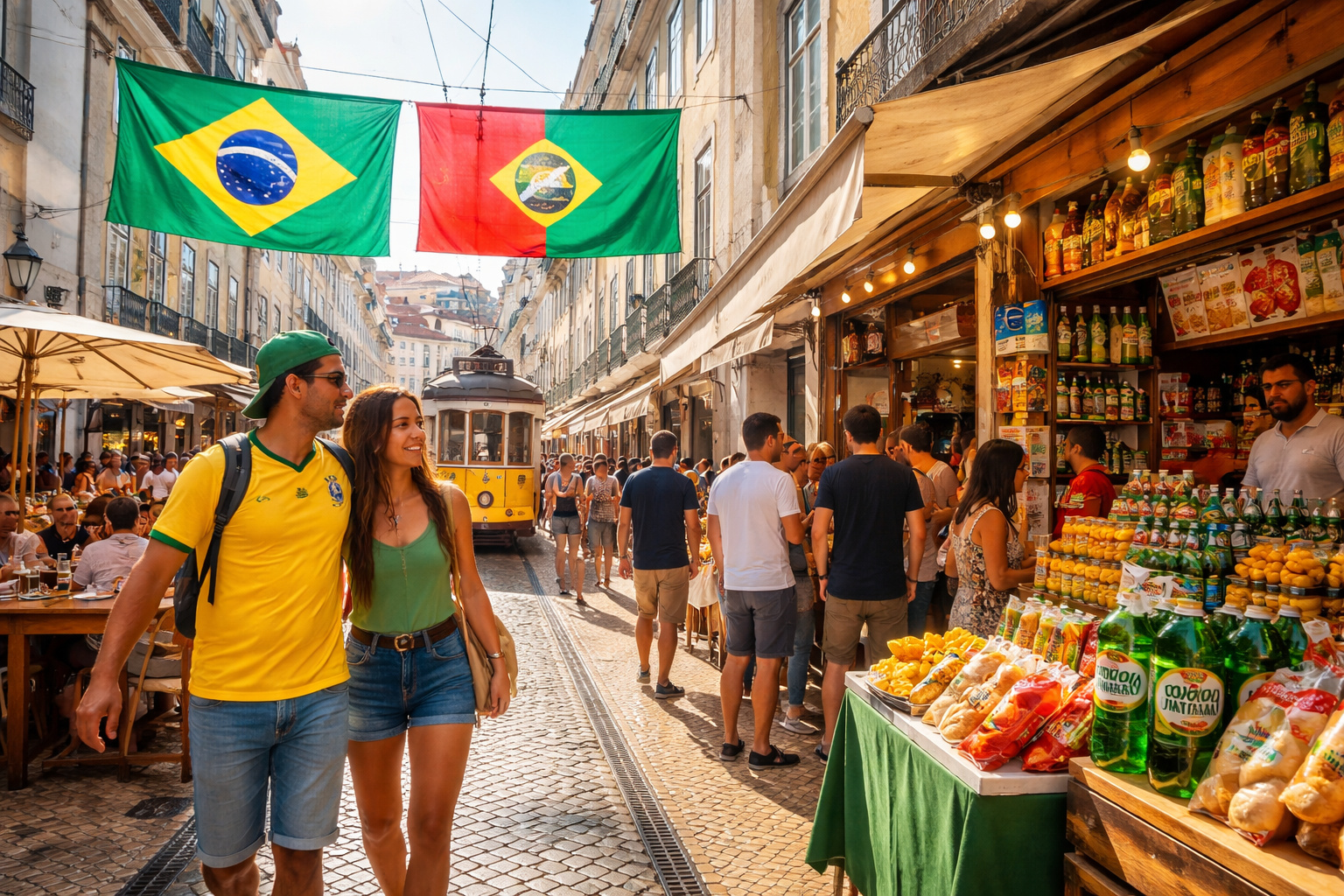
Pix in Commerce, Viral Memes, Growing Immigration, and Cultural Changes Show How Brazilian Presence Gained Visibility in Portugal and Began to Fuel Debates About National Identity, Integration, and Politics
Since 2023, Portugal has been experiencing an increasingly explicit public debate about Brazilian cultural influence, immigration, and national identity. In this context, symbolic episodes gained traction, especially on social networks, while practical decisions in daily life began to reflect this new reality.
Right in this initial scenario, the adoption of Pix by a supermarket chain in Braga, in the north of the country, became a milestone. Although the initiative was presented as a commercial pilot project, it was interpreted by nationalist groups as a direct sign of “Brazilianization of Portugal.”
Meanwhile, Brazilians reacted with irony. Thus, memes began to circulate referring to Portugal as “the new Brazilian state,” “Brazilian Guiana,” or “Pernambuco standing,” broadening the scope of the debate and bringing to light tensions related to the colonial past.
-
He started running at 66 years old, broke records at 82, and is now a subject of study for having a metabolic age comparable to that of a 20-year-old, in a case that is intriguing scientists and inspiring the world.

-
Oldest tree on the planet reappears after 130 years of searches: Wattieza, 385 million years old, was 10 meters tall and had no leaves or seeds; Gilboa fossils in New York solved the mystery in 2007.

-
A 48-square-meter house assembled in hours with 4,000 bricks made of recycled plastic that does not absorb moisture, has natural thermal insulation, and costs less than 90,000 reais in a complete kit.

-
Luciano Hang revealed that Havan’s air fleet has already accumulated more than 20,000 landings, 10,000 flight hours, and 6 million kilometers traveled, and he says that without the planes, the company would never have grown so quickly.


Brazilian Immigration Grows and Expands Presence in Everyday Life
Currently, more than 510,000 Brazilians live in Portugal, according to data from the Brazilian Ministry of Foreign Affairs. Furthermore, unlike previous migration flows, this wave includes Brazilians from all social classes, which increases their presence in commerce, the labor market, and cultural life.
According to Pedro Góis, a sociologist at the University of Coimbra, this visibility grows because Brazilian culture is marked by strong social, musical, and linguistic expression, enhanced by digital networks.
In 2024, the supermarket chain Continente confirmed the adoption of Pix in six stores in the Braga region. According to the company, the objective was to improve the consumer experience, especially for tourists and immigrants, although the decision generated a strong political reaction.


Language, Consumption, and Culture Undergo Transformation
At the same time, changes in everyday vocabulary have become noticeable. Terms like “refrigerator”, “grass”, and “tip” have started to be used more frequently, especially among young people influenced by Brazilian content creators. Although the phenomenon is most visible among teenagers, it also reaches older generations.
In Lisbon, where the largest Brazilian community in Europe is concentrated, this influence has become institutional. In 2025, the Municipal Chamber officially recognized the Brazilian Street Carnival in the city’s calendar. According to Mayor Carlos Moedas, the event is now part of Lisbon’s cultural identity.
Additionally, supermarkets have started selling Brazilian products, while specialized restaurants have multiplied, even under the command of Portuguese chefs, reinforcing integration through consumption and gastronomy.
Universities and Labor Market Feel the Effects
In the educational field, exchange programs have intensified. Currently, 19,000 Brazilians study at Portuguese universities, driven by the recognition of the Enem by 26 institutions. According to Pedro Góis, this movement generates economic benefits and forces universities to reconsider pedagogical practices and linguistic norms.
In the labor market, Brazilian dentists have integrated since the 1990s, while lawyers expanded their presence following agreements with the Order of Lawyers of Brazil, revoked only in 2023. Today, nearly 10% of voting members of the Portuguese Bar Association are Brazilian, which has increased the judicialization of immigration-related issues, especially involving the AIMA.
Political Reactions, Xenophobia, and Social Tension
At the same time, anti-immigration rhetoric has grown. Between 2017 and 2021, reports of xenophobia against Brazilians increased by 505%, according to the Commission for Equality and Against Racial Discrimination. Influencers and nationalist pages began to classify memes as a cultural threat, while experts point to unresolved historical resentments.
For historians and sociologists, this scenario reflects Portugal’s difficulties in critically revising its imperial past and dealing with contemporary diversity. Nevertheless, Pedro Góis relativizes the conflict and states that it is not an invasion, but rather a natural process of cultural sharing.
In light of this scenario, the question remains: Will Portugal be able to transform this intense coexistence into balanced integration, or will cultural tension tend to deepen in the coming years?









-

-

3 pessoas reagiram a isso.