





 Portuguese
  English
  Spanish
  3 min of reading
  1 comment


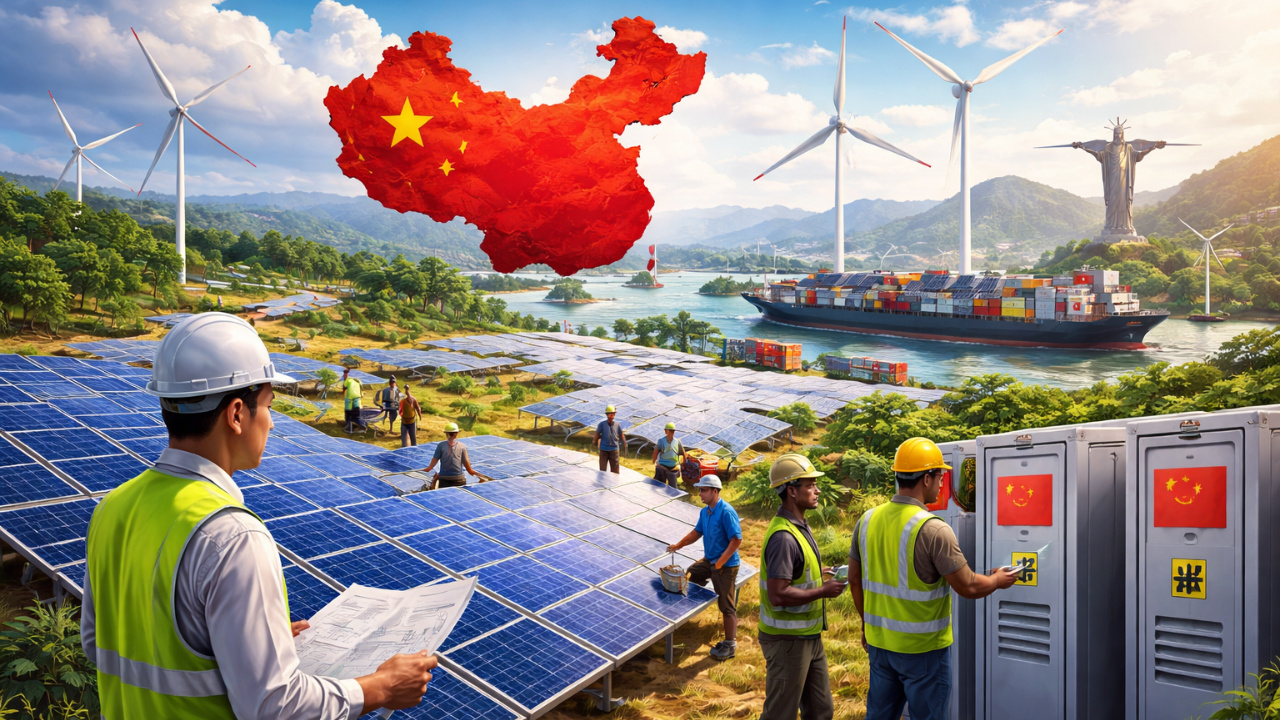

China Invests Hundreds Of Billions In Renewable Energy, Dominates Global Production, And Uses Green Technology To Expand Its Influence In Africa, Latin America And Asia.
While the United States and Europe discuss climate goals, China has already implemented a much more aggressive strategy. Since 2011, the Chinese government has activated what experts have come to call a true “Green Marshall Plan,” using renewable energy as a tool to reshape the planet’s political, economic, and energy landscape.
The plan goes beyond mere decarbonization. By heavily investing in solar panels, batteries, turbines, and electric cars, Beijing has started to offer developing countries something the West promised but rarely delivered: infrastructure, technology, and financing to grow without relying so heavily on fossil fuels.
A Billion-Dollar Plan That Grows At An Accelerated Pace
The numbers help explain the project’s scale. Since 2011, China has invested about US$ 227 billion in over 450 renewable energy-related projects.
-
The Brazilian state accelerates industrial competitiveness with a focus on the extraction of strategic minerals to boost the energy transition in Goiás.
-
A Canadian retiree creates a hydroelectric system on a real river, generating energy continuously throughout the day and demonstrating how the power of water can supply a house with stability even in a simple structure.

-
Petrobras reaffirms its commitment to the market and ensures that it will carry out the energy transition safely to maintain national sovereignty.

-
Researchers discover a possible hydrogen deposit of up to 46 million tons beneath an ancient coal basin, and the volume could exceed half of the entire global production.


However, the most surprising data is the recent speed of this expansion. About 88% of this volume was applied starting in 2022, which shows a clear acceleration.
In 2024 alone, Chinese investments in green energy abroad reached US$ 11.8 billion. In the first half of 2025, another US$ 9.7 billion were put on the table, reinforcing that the offensive did not slow down.


A major part of this money flows through the Belt and Road Initiative. Inspired by the ancient Silk Road, the proposal is to create a vast network of infrastructure and trade, now having renewable energies as the centerpiece.
The Overproduction That Allows Market Domination
The strategy only works because China dominates the global production chain. It is estimated that the country manufactures 80% of the world’s solar panels, 75% of lithium batteries, and 70% of wind turbines.
The internal competition among Chinese companies is so intense that they had to create something akin to a OPEC to avoid price wars. Even so, prices have plummeted, crushing Western competitors.
As a result, developing countries can purchase renewable energy technology at much lower costs than just a few years ago. This facilitates the energy transition while simultaneously increasing dependence on China.
In 2024, China’s exports of green technologies totaled US$ 177 billion, about 5% of all exports from the country. Of this total, US$ 72 billion were sent to developing countries.
Ethiopia is one of the clearest examples. The country banned the importation of new gasoline cars in 2024, betting on electric vehicles.
In exchange, China had already invested US$ 4 billion in the energy sector between 2011 and 2018, financing wind farms and the Grand Ethiopian Renaissance Dam. Now, another US$ 500 million has been directed towards solar energy factories.
In Morocco, Chinese companies have set up battery factories to supply the electric vehicle industry. Overall, China is traversing Africa delivering renewable energy while also building roads, ports, and access to critical material mines.
It is estimated that 90% of the solar panels installed on the African continent are of Chinese origin.
Latin America Enters The Radar, And Brazil Responds
Chinese expansion is also advancing through Latin America. In Brazil, the government decided to raise import tariffs on cars to force Chinese manufacturers to establish factories in the country. The result was immediate: BYD and Great Wall Motors announced industrial units on Brazilian soil.
The logic is similar to what China itself used in the past to attract foreign automakers. This way, the country seeks to avoid just importing technology and aims to create jobs and local industry.
Do you think that China’s renewable energies are helping the world or creating a new global economic dependency?








Only the author of this article has a negative view. Ask the citizens of the countries involved and they will be most happy.