





 Portuguese
  English
  Spanish
  6 min of reading
  1 comment


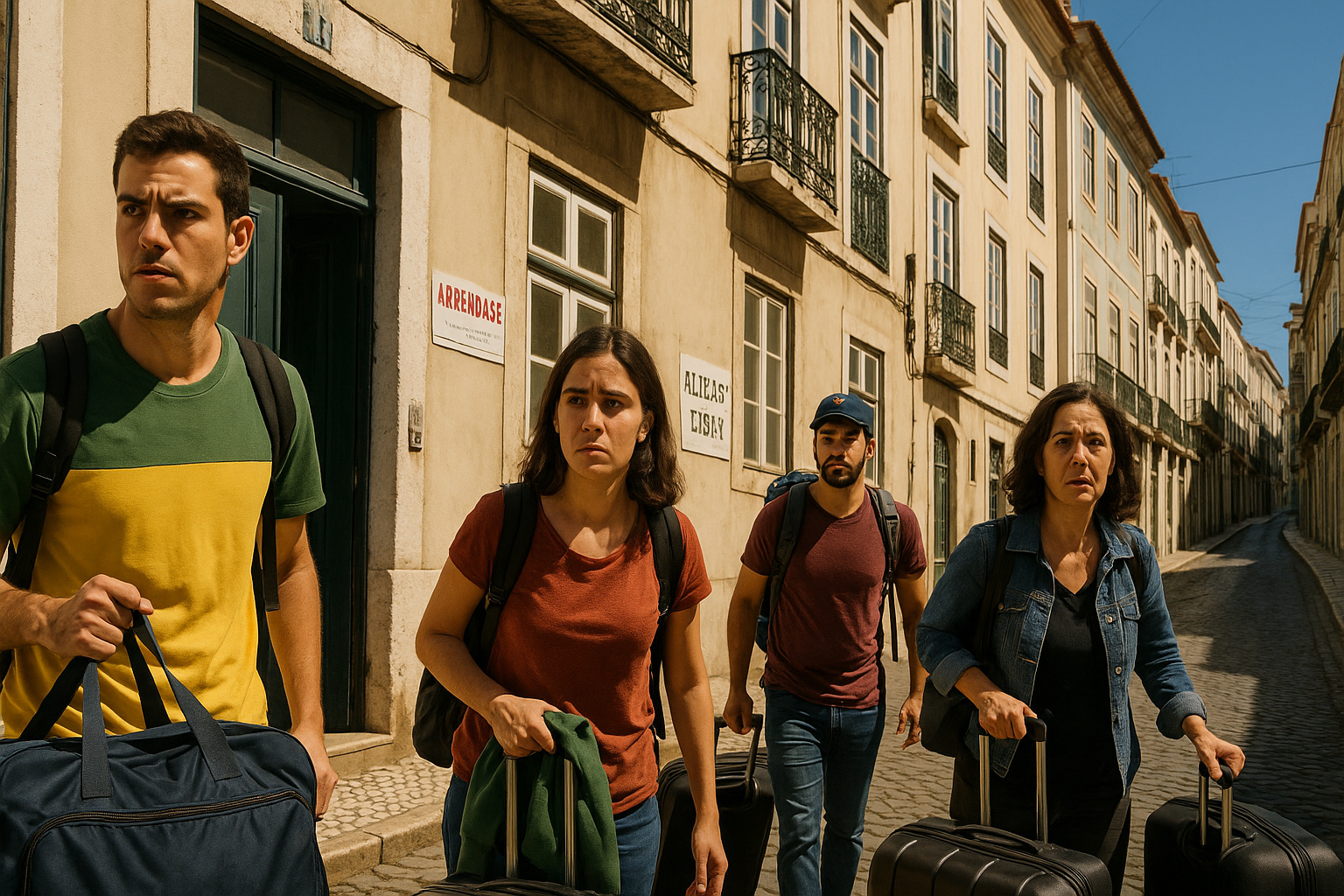


Silent Change Became Rupture: The End of the “Expression of Interest” and the Turn in Portuguese Migration Policy
For years, Portugal was seen as the most accessible European destination for Brazilians seeking to restart their lives abroad. However, in recent months, this scenario changed abruptly. What was once synonymous with welcoming, opportunities, and ease of documentation has become associated with fear, uncertainty, bureaucracy, and a high cost of living. As a result, an unexpected movement began to gain momentum: Brazilians are leaving Portugal and, in many cases, returning to Brazil or migrating to other European countries.
The information was reported by outlets such as BBC Brasil, CNN Portugal and official reports from the Portuguese government, which began to record a growing volume of notifications of voluntary abandonment and expulsion processes. This turn did not happen by chance. It is a direct consequence of a decision made in 2024, when the new Portuguese government decided to end one of the pillars of immigration in the country: the so-called expression of interest.
This mechanism allowed anyone who arrived in Portugal, started working and proved a labor bond to apply for residency after a certain period. For many years, it was this open door that transformed the country into one of the most flexible immigration regimes in Europe. As a direct effect, the number of foreign residents tripled in a decade, attracting people not only from Brazil but also from Asia and Africa.
-
Friends have been building a small “town” for 30 years to grow old together, with compact houses, a common area, nature surrounding it, and a collective life project designed for friendship, coexistence, and simplicity.

-
This small town in Germany created its own currency 24 years ago, today it circulates millions per year, is accepted in over 300 stores, and the German government allowed all of this to happen under one condition.

-
Curitiba is shrinking and is expected to lose 97,000 residents by 2050, while inland cities in Paraná such as Sarandi, Araucária, and Toledo are experiencing accelerated growth that is changing the entire state’s map.

-
Tourists were poisoned on Everest in a million-dollar fraud scheme involving helicopters that diverted over $19 million and shocked international authorities.


Minister António Leitão Amaro described this phenomenon as “the biggest demographic change in democratic Portugal’s history.” According to official data, around 1.5 million foreigners live in the country today, equivalent to 14% of the total population. From this contingent, more than 500,000 are Brazilians, consolidating Brazil as the main foreign nationality in Portuguese territory.
However, at the same time that immigration grew, pressures on public services, such as schools, hospitals, and the real estate market, also increased. The government itself began to assert that the system generated disorganization, slowness and functioned as an “open-door policy.” As one minister stated, “the number of foreign immigrants in Portugal has quadrupled, as has the number of foreign students in public schools, the demand for primary health care, and the foreign taxpayers for social security.”
It was in this context that, on June 3, 2024, the expression of interest was officially terminated. The new government, led by Luís Montenegro, established a simple and decisive rule: only those who already have a work contract before arriving in the country can immigrate. The consequence was immediate and profound.
A task force reviewed old processes that were stalled. As a result, 34,000 residency requests were denied, with 5,386 from Brazilians. These individuals began receiving official notifications granting 20 days for voluntary departure from Portugal.


Expulsions, Immigration Police, and Fear: Brazilians Live in a New Phase of Surveillance and Insecurity
According to a report from Aima – Agency for Integration, Migrations, and Asylum, released in 2023, 52.4% of the Voluntary Abandonment Notifications issued in Portugal are directed at Brazilians. Additionally, there is a specific program for Voluntary Return, funded by the European Union, that covers airfare and provides initial support in Brazil. According to official data, over 80% of the beneficiaries of this program are Brazilians.
If voluntary departure does not occur, the state may resort to coercive removal using security forces. To strengthen this control, the government created, in July 2025, the UNEF – National Unit for Foreigners and Borders. This is a new police force, linked to the Public Security Police, which began its operations with 1,200 agents and legal power to detain individuals in irregular migration situations.
In light of this new scenario, the Brazilian Consulate in Lisbon itself published official alerts. The recommendation is clear: Brazilians should always carry valid documents and prove a connection to the country, such as a work contract, proof of residence, or contributions to social security, to avoid problems during inspections.
Among the proponents of the new law is former Portuguese parliamentarian Miguel Helvas, who told CNN Portugal: “This is not an anti-immigration law, but a law that allows for control and conditioning. Previous governments allowed an open-bar policy, and now we need a control policy.”
However, while the official discourse speaks of organization, thousands of Brazilian families live under constant tension. There are reports of mothers notified to leave the country while their husbands, with residency permits, can remain. Lawyer Diego Bove, who works in Lisbon, reported to the press cases of couples living in permanent fear. According to him, “they are people with established lives, earning little, and being sent away at this moment can weigh heavily on the balance of life.”
Immigrant support associations accuse the government of spreading fear. Timóteo Macedo, president of the NGO Solidariedade Imigrante, went so far as to define the country as “an open-air prison.” Meanwhile, reports of xenophobia are multiplying, with Brazilians reporting verbal assaults and discrimination in the workplace.
Still, the phenomenon is not limited to expulsions. Even Brazilians in legal situations are choosing to leave spontaneously. And the main reason goes beyond migration rules.
Cost of Living Soars, Salaries Do Not Keep Up, and Even Portuguese Are Leaving the Country

Portugal remains beautiful, but living in the country has never been so expensive. In 2025, the cost of living reached unexpected levels even for the Portuguese themselves. The average rent reached 16.8 euros per square meter, and in cities like Lisbon and Porto, there are properties that consume between 40% and 60% of monthly family income.
The national minimum wage, set at 870 euros, does not keep up with the rising prices of food, energy, and housing. Brazilian translator Lara Sheffer, 30, felt this impact directly. In an interview with BBC, she said that the rent for her apartment in Oeiras rose from 935 to 1,250 euros in just two years. With an inflation rate of 2.8% and food prices increasing by 4%, the budget simply stopped balancing.
In early 2025, the situation worsened when the euro fell to US$ 1.01, reaching parity with the dollar and reducing the purchasing power of Europeans. In September, the currency regained value, reaching US$ 1.18, while the dollar fell against the real, dropping from R$ 6.18 in January to about R$ 5.40. Still, experts point out that this does not represent strengthening of the real, but rather weakening of the dollar.
At the same time, since 2022, tourism has exploded in Portugal. Thousands of residential properties have been converted into short-term accommodations, such as Airbnbs. The influx of foreign real estate funds and the creation of visas for digital nomads have intensified the competition for housing. Professionals with high salaries have started to compete directly with Brazilians employed in lower-income sectors, such as services, construction, and commerce.
Professor João Alfredo Lopes Nyegray, from PUC-PR, defines this scenario as a “double strangulation”: more demand and less supply. According to him, “even if legal residency is assured, material and social permanence becomes unviable for a significant part of this community.”
Librarian Lucas Carrera, after seven years in Lisbon, moved to Barcelona. He reported that his weekly food expenses jumped from 20 to 50 euros, while the electricity bill ranged from 15 to 75 euros. Today, he pays 630 euros for a studio in the center of Barcelona, an amount he considers “impossible” in Lisbon.
Similar cases are repeating. Glauco Brandão, a content moderator, earned with his husband 1,600 euros and paid 700 euros in rent. There was always a shortage of money at the end of the month. The couple moved to Gent, Belgium, where they started to have more income and comfort.
The impact also affects the Portuguese themselves. In 2023, about 70,000 citizens emigrated, equivalent to 0.66% of the population, a rate ten times higher than that of Brazilians leaving Portugal in the same period. According to Eurostat, house prices more than doubled in 15 years, with increases of up to 300%, while 20% of the population left historic centers between 2011 and 2021.
Geographer Luís Filipe Gonçalves Mendes, from the University of Lisbon, refers to this process as “turbo-gentrification,” which transforms cities into tourist showcases and expels residents. As he states, “a city without immigrants is no longer a city.”
Portugal remains enchanting, but for many, the charm no longer compensates for the price.
Source: Elementar









Teria que dar a reciprocidade, se tivéssemos um governo que se preze.
Teríamos que tratar os portugueses que aqui desembarcaram para matar a fome, com a mesma discriminação que sempre nos trataram.
Lá, só nos tratam bem quando chegamos “com as burras cheias de dólares ” 😡. E isso vem de berço, haja a vista o que crianças acabaram de fazer, decepando os dedos de um aluno brasileiro.