





 Portuguese
  English
  Spanish
  3 min of reading
  2 comments


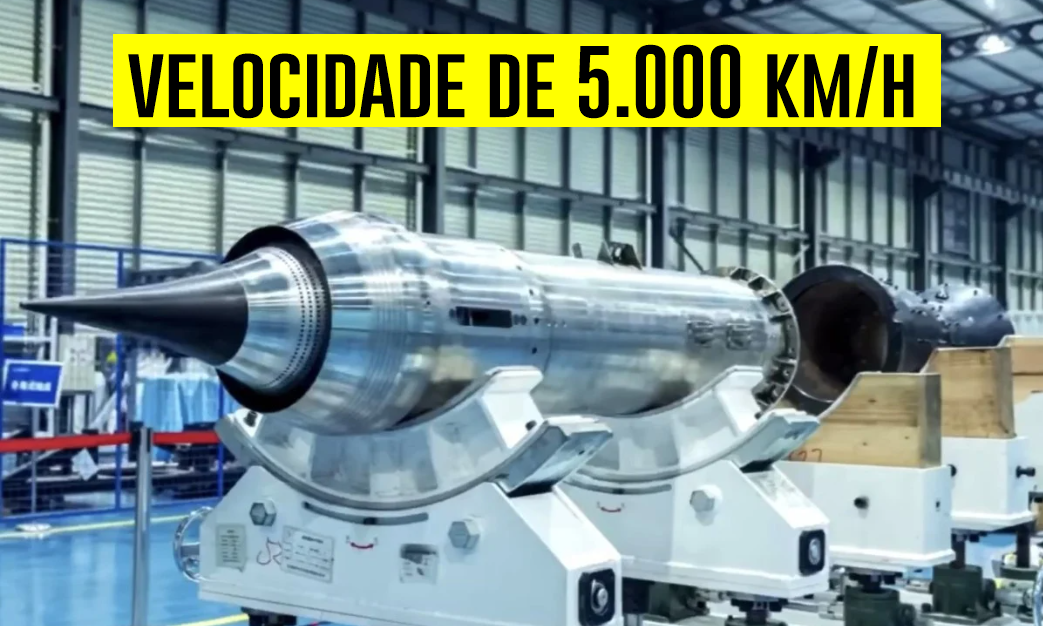


China Tests Supersonic Engine Capable of Transporting Passengers from Beijing to New York in 2 Hours. Discover the Details of This Innovation That Could Transform Air Travel
A major innovation in China’s aerospace sector could transform how air travel will be conducted in the future with a supersonic engine.
The company Space Transportation, also known as Lingkong Tianxing Technology, successfully tested a supersonic ramjet engine (a type of jet engine that has no moving parts) based on detonation, which can power aircraft capable of transporting passengers from Beijing to New York in just two hours.
The supersonic engine has been named Jindouyun or JinDou400, and its performance has been impressive, reaching speeds of Mach 4, or 5,000 km/h, at altitudes above 65,600 feet (approx. 20 km).
-
Motorola launched the Signature with a gold seal from DxOMark, tying with the iPhone 17 Pro in camera performance, Snapdragon 8 Gen 5 that surpassed 3 million in benchmarks, and a zoom that impresses even at night.

-
Satellites reveal beneath the Sahara a giant river buried for thousands of kilometers: study shows that the largest hot desert on the planet was once traversed by a river system comparable to the largest on Earth.

-
Scientists have captured something never seen in space: newly born stars are creating gigantic rings of light a thousand times larger than the distance between the Earth and the Sun, and this changes everything we knew about stellar birth.

-
Geologists find traces of a continent that disappeared 155 million years ago after separating from Australia and reveal that it did not sink, but broke into fragments scattered across Southeast Asia.


The Advancement of the Detonation Ramjet Engine
The detonation ramjet engine represents an advancement over conventional engines. While rocket or jet engines rely on turbines or compressors, the new design from Space Transportation does not depend on these components.
Instead, thrust is generated by shock waves created through detonation combustion. This technology offers significant advantages, such as greater efficiency and a simpler design.
Measuring just 30 centimeters in diameter and less than 3 meters in length, the detonation engine has an impressive capacity to generate around 400 kilograms of thrust.
Tests conducted during the flight trial confirmed the stability of the system, as well as validated the electrical, fuel supply, and control mechanisms essential for the engine’s performance.

The Technology Behind the Engine
Another crucial component of this advancement is the Ram-Rotor Detonation Engine (RRDE), developed by Tsinghua University in Beijing.
This hypersonic engine integrates a rotating detonation engine with a rotor compressor inspired by a ramjet.
The RRDE addresses typical issues of current detonation engines, such as low starting speeds and discontinuous thrust, to ensure continuous thrust and greater efficiency.
The operation of the RRDE is innovative: it uses helical blades within a stationary casing, compressing, igniting, and expanding fuel and air in a compact unit.
This minimizes shock waves, resulting in improved performance.
The engine is a key piece for the development of hypersonic aircraft, as it can operate at varying speeds, adjusting the rotor speed as needed.
Yunxing: The Future of Supersonic Flights
Tests with the Jindouyun are part of Space Transportation’s efforts to develop the supersonic jet Yunxing, which aims to push the limits of current commercial aircraft.
The Yunxing will be capable of reaching altitudes above 20,000 meters and flying at Mach 4, a speed four times that of sound.
Additionally, the aircraft will be able to take off and land vertically, representing a major technological innovation.
In comparison, the last commercial supersonic aircraft, the Concorde, entered service in 1976 and was retired in 2003.
The Concorde flew at altitudes of up to 18,300 meters and had a maximum speed of Mach 2. The Yunxing, however, uses modern technologies to operate at even higher altitudes and achieve much greater speeds.
The takeoff process for the Yunxing involves a booster that separates the aircraft in the air, allowing it to reach supersonic speed.
After reaching the necessary speed, the liquid rocket engine kicks in, slowing the aircraft down to subsonic speed, facilitating vertical landing.
Projections for the Future
With an ambitious timeline, Space Transportation plans to launch its supersonic passenger aircraft by 2027, aiming to conduct the first commercial point-to-point high-speed flight by 2030.
If testing continues to be successful, high-speed travel could become a reality for passengers around the world, altering the dynamics of international air travel.
This development could mark a significant milestone in the aviation industry, putting China at the forefront of a new era of supersonic travel.








Todos sabem que existem tecnologias recebidas em acordo com raças intra e extra terrena, para defesa do EUA e está a uns 20 anos afrente👽
Não duvido que a china vai superar o EUA, mas ainda levar algum anos. Mas quem definir isso é próprio EUA , que precisa de mais inovações e de investimentos de Alta tecnológico e incentivar mão de obra qualificado . Financeiramente EUA está com dívida no pescoço….se continuar assim chineses vão ultrapassar EUA em questão de anos.