





 Portuguese
  English
  Spanish
 5 min of reading
  0 comments


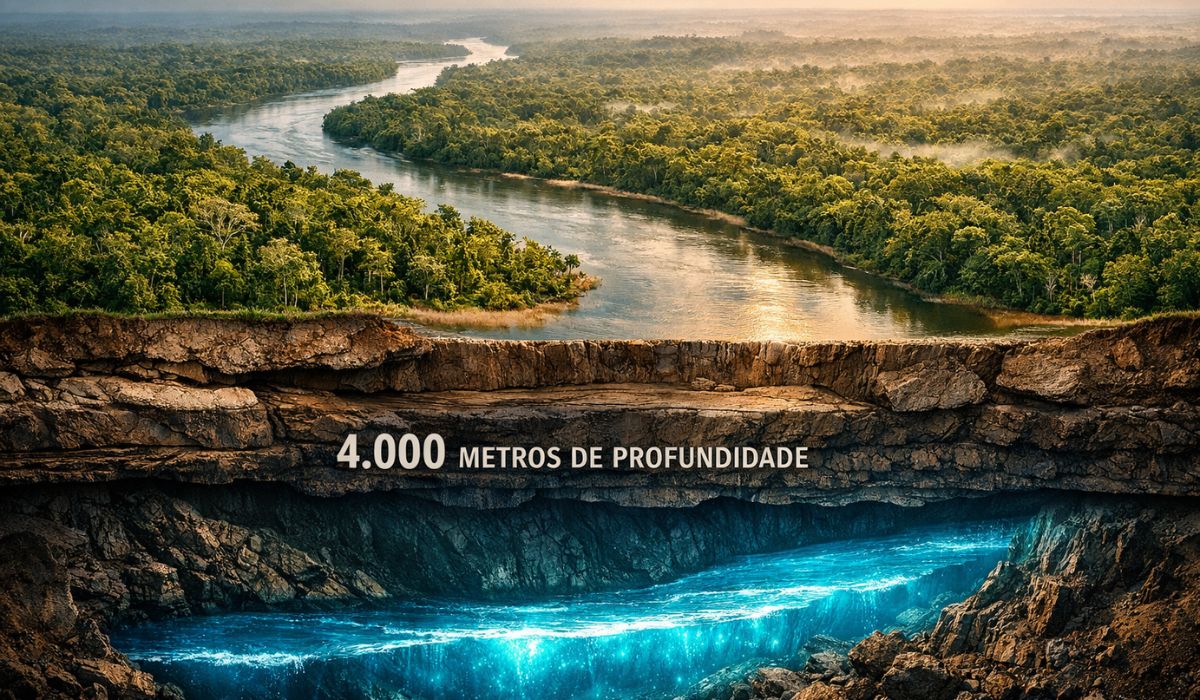
Beneath the Amazon Basin, a Deep Water Circulation System Entered the Center of Scientific Debate and Opened a New Front of Investigation into the Region’s Subsurface Amid Studies, Technical Disagreements, and Growing Public Interest.
Deep below the Amazon River bed, researchers identified evidence of an extensive subterranean water circulation system that traverses the Amazon basin from west to east.
Named Hamza in reference to geophysicist Valiya Hamza, the phenomenon became known as a “subterranean river,” although the most widely accepted technical description defines it as a deep flow in porous sedimentary layers, inferred from geothermal data analyzed by scientists linked to the National Observatory.
The study that projected the Hamza indicated a path of about 6,000 kilometers, at depths of approximately 4,000 meters, generally following the direction of the Amazon to the Atlantic continental margin.
-
Scientists drilled nearly 8,000 meters into the ocean floor above the fault that caused the 2011 tsunami in Japan and discovered that a layer of clay 130 million years old was responsible for making the wave much worse than any model had predicted.

-
Thousands of years after causing the largest eruption of the Holocene, one of the world’s largest supervolcanoes is rebuilding itself beneath the sea south of Japan, receiving new magma and alarming scientists with its transformation.
-
China has activated a magnet 700,000 times more powerful than the Earth’s magnetic field that operates for over 200 consecutive hours while consuming little energy, and now the world wants to know what Beijing plans to do with this technology in 2026.

-
Mercado Livre has started selling medications in Brazil with delivery in up to 3 hours, and the project that launches in São Paulo may expand to the entire country, transforming the way millions of Brazilians buy medicines.


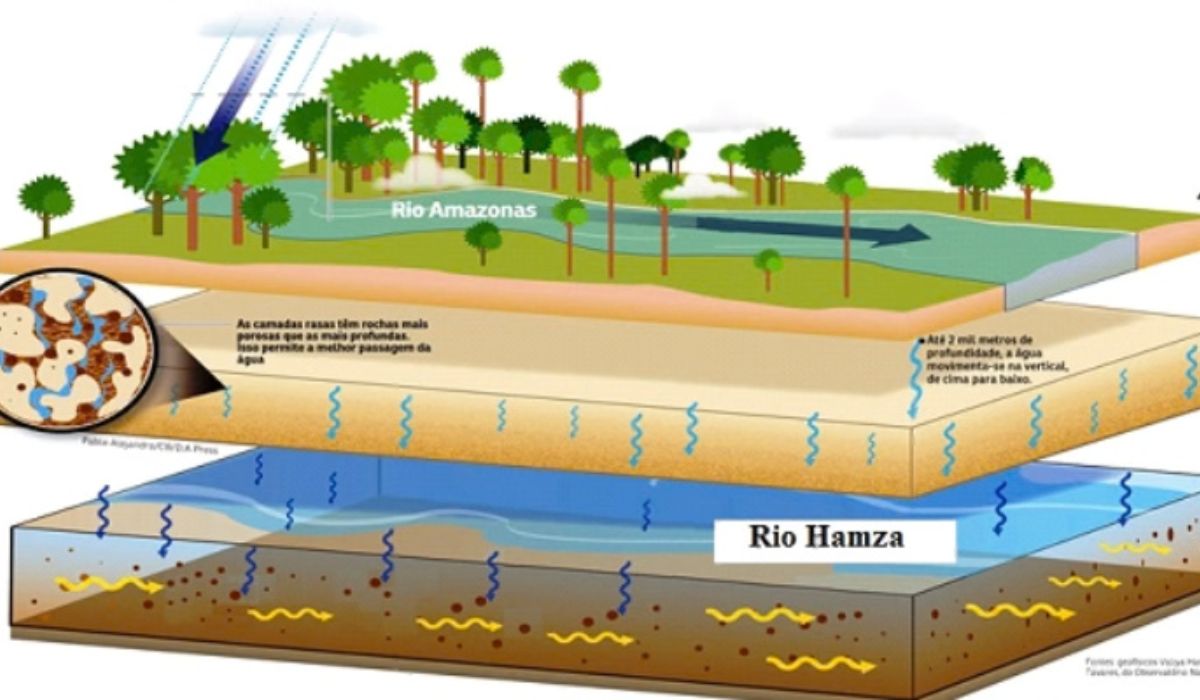
The authors also estimated very low velocities, on the order of tens to a few hundred meters per year, which differentiates this system from the behavior of a surface river.
Rio Hamza and What Scientists Identified Beneath the Amazon Basin
The research started from the analysis of temperatures recorded in 241 deep wells drilled by Petrobras between the 1970s and 1980s.
Instead of indicating the existence of an open channel, as seen in conventional rivers, the data were interpreted by researchers as a signal of water movement underground.
The work was initially presented at a congress of the Brazilian Society of Geophysics and later published in a scientific article in the Journal of South American Earth Sciences.
According to the article, there are indications of descending flows of groundwater at shallower levels and also at greater depths in the basins of Acre, Solimões, Amazonas, Marajó, and Barreirinhas.
The hypothesis presented by the authors is that water infiltrates, slowly crosses these sedimentary formations, and, at deeper portions, begins to flow laterally toward the east.
At the continental margin, the study estimated a flow rate of 3,287 cubic meters per second.
This volume helps to size the difference compared to the surface Amazon.
While the region’s main river discharges a much larger amount of water into the Atlantic and maintains a strong current, the Hamza, according to the modeling proposed by the authors, would operate as a deep and slow drainage.
Therefore, although the scale comparison has attracted attention since the research was released, the two systems do not exhibit the same hydrological dynamics.
Why the Term Subterranean River Generates Debate Among Experts
The expression “subterranean river” gained traction in the news for making it easier for the public to understand.
Still, experts pointed out reservations about the use of this term.
In analyses published after the study’s release, geologists and hydrogeologists noted that a subterranean river, in a stricter geological sense, is usually associated with flows in caves or conduits, not to water that flows slowly through permeable rocks.
This distinction is central to the scientific debate.
The study’s authors defended their choice of name by arguing that the data reveal regional water movement, rather than just static storage.
Researchers who criticized the interpretation stated that the available evidence was indirect and insufficient to support broader conclusions about dimensions, flow rate, and direct connection to the ocean.
Thus, the controversy does not invalidate the scientific interest of the research, but imposes caution on how to describe the phenomenon.
In academic circles, the Hamza is more frequently treated as a deep subterranean flow system than as a river in conventional terms.
Estimated Path of the Hamza Beneath the Amazon
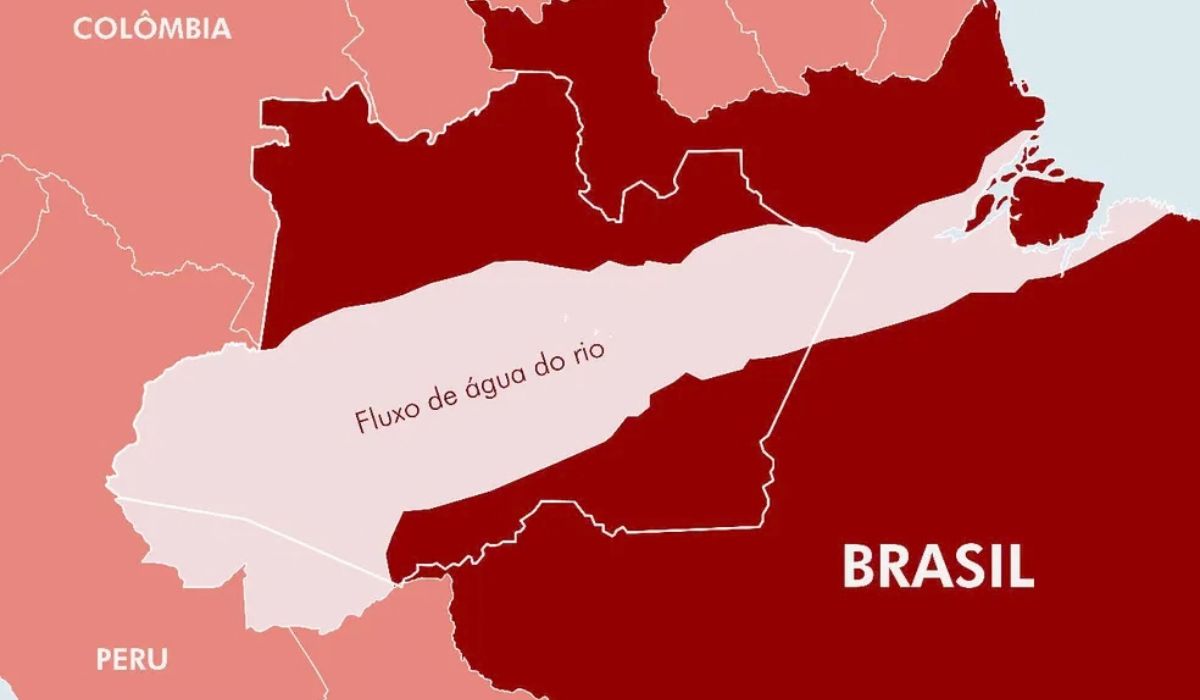
According to the interpretation presented in the article, the system would originate in the western portion of the Amazon, in areas near Acre and the Andean edge, before crossing large sedimentary basins to the Atlantic.
The suggested path generally follows the same direction as the Amazon, from west to east, although on a different physical scale and with much slower velocity.
This hypothesis reinforced a broader understanding of Amazonian hydrology.
Instead of considering only visible rivers, the region began to be observed also from the perspective of subterranean circulation, with processes of infiltration, storage, and deep movement of water.
Subsequent studies on groundwater in the Amazon basin indicated that this component plays a relevant role in regional water storage, although this does not represent complete confirmation of all the conclusions popularized about the Hamza.
What the Discovery Added to the Study of Amazonian Hydrology
The main effect of the disclosure of the Hamza was to broaden the debate about the Amazonian subsurface, still little known on a regional scale.
The 2012 article highlighted the scarcity of studies on deep flows in the Amazon and demonstrated how geothermal data can be used to infer water movements in large sedimentary basins.
Additionally, the case helped to reposition groundwater at the center of discussions about the region’s water dynamics.
Subsequent research has indicated the importance of this reservoir for the hydrological behavior of the basin, for forest ecosystems, and for variations in the storage of water.
This point remains relevant regardless of whether the Hamza is described, in public debate, as a “subterranean river” or, in technical language, as a regional deep flow system.


What Still Lacks Consensus About the Hamza River
More than a decade after the initial disclosure, the Hamza continues to be surrounded by scientific interest and interpretation disagreements.
The original study presented evidence of deep subterranean circulation based on thermal modeling and well data, but part of the scientific community questioned the extent of this evidence and the extrapolation of its results.
So far, the consulted sources do not report unequivocal consensus that there is a “river” underground in the terms that the term is usually understood outside geology.
What exists, according to the study and the subsequent academic repercussions, is a set of indications of deep water flow beneath the Amazon basin, whose dimension and functioning still depend on further investigation.
In this context, the Hamza case has come to be cited as an example of how the Amazon basin involves hydrological processes that go beyond what is visible on the surface.
Under the forest and below the planet’s largest river by water volume, there are large-scale subterranean mechanisms that continue to be analyzed by researchers.







-

-

-

8 pessoas reagiram a isso.